Band 5.5 IELTS Writing Task 1 Model Answer
Overall Band Score: 5.5 · Cambridge IELTS 19 · 2026-11-28
IELTS Writing Task 1 question
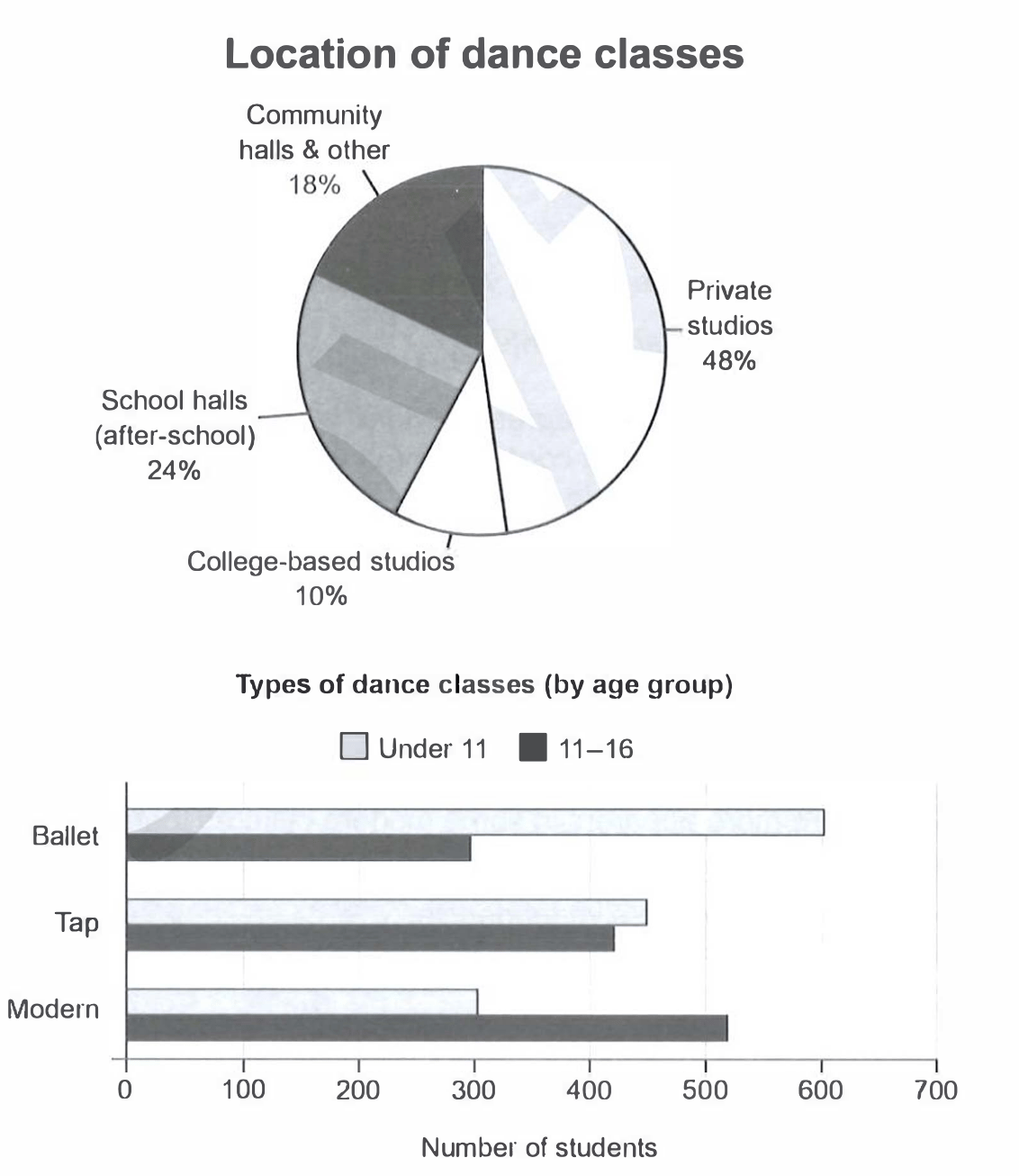
The charts below give information on the location and types of dance classes young people in a town in Australia are currently attending.
Summarise the information by selecting and reporting the main features, and make comparisons where relevant.
Student answer (Band 5.5)
The pie chart illustrates information on the location and types of dance classes young people in a town in Australia are currently attending.
Overall, the pie chart shows the location of dance classes. There are 4 locations for dance classes such as Community halls, schools halls, private studios and last one is college based studios but the private studios have the highest ratio for dance classes. However it also shows the types of dance classes by the age groups.
On the one hand, private studios have very high ratio of dance classes for about 48% . Moreover schools halls (after-school) is about 24% students in this hall. Whereas community halls is about 18% but college based studios is about 10% which is very low among all others.
On the other hand, there are different types of dance classes reflecting by the different age groups. The first type is ballet, however it represents 600 students which are under 11, moreover 300 students are those who are in the age group of 11-16. Furthermore the next is tap who represents 450 students who are under 11 and 420 who are in the age group of 11-16. The third one is namely Modern which represents 300 dancers with the age under 11, whereas 500 students lie on 11-16 age group.
AI examiner evaluation
| Criterion | Band |
|---|---|
| Task Achievement / Task Response | 6.0 |
| Coherence and Cohesion | 5.5 |
| Lexical Resource | 5.5 |
| Grammatical Range and Accuracy | 5.5 |
| Overall | 5.5 |
Task Achievement / Task Response: Band 6.0
You cover both charts and include the main location figures, correctly identifying private studios as the largest share (48%) and college-based studios as the smallest (10%). You also compare the age groups across ballet, tap and modern. However, the overview is limited: it mainly repeats that the charts show locations and class types, rather than highlighting the key contrast that younger children favour ballet while older students favour modern. Some figures are inaccurate: modern for ages 11–16 is about 520, not 500, and the location percentages describe classes, not the number of students in each hall. The response addresses the task, but some comparisons and the overall summary are less fully developed.
Coherence and Cohesion: Band 5.5
The response has a recognisable structure, with an introduction, an overview and separate paragraphs for the two charts. This helps the reader follow the broad division of information. However, progression within paragraphs is sometimes mechanical: repeated transitions such as “Moreover,” “Furthermore” and “On the other hand” do not always show a clear relationship between the data. The overview also repeats the chart’s subject instead of synthesising its main patterns, and the final paragraph lists figures without drawing out the age-group contrast. Improve cohesion by grouping related comparisons and using clearer references, for example, contrasting the younger group’s higher ballet figure with older students’ preference for modern.
Lexical Resource: Band 5.5
You use relevant chart vocabulary, including “location,” “age groups,” “represents” and “ratio,” and the reader can generally understand the comparisons. However, several choices are imprecise or repetitive. “Very high ratio” is not a natural way to describe the largest share, and “students in this hall” incorrectly suggests a student count when the chart gives percentages of class locations. The repeated use of “represents” and “dance classes” also limits flexibility. Aim for more precise reporting language and natural collocations, such as “accounted for,” “share” and “the number of students attending.” These improvements would make the descriptions clearer and more concise.
Grammatical Range and Accuracy: Band 5.5
You attempt a mixture of simple sentences and longer sentences with clauses, and the main information is usually understandable. Some grammatical errors remain, particularly with articles, agreement and sentence construction. For example, “There are 4 locations … such as Community halls” is awkwardly formed, while “community halls is about 18%” has a subject–verb agreement error. In “the next is tap who represents,” the relative pronoun and clause structure are unsuitable for a class type. Punctuation is also inconsistent, including spaces before full stops and commas. Practise building accurate comparison sentences, such as “Community halls account for 18%, whereas college-based studios make up 10%.”
See this exact question answered at other band scores. The same prompt compared across bands.
Browse more IELTS Writing model answers or get your own writing scored by the same AI examiner.