Band 7.0 IELTS Writing Task 1 Model Answer
Overall Band Score: 7.0 · Cambridge IELTS 19 · 2026-11-28
IELTS Writing Task 1 question
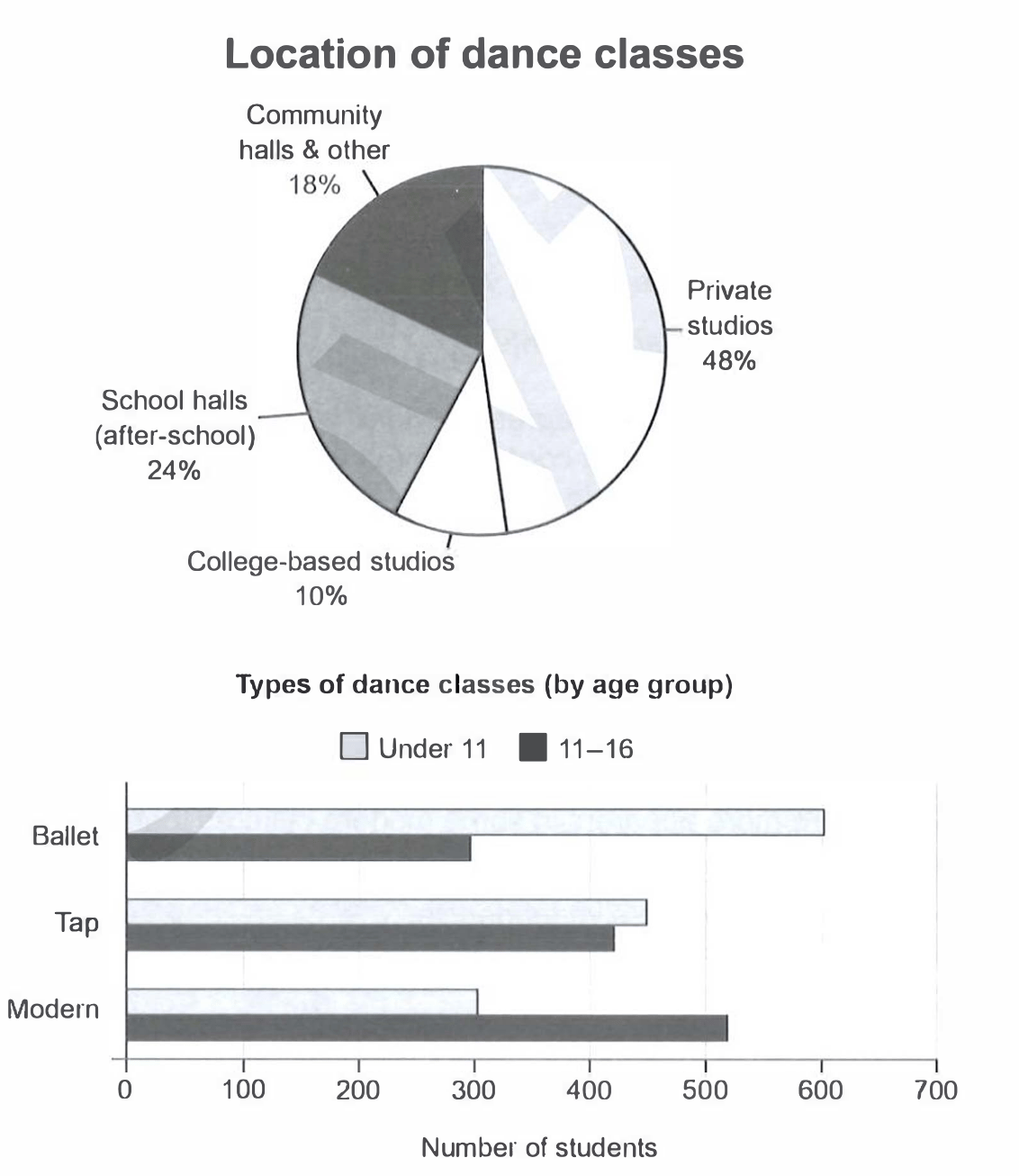
The charts below give information on the location and types of dance classes young people in a town in Australia are currently attending.
Summarise the information by selecting and reporting the main features, and make comparisons where relevant.
Student answer (Band 7.0)
The pie chart presents the different destination of dance classes, while the bar chart illustrates the types of dance classes taken by various age-groups in an Australian town.
Overall, private studios was the most popular location, whereas college-based studios was the least. For children under 11, ballet had the highest number and modern dance had the least. In contrast, for those between 11 and 16, ballet had the lowest number and modern dance had the biggest number. Tap came second for both age groups.
Looking at the locaton of the dance classes, private studios had nearly half,48%, of the total proportion compared to college-based studios who had only 10%. Community halls and other together with after school halls were 18% and 24%, respectively.
Turning to types of dance, 600 under 11 took ballet, while only 300 took modern dance. Tap was the second for this age group at approximately 570. Modern dance was popular among the older age- group as more than 500 took it. Conversely only 300 took ballet and almost 430 enrolled in tap dance.
AI examiner evaluation
| Criterion | Band |
|---|---|
| Task Achievement / Task Response | 7.0 |
| Coherence and Cohesion | 7.0 |
| Lexical Resource | 6.5 |
| Grammatical Range and Accuracy | 6.5 |
| Overall | 7.0 |
Task Achievement / Task Response: Band 7.0
The response covers both charts and gives a clear overview of the main patterns: private studios are the leading location, while ballet leads among under-11s and modern leads among 11–16-year-olds. Most figures are reported accurately, including the location percentages and the ballet and modern figures. However, the under-11 tap figure is given as approximately 570, whereas the chart shows about 450, and this is a notable factual error. The statement that tap came second for both groups is broadly supported, although the older group’s tap figure is close to modern. To strengthen the report further, ensure every figure is checked against the chart and make comparisons between the age groups more explicit.
Coherence and Cohesion: Band 7.0
The information is organised clearly into an introduction, an overview, and separate paragraphs for the location and dance-type data. The progression from the broad summary to specific figures is easy to follow, and signposting such as “Overall,” “Looking at,” and “Turning to” helps guide the reader. Comparisons are also made with “while” and “Conversely.” Some linking is slightly mechanical, and the final paragraph could connect the age-group figures more directly rather than presenting them mainly as a sequence of facts. For example, explicitly contrasting the younger group’s preference for ballet with older students’ preference for modern would create a more integrated comparison. Overall, the organisation is logical and cohesive, with room for more flexible linking.
Lexical Resource: Band 6.5
The response uses an adequate range of task-appropriate vocabulary, including “proportion,” “popular,” “approximately,” and “enrolled,” and it varies some descriptions of the data. However, several choices are imprecise or awkward: “different destination of dance classes” does not naturally describe class locations, and “the second” is less idiomatic than “the second most popular.” There are also spelling errors in “locaton” and inconsistent forms such as “age-groups” and “age- group.” These do not prevent understanding, but they limit precision and polish. More accurate collocations and careful proofreading would help the vocabulary feel more natural and flexible.
Grammatical Range and Accuracy: Band 6.5
There is a useful mix of simple and complex sentence forms, including contrast clauses such as “while only 300 took modern dance” and “whereas college-based studios was the least.” Most sentences communicate the intended comparisons clearly. Some errors remain in agreement and sentence construction: “private studios was” should be “private studios were,” and “college-based studios was” should likewise use “were” or be recast as “college-based studios were the least popular location.” The phrase “nearly half,48%, of the total proportion” also needs clearer punctuation and structure. These issues are noticeable but do not generally obstruct meaning. Greater control of agreement and more consistently accurate sentence patterns would improve the response.
See this exact question answered at other band scores. The same prompt compared across bands.
Browse more IELTS Writing model answers or get your own writing scored by the same AI examiner.