Band 5.0 IELTS Writing Task 1 Model Answer
Overall Band Score: 5.0 · Cambridge IELTS 20 · 2026-11-05
IELTS Writing Task 1 question
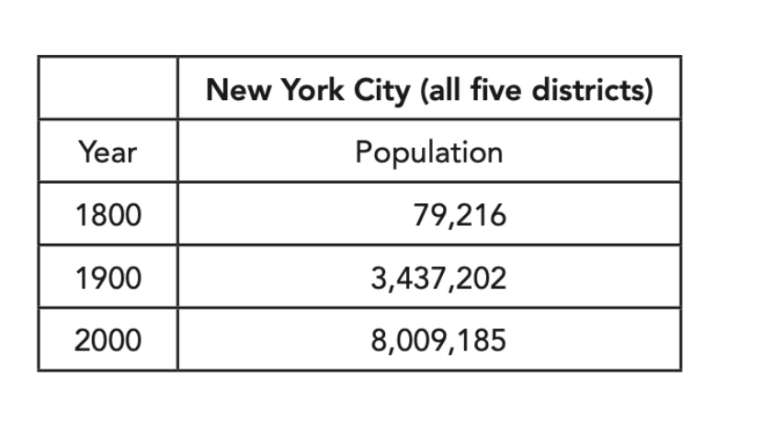
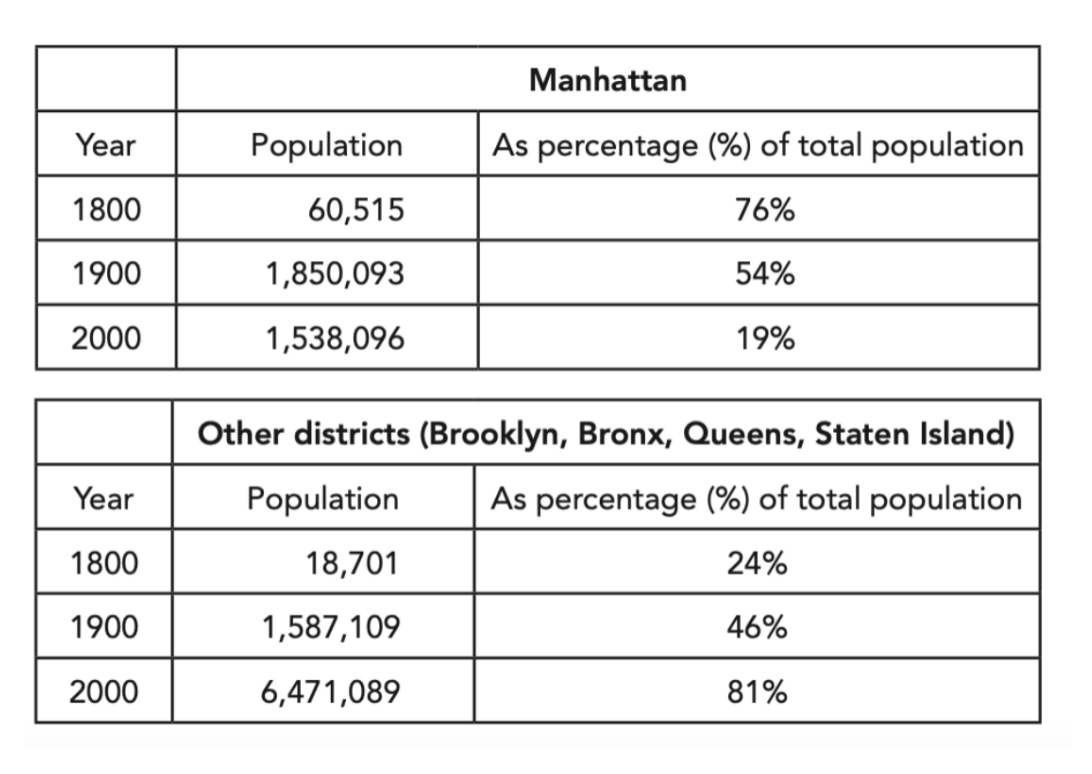
The first table below shows changes in the total population of New York City from 1800 to 2000. The second and third tables show changes in the population of the five districts of the city (Manhattan, Brooklyn, Bronx, Queens, Staten Island) over the same period.
Summarise the information by selecting and reporting the main features, and make comparisons where relevant.
Student answer (Band 5.0)
The initial table represents the change in total population of New York City from [redacted phone]. In middle and last table demonstrates the difference in in the people of the five districts of the city (Manhattan, Brooklyn, Queens, Staten Island ) over the same time.
Overall, population almost increased by 3 times after every century of all the five districts of the New York City. In 1800, almost 3/4 of the total population lived in Manhattan but with the passage of time, they migrated to other districts like Brooklyn, Bronx, Queen, Staten Island. At the end , leaving approximately 1/5 of the population in Manhattan City.
New York City had about 80,000 people in 1800 which turned into almost 0.35 million in a century, which id almost 3 times of the actual population and it crossed over [redacted phone] after another human year.
In 1800, Manhattan had more than 3/4 people of the entire population and other districts had less than 1/4 but with the passage of time people shifted from Manhattan to the other districts. After 200 years Manhattan only left with almost 1/5th of the population.
AI examiner evaluation
| Criterion | Band |
|---|---|
| Task Achievement / Task Response | 5.5 |
| Coherence and Cohesion | 4.5 |
| Lexical Resource | 5.0 |
| Grammatical Range and Accuracy | 5.0 |
| Overall | 5.0 |
Task Achievement / Task Response: Band 5.5
You identify the broad trends: New York City’s population grew substantially, Manhattan’s share fell, and the other districts’ share rose. The overview also selects the important contrast between Manhattan and the rest of the city. However, some reporting is inaccurate or unclear: the population did not increase “by 3 times after every century,” and 3,437,202 in 1900 is about 3.4 million, not “0.35 million.” The claim that the total “crossed over 800000” in 2000 also understates the actual figure of about 8 million. You mention migration, but the tables show population changes, not that residents moved from Manhattan. Include accurate figures and compare the 1900 peak in Manhattan with its decline by 2000.
Coherence and Cohesion: Band 4.5
The response has a recognisable structure, with an introduction, an overview and two detail paragraphs, and the main topic remains clear. However, progression within paragraphs is limited: the final paragraph largely repeats the overview rather than adding a distinct comparison, while the total-population paragraph gives figures without a clear, accurate sequence. Linking phrases such as “with the passage of time” are repeated, and “At the end” is awkwardly separated from the sentence that follows. Some references, including “they” and “it,” are not immediately clear. Organise the details chronologically and use each paragraph for a separate comparison; this would make the progression easier to follow and reduce repetition.
Lexical Resource: Band 5.0
You use some relevant vocabulary, including “total population,” “districts,” “migrated,” and “approximately,” so the subject is generally understandable. However, the range is limited and several choices are inaccurate or unnatural for describing table data. “Difference in in the people” is unclear, “human year” does not express a time period, and “Manhattan only left with” is not an appropriate way to describe a population share. “Queen” should be “Queens,” and “Manhattan City” is not the label used in the data. Aim for precise terms such as “population,” “accounted for,” “share,” and “rose/fell,” and avoid implying migration when the tables only show changing totals.
Grammatical Range and Accuracy: Band 5.0
You attempt both simple and longer sentences, and the overall meaning can usually be followed. However, control is inconsistent, especially in longer constructions. For example, “In middle and last table demonstrates” has an incomplete grammatical structure, while “Overall, population almost increased by 3 times after every century of all the five districts” is difficult to parse. The phrase “Manhattan only left with” is missing a suitable verb construction, and “which id almost 3 times” contains a verb-form error. Articles, plurals and punctuation are also uneven, as in “the entire population” and the spacing around “At the end ,”. Build clearer sentences with a subject and verb, and check agreement and sentence boundaries.
See this exact question answered at other band scores. The same prompt compared across bands.
Browse more IELTS Writing model answers or get your own writing scored by the same AI examiner.