Band 5.5 IELTS Writing Task 1 Model Answer
Overall Band Score: 5.5 · Cambridge IELTS 20 · 2026-11-05
IELTS Writing Task 1 question
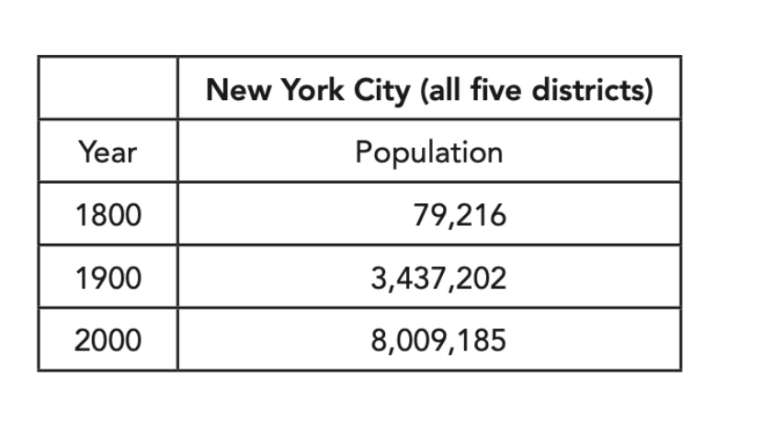
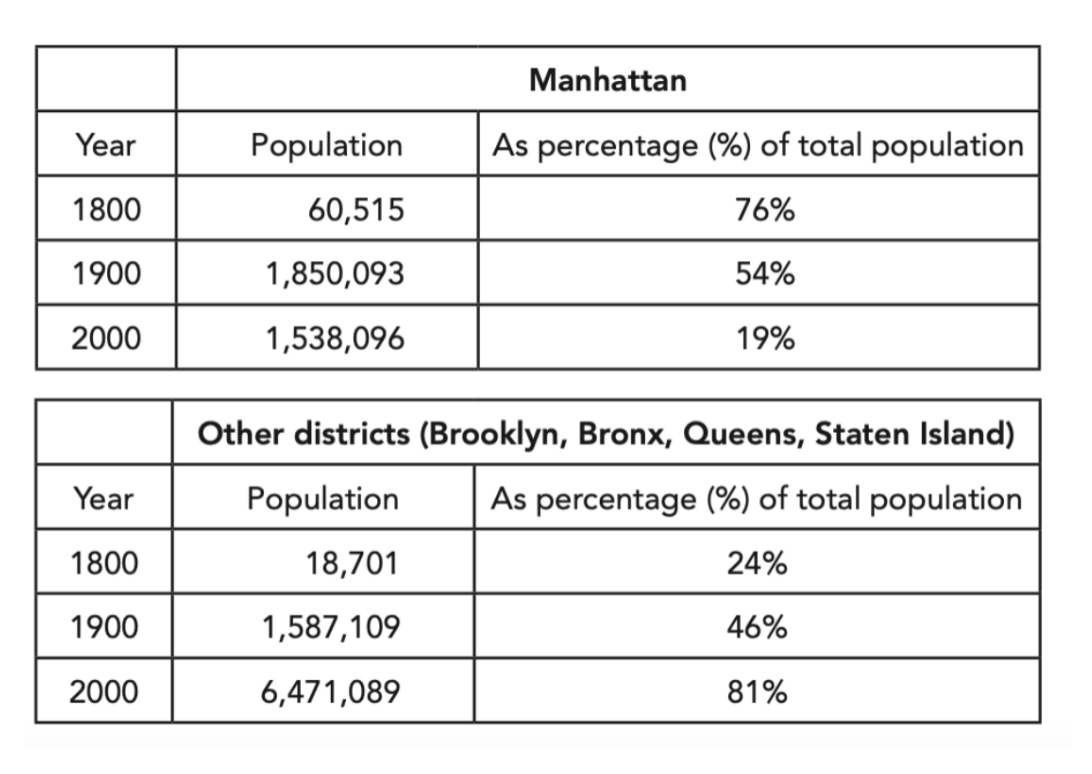
The first table below shows changes in the total population of New York City from 1800 to 2000. The second and third tables show changes in the population of the five districts of the city (Manhattan, Brooklyn, Bronx, Queens, Staten Island) over the same period.
Summarise the information by selecting and reporting the main features, and make comparisons where relevant.
Student answer (Band 5.5)
The first table illustrate variations in the total population of New York over the period of 1800 to 2000. While the second and third tables present changes the number of people of the five districts of various cities at the same time. Overall, there is a considerable increase in new york population and also its four districts, such as Brooklyn, Bronx, Queens, Staten Island. However there is a decline in Manhattan population.
On the one hand, initially all five districts of new york had around 79,216 people in year 1800. Next this number rises from 79,216 to 3,437,202 in year 1900. Subsequently, in 2000, this number reached approximately 8,009,185.
On the other hand, in 1800,four districts including Brooklyn, Bronx, Queens, Staten Island had population around 18,701 and 24% of total population. After that, this number increses to 1,587,109 and 46% of total population. Ultimately, this number comes up to 6,471,089 and 81% of population. However, in 1800, Manhattan population was 60,515 and 76% of total population. In 1900, it increases to 1,850,093 and 54% of total population. Eventually, this number pludge to 1,538,096 and 19% of total population.
AI examiner evaluation
| Criterion | Band |
|---|---|
| Task Achievement / Task Response | 6.0 |
| Coherence and Cohesion | 5.5 |
| Lexical Resource | 5.5 |
| Grammatical Range and Accuracy | 5.5 |
| Overall | 5.5 |
Task Achievement / Task Response: Band 6.0
You identify the main overall pattern: New York’s population grew substantially, while Manhattan’s share fell and the other four districts’ share rose. The figures you report for 1800, 1900 and 2000 are generally accurate, and the comparison between Manhattan and the combined other districts is relevant. However, some details are unclear or imprecise: “all five districts ... had around 79,216 people” could suggest this was the population of each district, rather than the city total. Also, the overview says the four districts increased in population but does not clearly state that Manhattan’s population itself rose to 1900 before declining by 2000. Make this two-stage trend explicit and distinguish population totals from percentages to cover the data more fully.
Coherence and Cohesion: Band 5.5
The response has a recognisable structure, with an introduction, an overview and separate paragraphs for the city total and district figures. This gives the reader a basic route through the information. However, progression is weakened by mechanical transitions such as “On the one hand,” “On the other hand,” “Next,” and “Ultimately,” which do not always express a clear contrast or sequence. The repeated phrase “this number” also makes it difficult to tell whether you mean the total population, a district population or a percentage. Group the figures more deliberately—for example, describe the city’s growth first, then compare Manhattan with the other districts—and use precise references such as “the city’s total” and “their combined share.”
Lexical Resource: Band 5.5
You use relevant vocabulary for describing data, including “total population,” “decline,” “percentage,” and “reached,” so the main comparisons are understandable. There is some variety in your trend language, but several choices are inaccurate or awkward for formal data reporting. “Variations” is less precise than “changes,” and “comes up to” is not a natural way to describe a figure reaching a value. “Pludge” appears to be a misspelling of “plunge,” while “increses” is also misspelled; these errors reduce accuracy. The phrase “districts of various cities” is confusing because the figures concern districts of New York City. Aim for precise collocations such as “the population rose to” and “accounted for” when reporting shares.
Grammatical Range and Accuracy: Band 5.5
You attempt both simple and more complex sentence forms, including the contrast introduced by “While” and the sentence beginning “Although” is not present; your use of “However” does show an effort to connect contrasting trends. Most of the data remains understandable, but some grammatical errors affect clarity. For example, “The first table illustrate” has subject–verb disagreement, and “the second and third tables present changes the number” is missing “in.” The opening “While” clause is not a complete sentence, and “in 1800,four districts” needs a space after the comma. Check agreement, sentence completeness and punctuation, and vary sentence structures while keeping each comparison grammatically complete.
See this exact question answered at other band scores. The same prompt compared across bands.
Browse more IELTS Writing model answers or get your own writing scored by the same AI examiner.