Band 5.5 IELTS Writing Task 1 Model Answer
Overall Band Score: 5.5 · Cambridge IELTS 20 · 2026-11-06
IELTS Writing Task 1 question
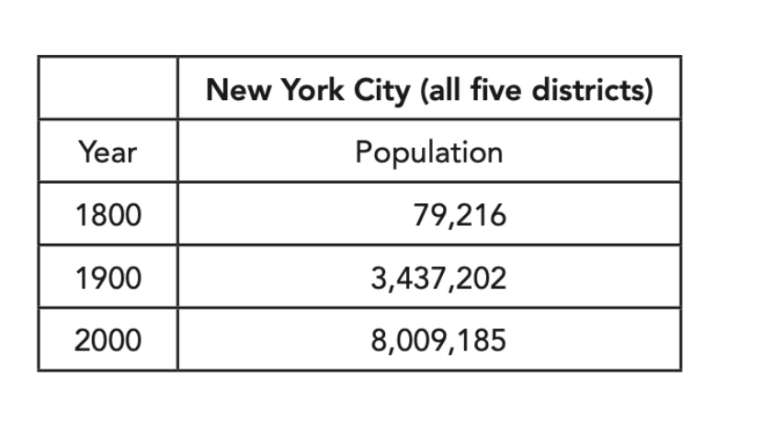
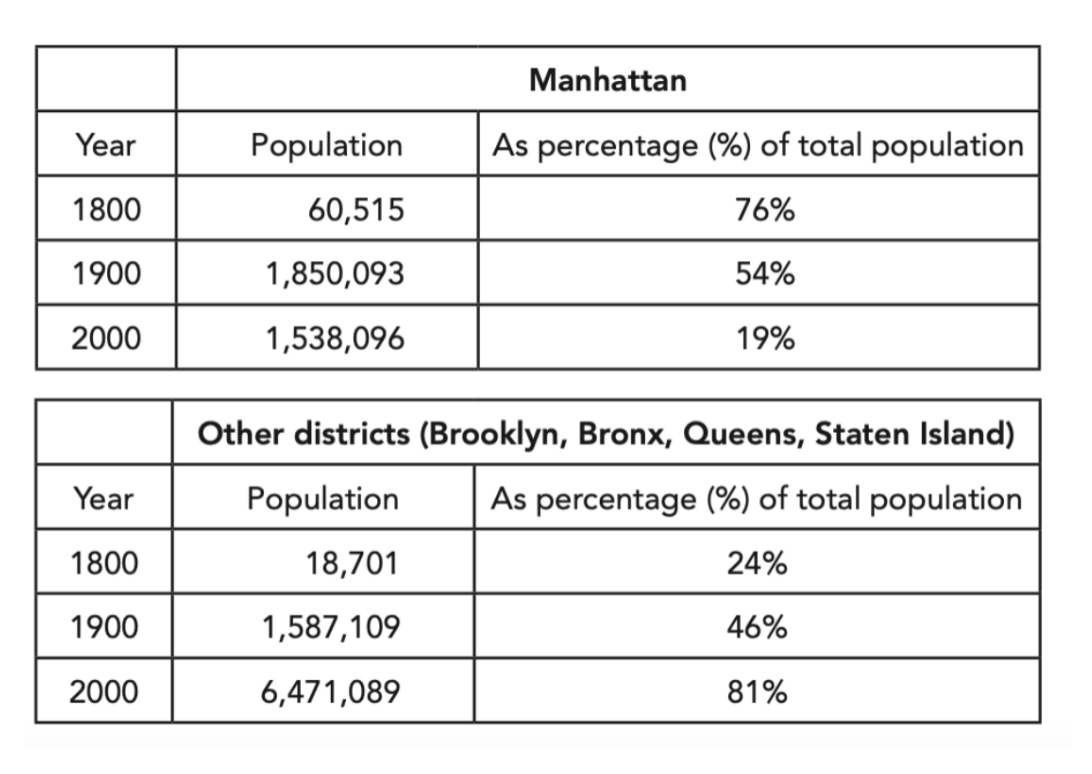
The first table below shows changes in the total population of New York City from 1800 to 2000. The second and third tables show changes in the population of the five districts of the city (Manhattan, Brooklyn, Bronx, Queens, Staten Island) over the same period.
Summarise the information by selecting and reporting the main features, and make comparisons where relevant.
Student answer (Band 5.5)
These tables shows the changing in total number of indviduals resided in city of New York between 1800 and 2000.First table shows faluctuations in population of whole 5 areas of city. Whereas, second and third figures labeled population in five diffrent districts of New York(Manthan, Brooklyn, Bronx,Queens and Staten Island) over the same interval.
Overall, the population of new york in all five areas as common increased rapidly after every 100 years. As in year 1800 number of people living in those areas was just 79,216 in total. Further more, century later it became 3,37,202 in total population in 1900. Year after year total number of humans in those five areas of new york were increasing rapidly. Additionally, at the end of the period total number rose to 8,009,185.
While looking in further details by analysing each district from all five seprately it shows diffrent variations . When analysed Manthan only in year 1800, its population was 60,515 making it 76% of total population whereas, other districts were only 24% with 18,701 number of individuals. In 1900, there were significant changes in district Manthan the number was 1,850,096 which was 54% all mean while, other districts were standing at [redacted phone] making them 46% of total. At last, in 2000 there were noticeable changes in Mathon there were only [redacted phone] making it only 19%, where in others there were 6,471,089 total population making them 81% which was highest recorded number from other ditricts in a full 300 years time period .
AI examiner evaluation
| Criterion | Band |
|---|---|
| Task Achievement / Task Response | 6.0 |
| Coherence and Cohesion | 6.0 |
| Lexical Resource | 5.0 |
| Grammatical Range and Accuracy | 5.0 |
| Overall | 5.5 |
Task Achievement / Task Response: Band 6.0
You cover the main changes across the period and include relevant figures for the city total and the district groups. The overview correctly identifies strong overall growth and the shift in population share from Manhattan to the other districts. However, some details are inaccurate: the 1900 city total is written as 337,202 rather than 3,437,202, and Manhattan’s 1900 population is given as 1,850,096 instead of 1,850,093. The statement that the total increased “after every 100 years” is broadly supported by the three snapshots, but “year after year” suggests continuous annual data that the tables do not provide. To strengthen the report, select the key contrast more precisely: Manhattan’s population peaked by 1900 and then fell, while the other districts grew substantially.
Coherence and Cohesion: Band 6.0
The response has a clear overall arrangement: an introduction, an overview, and a paragraph comparing the district figures. This makes the main stages easy to identify, and transitions such as “Overall,” “In 1900,” and “At last” help guide the reader. However, some linking is mechanical or awkward, particularly “Whereas” at the end of the introduction and the repeated use of “Additionally” and “While looking in further details.” Several long sentences combine multiple comparisons, making relationships less clear. For example, the final sentence contains the 2000 figures, percentages, and a claim about the highest recorded number all at once. Use shorter comparison-focused sentences and clearer references to Manhattan and the combined other districts.
Lexical Resource: Band 5.0
You use a reasonable range of vocabulary for describing change, including “increased rapidly,” “significant changes,” and “noticeable changes.” However, word choice and spelling errors are frequent enough to make the writing less precise and sometimes distract the reader. Examples include “fluctuations” for a steady overall rise, “humans” for residents or people, and repeated misspellings of “Manhattan,” “different,” and “districts.” Some phrases are also unnatural, such as “number of individuals” and “highest recorded number from other districts.” Aim for accurate, conventional language for table reports, and avoid using several different expressions for the same idea when a precise term such as “population” or “share” is clearer.
Grammatical Range and Accuracy: Band 5.0
You attempt both simple and more complex sentence forms, including comparisons with “whereas” and clauses beginning “When analysed.” The overall meaning is usually understandable, but errors in agreement, articles, sentence boundaries, and punctuation are noticeable. For example, “These tables shows” should use a plural verb, and “the changing in total number” does not form a correct grammatical phrase. The opening also runs sentences together after “2000,” while commas are often used where a full stop or semicolon would make the structure clearer. Some sentences become difficult to follow because several clauses are joined without clear grammatical control. Check subject–verb agreement and build each comparison around a clear subject and verb.
See this exact question answered at other band scores. The same prompt compared across bands.
Browse more IELTS Writing model answers or get your own writing scored by the same AI examiner.