Band 6.0 IELTS Writing Task 1 Model Answer
Overall Band Score: 6.0 · Cambridge IELTS 20 · 2026-11-06
IELTS Writing Task 1 question
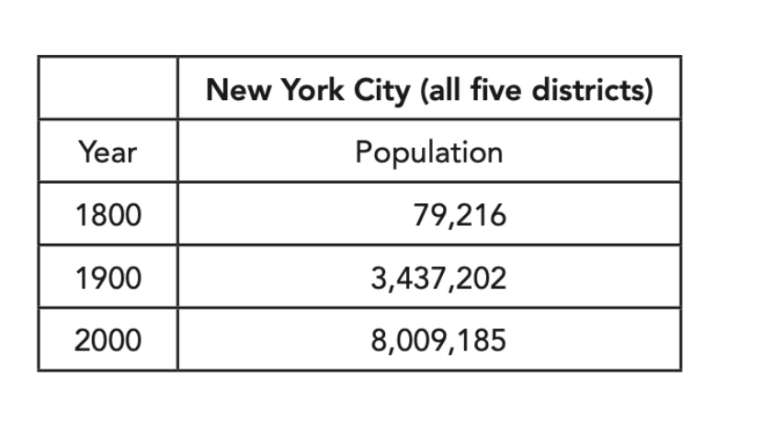
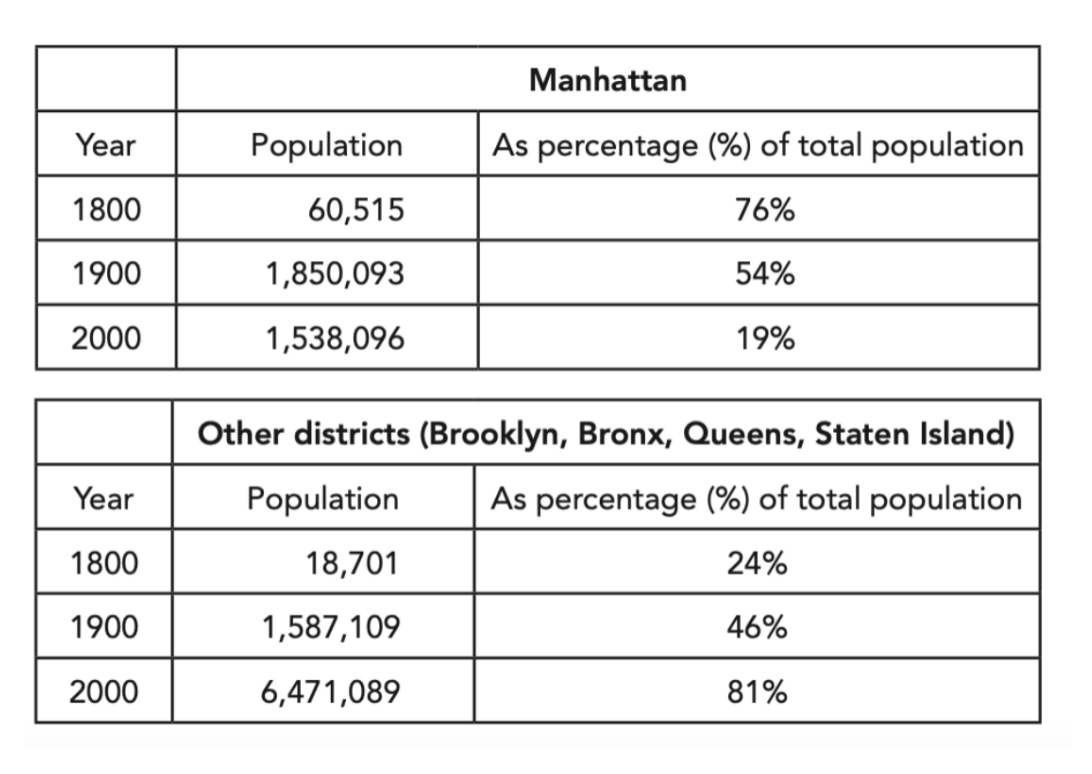
The first table below shows changes in the total population of New York City from 1800 to 2000. The second and third tables show changes in the population of the five districts of the city (Manhattan, Brooklyn, Bronx, Queens, Staten Island) over the same period.
Summarise the information by selecting and reporting the main features, and make comparisons where relevant.
Student answer (Band 6.0)
The tables show the comparision of population of New York City, Manhattan and other four districts from 1800 to 2000.
Overall, population of all districts increased in 2000 compared to year 1800. Percentage of population living in Manhattan decreased in the year 2000 whereas percentage of population of other districts show tremendous growth.
To begin with, Population of New York City increased by four times in 1900 compared to year 1800 and it reached 8 million in 2000 which is doubled of population in year 1900. Similarly, population of Manhattan was also in growing trend. Total number of people living in this district was just around 60 thousand and eventually it increses to around 1.5 million in an interval of two century year. But in contrast, the percentage of total population living in this district was 76% in the year 1800 which decreased to 19% by 2000.
Moreover, the population of other four districts was in same increasing manner. These districts have more population in 2000 than in Manhattan. In contrast, percentage of total population increased in year 2000 compared to the year 1800.
AI examiner evaluation
| Criterion | Band |
|---|---|
| Task Achievement / Task Response | 6.0 |
| Coherence and Cohesion | 6.5 |
| Lexical Resource | 5.5 |
| Grammatical Range and Accuracy | 5.5 |
| Overall | 6.0 |
Task Achievement / Task Response: Band 6.0
You identify the main overall contrast: New York City’s population grew substantially, while Manhattan’s share fell and the other districts’ share rose. You also include relevant figures such as Manhattan’s 76% share in 1800 and 19% in 2000. However, some comparisons are incomplete or inaccurate. The city’s population did not increase fourfold by 1900; it rose from 79,216 to about 3.44 million. Manhattan’s population also peaked in 1900 at about 1.85 million before falling to 1.54 million, so describing it as continuously increasing misses an important feature. The other districts’ population and share are discussed only generally, with no figures or clear comparison across all three years. Covering these changes more precisely would make the summary more complete.
Coherence and Cohesion: Band 6.5
The response has a clear overall arrangement: an introduction, an overview, and two body paragraphs. Its progression from the city-wide figures to Manhattan and then the other districts is easy to follow, and linking phrases such as “To begin with,” “Similarly,” and “Moreover” help signal the sequence. This coherent structure is already effective, though some connections are mechanical or imprecise. For example, “Similarly” introduces Manhattan’s population trend even though it later contrasts with the city-wide pattern, and “In contrast” is repeated without always clarifying exactly which figures are being contrasted. The final paragraph also ends with a broad statement rather than a specific comparison. Use clearer references and connect each comparison directly to the relevant figures.
Lexical Resource: Band 5.5
You use enough topic vocabulary to communicate the main trends, including “population,” “percentage,” “decreased,” and “tremendous growth.” However, the range and precision are uneven, and several word-choice or spelling errors reduce the naturalness of the report. “Comparision” is misspelled, “in same increasing manner” is awkward, and “four times” does not accurately express the scale of the city’s growth. “In an interval of two century year” is also unclear. Aim for precise reporting language such as “rose from,” “accounted for,” and “declined,” and check spelling and collocations. More varied, accurate vocabulary would help you describe the figures without relying on general phrases such as “more population” and “same increasing manner.”
Grammatical Range and Accuracy: Band 5.5
You attempt a mixture of simple and more complex sentences, including contrast clauses with “whereas” and “whereas”/“in contrast,” and most of the meaning remains understandable. Some grammatical errors persist, particularly with articles, agreement, and verb forms. For example, “Overall, population of all districts” needs an article, while “percentage of population of other districts show” has a subject–verb agreement problem. “It increses” uses an incorrect verb form for the past period, and “which is doubled of population” is not a well-formed comparison. Capitalisation is also inconsistent, as in “Population” mid-sentence. Review article use and past-tense reporting, and practise constructing comparisons with forms such as “was twice the 1900 figure.” Greater control of these patterns would make the report smoother.
See this exact question answered at other band scores. The same prompt compared across bands.
Browse more IELTS Writing model answers or get your own writing scored by the same AI examiner.