Band 5.0 IELTS Writing Task 1 Model Answer
Overall Band Score: 5.0 · Cambridge IELTS 20 · 2026-11-06
IELTS Writing Task 1 question
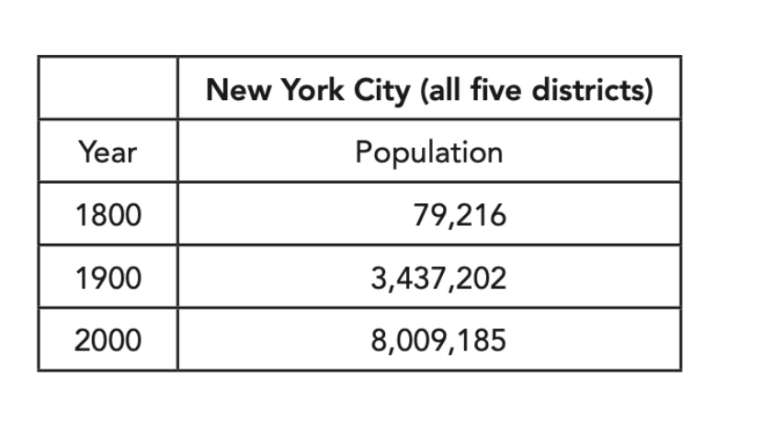
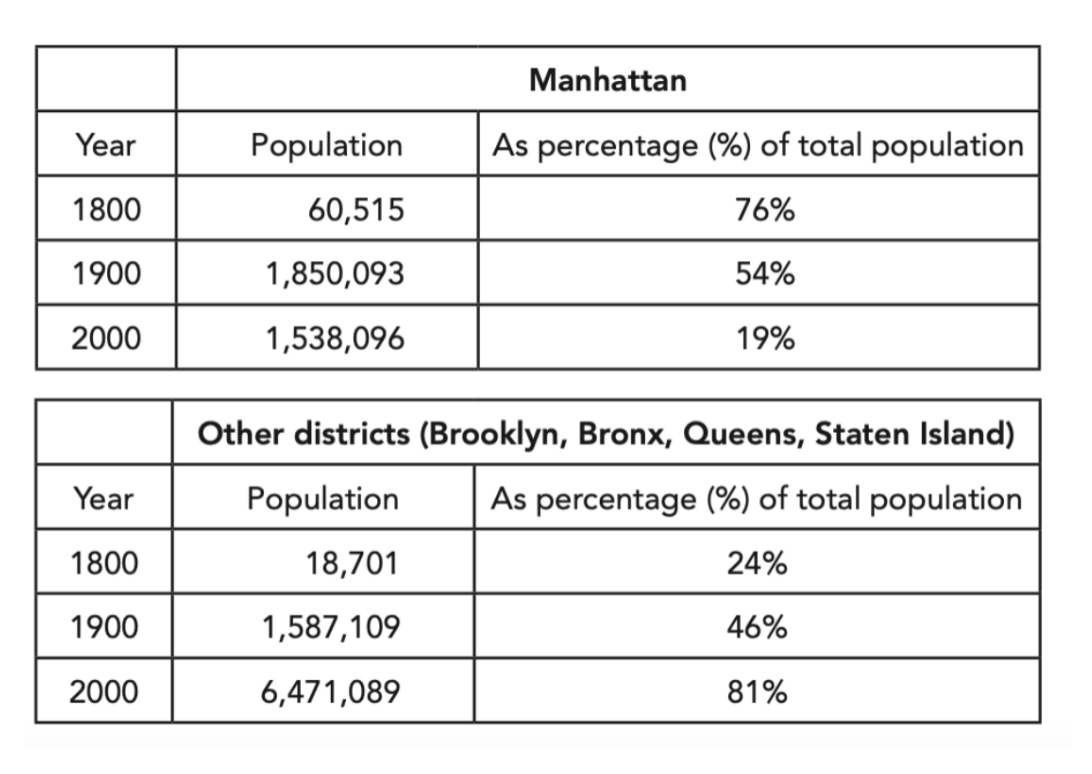
The first table below shows changes in the total population of New York City from 1800 to 2000. The second and third tables show changes in the population of the five districts of the city (Manhattan, Brooklyn, Bronx, Queens, Staten Island) over the same period.
Summarise the information by selecting and reporting the main features, and make comparisons where relevant.
Student answer (Band 5.0)
First table illustrates the ups and dawon the all community of the New York City, from 1800 to 2000. Also another table shows changes in the population of the five districts of the city, Manhattan, Brooklyn, The Bronx, Queens, and Staten Island, in same time schedule,
First of all, in top table we see all New York City all 5 districts, in 1800 number of peoples are 79,216, and 1900, 3,437,202, Also in 2000 it is improved to much round about 8,009,185,
However, on the other side, Manhattan city and Other districts are aslo available in these two tables, the whole population of manhattan in 1800, is 60,515, is the 76% of total population. Moreover, other five districts in 1800 only 24%, "but" after some years, In year of 2000 Manhattan population, 1,538,096 is the 19% of all percentage of total population , Farthermore, In 2000 the population of others are 6,471,089, that, is 81% of all community,
AI examiner evaluation
| Criterion | Band |
|---|---|
| Task Achievement / Task Response | 5.0 |
| Coherence and Cohesion | 5.0 |
| Lexical Resource | 5.0 |
| Grammatical Range and Accuracy | 5.0 |
| Overall | 5.0 |
Task Achievement / Task Response: Band 5.0
You report several accurate figures, including the city’s populations in 1800, 1900 and 2000, and Manhattan’s 2000 population and share. However, the response only partially summarises the tables: it gives no figure for Manhattan in 1900 and does not explain the key contrast that Manhattan’s population rose to 1900 before falling, while the other districts grew substantially. The overview is also unclear, and “other five districts” misrepresents the four districts grouped with Manhattan. The response contains 145 words, below the required 150, which further limits its development. Add a concise overview and compare the main changes across all three years, using the figures selectively.
Coherence and Cohesion: Band 5.0
There is some organisation: the response begins by introducing the tables and then moves from the city total to Manhattan and the other districts. However, the progression is not clear enough to guide the reader through the main comparisons. The opening paragraph is one long, awkward sentence, and the second paragraph lists figures without a clear overview or consistent year-by-year structure. Connectors such as “First of all,” “However,” and “Moreover” are used, but “However” does not establish a clear contrast, and “but” is placed in quotation marks. Use separate paragraphs for the overview and details, and group related figures by year or population trend.
Lexical Resource: Band 5.0
The response uses some relevant topic vocabulary, including “population,” “total population,” and “districts,” so the basic subject is understandable. However, the range is limited and several word choices or collocations are inaccurate, which sometimes makes the meaning difficult to follow. For example, “ups and dawon” is not an appropriate way to describe population change, “improved” suggests a positive judgement rather than an increase, and “all community” is unclear. There are also noticeable spelling errors, such as “dawon” and “aslo.” Choose precise, neutral terms for trends and use standard spellings; this will make the comparisons clearer and more suitable for an academic report.
Grammatical Range and Accuracy: Band 5.0
You attempt to combine information using clauses and linking words, but sentence structures are limited and errors occur frequently. For example, “in same time schedule” lacks an article, while “in 1800 number of peoples are 79,216” has problems with article use, plural agreement and tense. The sentence beginning “the whole population of manhattan in 1800” is also difficult to follow because several clauses are joined with commas rather than clearly structured. Capitalisation and punctuation are inconsistent, including sentence starts after commas and the unnecessary quotation marks around “but.” Practise writing complete sentences with a clear subject and verb, and use past-tense forms consistently when reporting historical data.
See this exact question answered at other band scores. The same prompt compared across bands.
Browse more IELTS Writing model answers or get your own writing scored by the same AI examiner.