Band 6.0 IELTS Writing Task 1 Model Answer
Overall Band Score: 6.0 · Cambridge IELTS 20 · 2026-11-06
IELTS Writing Task 1 question
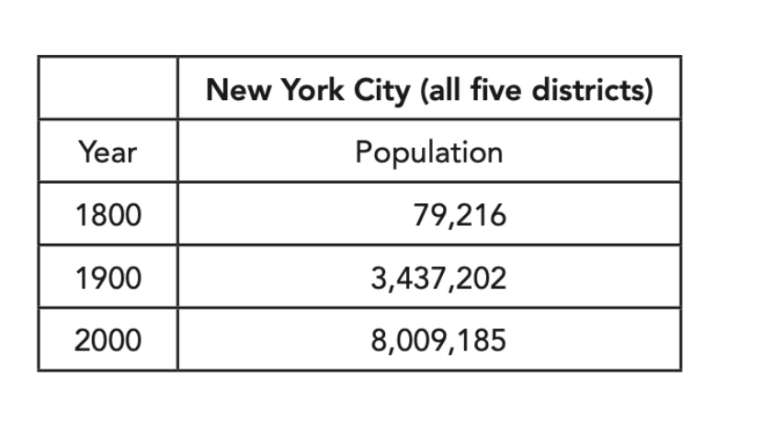
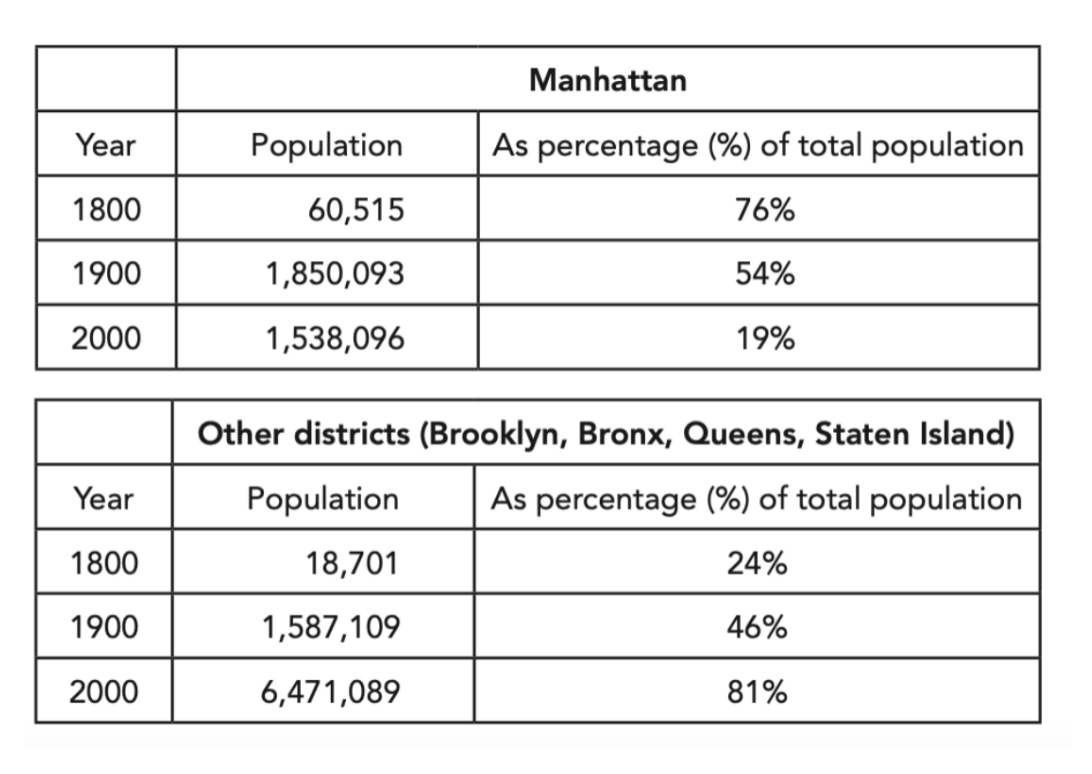
The first table below shows changes in the total population of New York City from 1800 to 2000. The second and third tables show changes in the population of the five districts of the city (Manhattan, Brooklyn, Bronx, Queens, Staten Island) over the same period.
Summarise the information by selecting and reporting the main features, and make comparisons where relevant.
Student answer (Band 6.0)
The one of the tables illustrates the population of New York from 1800 to 2000 and other shows information about five disctricts in New York population change in the same period.
Overall, New York population increased sharply with each century. Even thoughh Manhattan population Fluctuated over the time, as a proportion, the number decreased dramatically. Other four disctricts combioned has a sharp increase of citizens over the priod.
The total population of New York was 79216 in 1800 and in the next century it increased nearly to 3.5 million. In 2000, the population was just over 8 million. In Manhattan, there were more than three quarters of the citizen lived in 1800 and as a number it was 60515. In 1900, the number of citizens more than tripled and overall population decreased to just obove to a half of the total. The total number of citizens in Manhattan decreased to [redacted phone] in 2000 and as a propotion it is less than 20% compared to the total.
Other 4 districted population increaded sharpy from 18701 to nearly 6.5 million within the period. The total citizens number proportion increased from 24% to 81% from 1800 to 2000.
AI examiner evaluation
| Criterion | Band |
|---|---|
| Task Achievement / Task Response | 6.5 |
| Coherence and Cohesion | 6.5 |
| Lexical Resource | 5.5 |
| Grammatical Range and Accuracy | 5.5 |
| Overall | 6.0 |
Task Achievement / Task Response: Band 6.5
You cover the main trends and make relevant comparisons: the city’s population rises from 79,216 to just over 8 million, while Manhattan’s share falls from 76% to 19% and the other districts’ share grows to 81%. The overview identifies these broad changes, and most figures are consistent with the tables. However, the statement that Manhattan’s population “Fluctuated” is not accurate: it rose substantially between 1800 and 1900, then declined by 2000. The account also gives limited detail about the 1900-to-2000 change in the other districts, and “other four districts” could be more precisely identified as the combined population of the four named districts. More precise trend descriptions and fuller comparison across the three dates would strengthen the report.
Coherence and Cohesion: Band 6.5
The response has a clear overall arrangement: an introduction, an overview, and paragraphs reporting the total and district populations. This makes the main information easy to locate, and time markers such as “In 1900” and “In 2000” help establish sequence. The progression is generally logical, but some links between figures and comparisons are awkward or unclear. For example, “In 1900, the number of citizens more than tripled and overall population decreased to just obove to a half” does not clearly distinguish Manhattan’s population from its share of the city total. The final paragraph is also brief and does not fully develop the comparison across all years. Use clearer references and connect each figure explicitly to its group or percentage.
Lexical Resource: Band 5.5
You use relevant vocabulary for describing data, including “increased sharply,” “proportion,” “decreased dramatically,” and “nearly.” These choices show an attempt to vary language beyond simply repeating “population.” However, spelling and word-choice errors are noticeable, including “disctricts,” “combioned,” “priod,” “obove,” “propotion,” and “increaded.” Some expressions are also imprecise or unnatural, such as “the total citizens number proportion” and “as a number it was 60515.” These do not prevent the reader from understanding the broad trends, but they reduce precision and fluency. Aim for standard collocations such as “population share” and “the population stood at,” and proofread carefully for spelling and word forms.
Grammatical Range and Accuracy: Band 5.5
You attempt a mix of simple and more complex sentences, including a concessive overview beginning “Even though…” and comparisons using “while” or “and.” The main trends remain understandable, but some grammatical errors recur. For example, “The one of the tables” has an incorrect article construction, and “there were more than three quarters of the citizen lived” has faulty clause structure and number agreement. In “the number of citizens more than tripled,” the sentence is missing a finite verb, while “it is less than 20%” shifts tense from the past reporting period. Work on complete sentence patterns, agreement, and consistent past tense. More accurate control of these structures would make your comparisons clearer.
See this exact question answered at other band scores. The same prompt compared across bands.
Browse more IELTS Writing model answers or get your own writing scored by the same AI examiner.