Band 6.0 IELTS Writing Task 1 Model Answer
Overall Band Score: 6.0 · Cambridge IELTS 20 · 2026-11-06
IELTS Writing Task 1 question
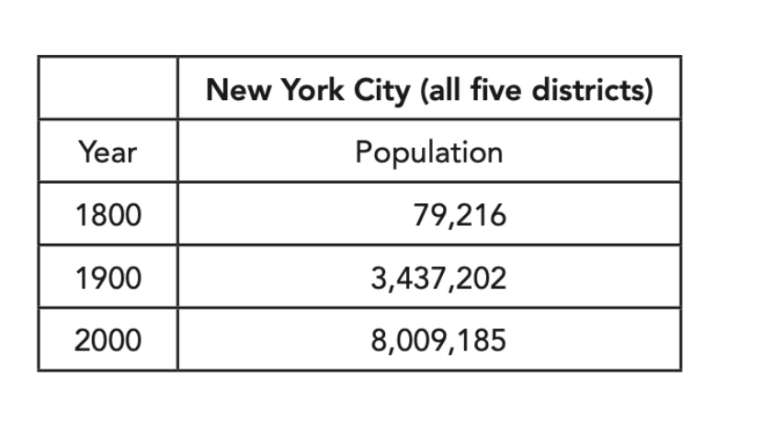
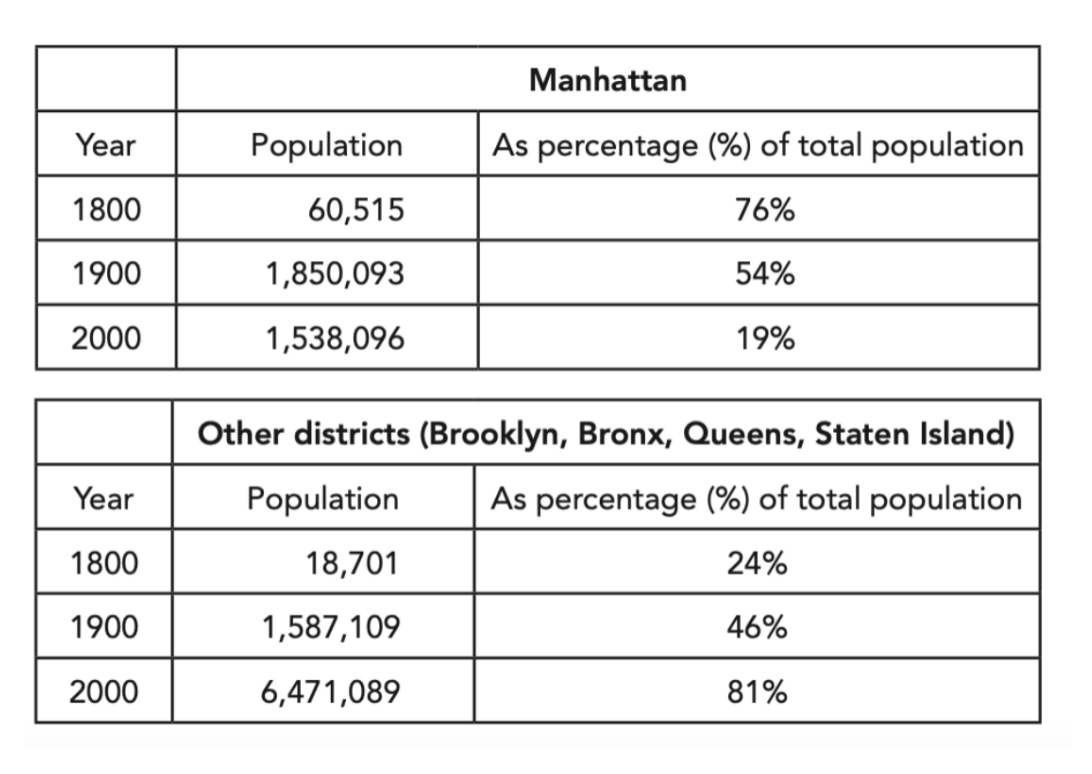
The first table below shows changes in the total population of New York City from 1800 to 2000. The second and third tables show changes in the population of the five districts of the city (Manhattan, Brooklyn, Bronx, Queens, Staten Island) over the same period.
Summarise the information by selecting and reporting the main features, and make comparisons where relevant.
Student answer (Band 6.0)
The table compare the total population in New York City and its Manhattan and other four districts population in 1800, 1900 and 2000.
Overall, The population of New York increased significantly, while Manhattan population dramatically fallen and other four districs, the population increased.
In 1800, the population of New York city increased at 79,216 while, Manhattan have total population increased 60,515 which increased the percentage are 76%, and remaining districtics have population decreased which are 24%. By 1900, the population of New York city increased 3,437,202, while manhattan, population have decreased at 1,850,093 and at this point the percentage have 54% and remaining districts have 1,587,109 and percentage have 46%.
In 2000, the population of new york increased 8,009,185 while, Manhattan have population sharply fallen 1,538,096 which percentage have 19% and remaining districtics have 6,471,089 which increased the percentage have 81% they are highest poulation and percentage as compare to others.
AI examiner evaluation
| Criterion | Band |
|---|---|
| Task Achievement / Task Response | 6.0 |
| Coherence and Cohesion | 6.5 |
| Lexical Resource | 5.5 |
| Grammatical Range and Accuracy | 5.0 |
| Overall | 6.0 |
Task Achievement / Task Response: Band 6.0
You cover the main time points and report the overall growth in New York City, alongside the contrasting changes in Manhattan and the other districts. The figures and percentages you give match the tables, and the overview identifies the key shift in population share from Manhattan to the other districts. However, some descriptions are unclear or inaccurate in meaning: for example, saying Manhattan’s population “dramatically fallen” overlooks that it first rose substantially by 1900 before declining by 2000. The 1800 and 1900 details are also presented mainly as a sequence of figures rather than being compared. To strengthen the response, make the rise-then-fall pattern explicit and highlight the scale of the other districts’ growth in the final period.
Coherence and Cohesion: Band 6.5
The response has a clear overall arrangement: an introduction, an overview, and chronological details for 1800, 1900 and 2000. This gives the reader a basic progression through the data, and linking phrases such as “By 1900” and “In 2000” help signal the stages. However, cohesion is sometimes mechanical, with repeated “while” and “which” constructions, and several long sentences combine multiple figures without clear relationships. For instance, the 1800 sentence moves from the city total to Manhattan and then the remaining districts in one chain. Use separate, balanced sentences to compare the groups, and make references such as “they” unambiguous. This would preserve the logical structure while making the comparisons easier to follow.
Lexical Resource: Band 5.5
You use relevant vocabulary for describing data, including “population,” “percentage,” “increased,” and “fallen,” so the topic is generally clear. There is also an attempt to vary intensity with “significantly” and “sharply.” However, word choice and collocation are often inaccurate: populations do not “increased at” a figure, and “the percentage have” does not express a share naturally. Several misspellings, including “districs,” “districtics,” and “poulation,” also reduce accuracy. The repeated use of “increased” and “population” limits flexibility. Practise standard reporting phrases such as “stood at,” “accounted for,” and “rose to,” and check spelling carefully. More precise vocabulary would make the comparisons clearer and more natural.
Grammatical Range and Accuracy: Band 5.0
You attempt both simple and longer sentences, and the chronological clauses show some ability to connect information. However, control of sentence structure and verb forms is inconsistent, which makes several statements difficult to read. Examples include “The table compare,” “Manhattan have,” and “the population dramatically fallen”; these require subject–verb agreement and correctly formed verbs. Articles and sentence boundaries also need attention, as in “the population of New York city” and the long 1800 sentence joined with commas. Build accuracy first with clear comparative sentences, such as “Manhattan’s population rose to …, then fell to ….” Then add more complex structures only when the verb forms and punctuation remain controlled.
See this exact question answered at other band scores. The same prompt compared across bands.
Browse more IELTS Writing model answers or get your own writing scored by the same AI examiner.