Band 5.0 IELTS Writing Task 1 Model Answer
Overall Band Score: 5.0 · Cambridge IELTS 20 · 2026-11-06
IELTS Writing Task 1 question
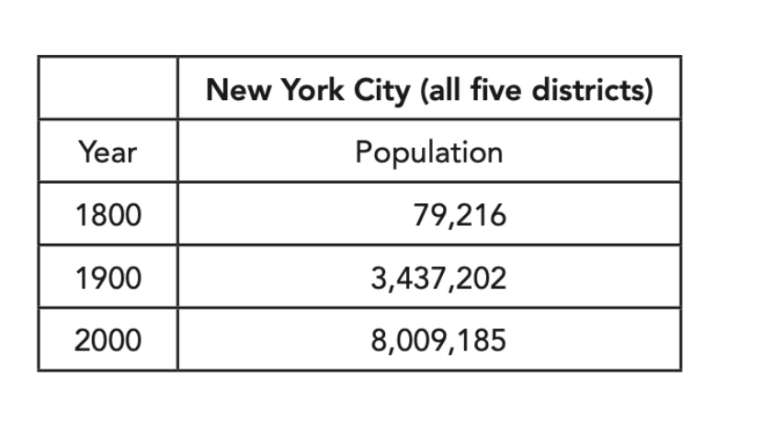
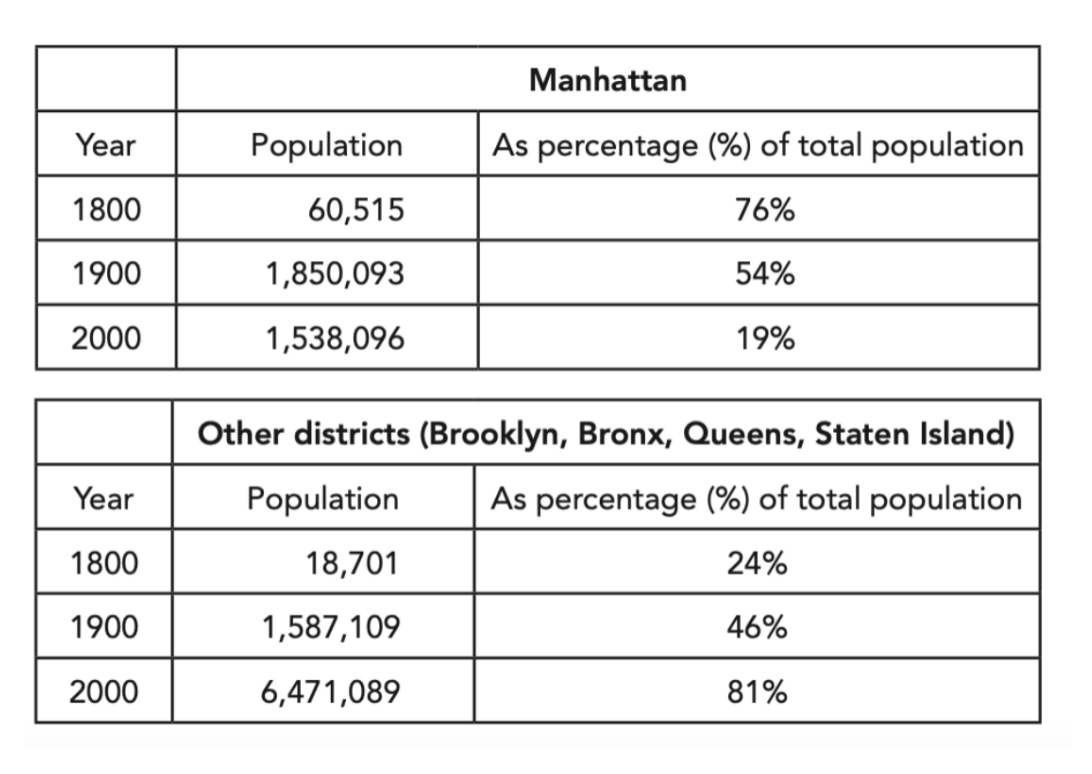
The first table below shows changes in the total population of New York City from 1800 to 2000. The second and third tables show changes in the population of the five districts of the city (Manhattan, Brooklyn, Bronx, Queens, Staten Island) over the same period.
Summarise the information by selecting and reporting the main features, and make comparisons where relevant.
Student answer (Band 5.0)
The table demonstrate changes in the total individuals of New York City between 1800 and 2000.While the other tables provide data of people in five districts over the same period.
Overall, it can be clearly obvious that the population in New York city is larger than other districts from 1800 to 2000, while the total of citizens in Manhattan is significantly bigger than Brooklyn, Bronx, Queens, Staten Island between 1800 and 2000.
To begin with, in New York City year after year and the total of people get larger it jump from 79,216 in 1800 to 8,009,185 in 2000 and this number is even bigger than the population of Manhattan not only this but also other districts.
Moreover, the proportion of population in Manhattan is dimish from 76% to 19% between 1800 and 2000. As a result, individuals are huge in 1900 with the number of 1,850,093.
On the other side, we have the percentage of individuals get bigger over years from 24% to 81%.Furthermore, the population number is huge in 2000 with 6,471,089.
AI examiner evaluation
| Criterion | Band |
|---|---|
| Task Achievement / Task Response | 5.5 |
| Coherence and Cohesion | 5.0 |
| Lexical Resource | 5.0 |
| Grammatical Range and Accuracy | 5.0 |
| Overall | 5.0 |
Task Achievement / Task Response: Band 5.5
You identify the broad rise in New York City’s population and the changing shares of Manhattan and the other districts, and you include several accurate figures, such as the total of 79,216 in 1800 and 8,009,185 in 2000. However, the overview is unclear and includes a misleading comparison: Manhattan is not larger than the other districts across the whole period; by 2000, the other districts together had 6,471,089 people compared with Manhattan’s 1,538,096. The response also omits the important fact that Manhattan’s population peaked in 1900 and then fell, while the other districts grew substantially. Develop the main comparisons more precisely and distinguish population totals from percentages to make the summary more complete.
Coherence and Cohesion: Band 5.0
The response has a basic paragraph structure, moving from an introduction and overview to details about the city total, Manhattan, and the other districts. Some linking expressions, including “Moreover” and “On the other side,” help signal these shifts. However, progression is not consistently clear: “To begin with, in New York City year after year” does not form a clear lead-in, and the overview’s comparison is difficult to follow. Connections between figures and their meaning are also weak, particularly in “As a result, individuals are huge in 1900.” Use one paragraph for the overall trends and organise the details in a clear sequence, explicitly linking each figure to the relevant population or share.
Lexical Resource: Band 5.0
You use some relevant topic vocabulary, including “population,” “proportion,” “percentage,” and “districts,” so the subject is generally recognisable. However, the range is limited and several choices are inaccurate or unnatural for describing statistical data. “Total individuals” and “individuals are huge” do not clearly express population size, while “the population number is huge” is imprecise. “Dimish” is also misspelled, and “bigger” is repeated where more exact comparisons would help. Choose standard collocations for data reporting, such as “population increased,” “accounted for,” and “declined,” and use “figure” or “population” rather than “individuals” when referring to totals.
Grammatical Range and Accuracy: Band 5.0
The response attempts both simple and more complex forms, for example the opening contrast beginning “While the other tables…” and the sentence using “not only this but also.” However, errors are frequent and sometimes make relationships between ideas difficult to understand. The opening has subject–verb disagreement (“The table demonstrate”), and the “While” clause is left without a complete main clause. Other problems include missing spaces after full stops, inconsistent sentence boundaries, and awkward clause construction in “the total of people get larger it jump.” Work on complete sentences, subject–verb agreement, and past-tense forms when describing changes over the period. Clearer punctuation will also help separate the comparisons.
See this exact question answered at other band scores. The same prompt compared across bands.
Browse more IELTS Writing model answers or get your own writing scored by the same AI examiner.