Band 6.0 IELTS Writing Task 1 Model Answer
Overall Band Score: 6.0 · Cambridge IELTS 20 · 2026-11-06
IELTS Writing Task 1 question
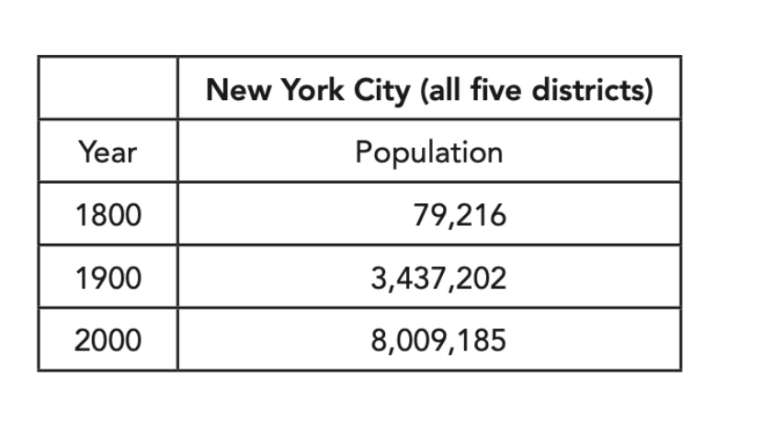
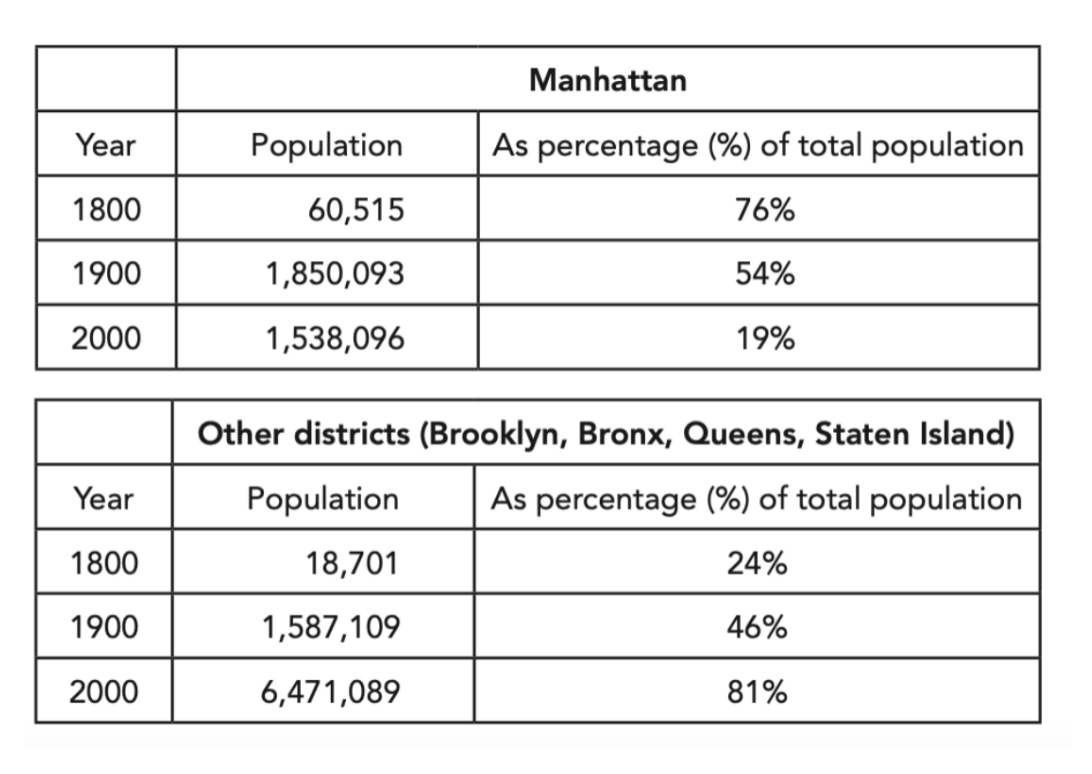
The first table below shows changes in the total population of New York City from 1800 to 2000. The second and third tables show changes in the population of the five districts of the city (Manhattan, Brooklyn, Bronx, Queens, Staten Island) over the same period.
Summarise the information by selecting and reporting the main features, and make comparisons where relevant.
Student answer (Band 6.0)
The tables show the population of New York city as a whole, and shared held by Manhattan and other four districts from 1800 to 200.
Overall the city's population grew enormously over the two century period and the balance of total population shifted from Manhattan to other districts.
In1800most of the city's population of roughly 79000 had residents from Manhattan (60500) meanwhile other districts roughly made up 24% of the total population. By 1900 the total populous had drastically risen up to roughly 3.4 million and so the population percentage difference had also changed with manhattan having roughly 54% while other districts having 46% of the total population. The same trend continued to the 2000's with the total population increasing to 8 million, where Manhattans population percentage fell to 19% and the population also decreased from 1.8 million to 1.5 million. While the other districts saw a huge dramatic increase as the now covered roughly 81% of the total population.
In conclusion Manhattan went from being the most district to a minority, whereas the other districts expanded a ton and hold the current majority of New York's population.
AI examiner evaluation
| Criterion | Band |
|---|---|
| Task Achievement / Task Response | 6.5 |
| Coherence and Cohesion | 6.5 |
| Lexical Resource | 5.5 |
| Grammatical Range and Accuracy | 5.5 |
| Overall | 6.0 |
Task Achievement / Task Response: Band 6.5
You identify the two central trends: New York’s total population rose substantially, while its population share shifted from Manhattan to the other districts. The figures you give for 1800, 1900 and 2000 are broadly consistent with the tables, including Manhattan’s fall from 54% to 19% after 1900 and the other districts’ rise to 81%. This provides a relevant overview and covers the main comparisons. However, some details are less fully reported: for example, you mention Manhattan’s population declining from 1.8 to 1.5 million but do not clearly contrast this with the other districts’ increase in absolute population from about 1.6 to 6.5 million. The conclusion repeats the overview rather than adding a precise comparison. More balanced reporting of both population totals and shares would strengthen the response.
Coherence and Cohesion: Band 6.5
The response has a clear overall shape: an introduction, an overview, a chronological account and a concluding statement. The progression from 1800 to 1900 and then 2000 is easy to follow, and linking expressions such as “By 1900,” “The same trend continued” and “In conclusion” help signal the stages. However, the body is presented as one long paragraph, so the overview and detailed comparisons are not visually separated from the conclusion. Some connections are also awkward or unclear, particularly “and so the population percentage difference had also changed” and the transition beginning “While the other districts…”. Use separate overview and detail paragraphs, and make comparisons directly rather than relying on broad linking phrases.
Lexical Resource: Band 5.5
You use some suitable task vocabulary, including “population,” “percentage,” “increased,” “decreased” and “majority,” and you attempt more emphatic expressions such as “grew enormously.” However, word choice and collocation are often imprecise or informal for an academic report. “Total populous” is not the correct expression for total population, “shared held by” is unclear, and “expanded a ton” is too conversational. There are also spelling and form issues, including “Manhattans” where a possessive is not intended and “200” instead of “2000.” Aim for precise, neutral terms such as “accounted for,” “rose sharply” and “population share,” and check spelling and word forms carefully.
Grammatical Range and Accuracy: Band 5.5
You attempt a mixture of simple and more complex sentences, including a contrast with “whereas” and a time sequence introduced by “By 1900.” The main trends remain understandable, but grammatical control is uneven. For example, “In1800most of the city's population … had residents from Manhattan” has faulty spacing and an awkward sentence structure, while “other districts having 46%” does not form a complete parallel clause. The sentence beginning “While the other districts saw…” is also left as a fragment, and “Manhattans population percentage fell” lacks the apostrophe needed for the possessive form. Improve sentence boundaries and parallel structures, and proofread spacing, punctuation and possessives. More consistently accurate complex sentences would make the comparisons clearer.
See this exact question answered at other band scores. The same prompt compared across bands.
Browse more IELTS Writing model answers or get your own writing scored by the same AI examiner.