Band 6.0 IELTS Writing Task 1 Model Answer
Overall Band Score: 6.0 · Cambridge IELTS 20 · 2026-11-06
IELTS Writing Task 1 question
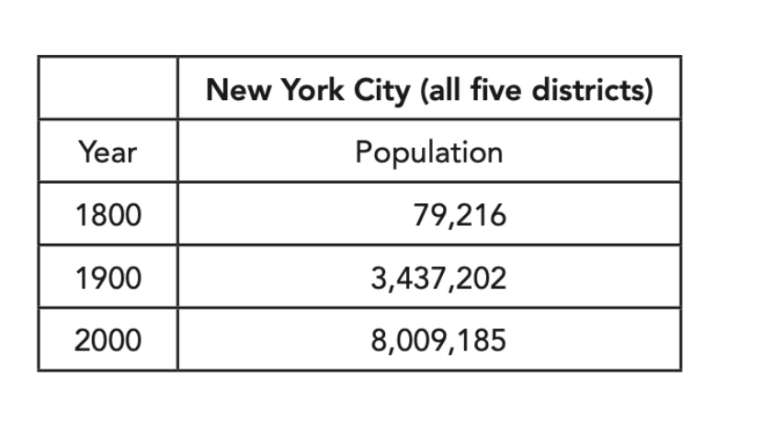
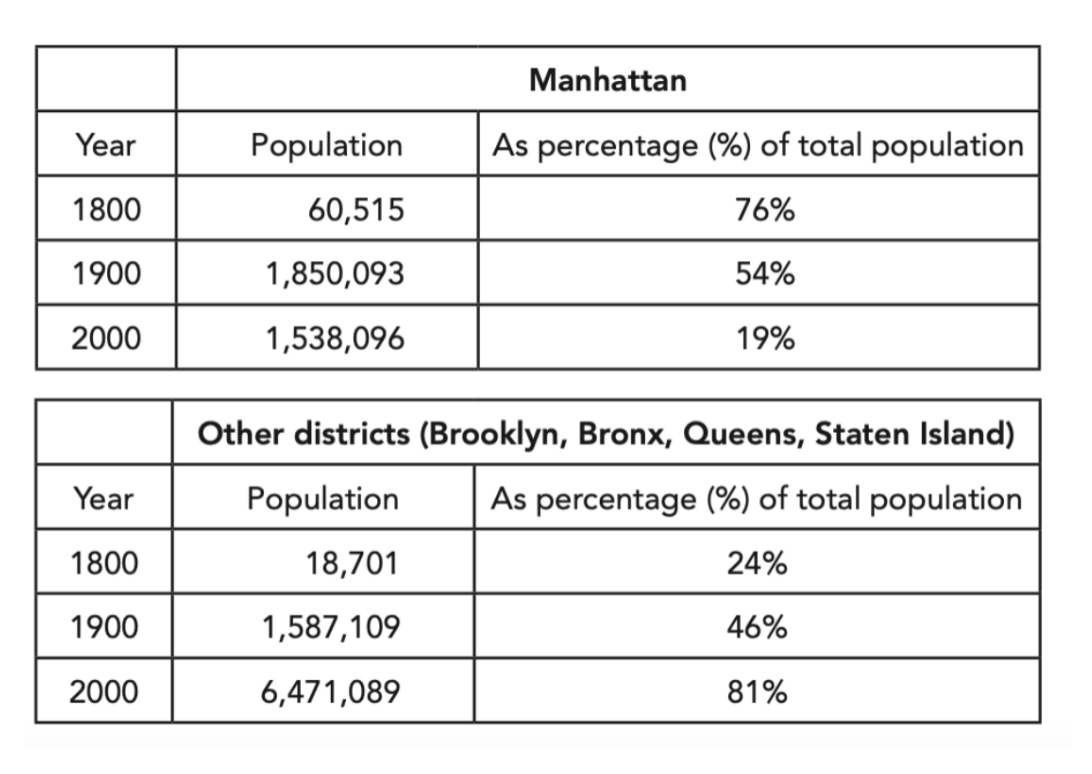
The first table below shows changes in the total population of New York City from 1800 to 2000. The second and third tables show changes in the population of the five districts of the city (Manhattan, Brooklyn, Bronx, Queens, Staten Island) over the same period.
Summarise the information by selecting and reporting the main features, and make comparisons where relevant.
Student answer (Band 6.0)
The three tables compares the number of people lived in New York city between the year 1800 and 2000 and the changes in the population of the five different districts of the city over the same period.
It is clear that, the amount of people lived in New York city changed considerably. It is also noticeable that, the population of Manhatton district declined significantly while the population of other districts rose steadily over the 200 years.
Looking to the first and second tables in more details, the population of New York city saw a upward trend from 79,216 people lived in 1800s where in 2000s over 8 lakhs people lived in that region. Whereas, in the 80s 76% people of total population used to live in Manhatton district. But the amount fell over the period made it only 19% in 2000s.
However the third table presented an opposit trend. In terms of average proportion of total population lived in other districts rose heavily during the period between 1800s and 2000s. Only 18,701 of total 79,216 people lived in the districts like Brooklyn, Bronx, Queens and Staten Island. But after 200 years more than six lakhs people lived in these districts, at 81% of total New York city's population.
AI examiner evaluation
| Criterion | Band |
|---|---|
| Task Achievement / Task Response | 6.0 |
| Coherence and Cohesion | 6.0 |
| Lexical Resource | 5.5 |
| Grammatical Range and Accuracy | 5.5 |
| Overall | 6.0 |
Task Achievement / Task Response: Band 6.0
You identify the main contrast accurately: Manhattan’s share falls from 76% to 19%, while the other districts’ share rises from 24% to 81%. You also note the city’s overall growth and include relevant figures for 1800 and 2000. However, some key details are incomplete or inaccurate: the city had 8,009,185 people in 2000, not “over 8 lakhs,” and the other districts had 6,471,089, not merely “more than six lakhs.” The important 1900 figures are largely omitted, including Manhattan’s peak population of 1,850,093 before its decline by 2000. Develop the comparison across all three dates and report the scale of change more precisely.
Coherence and Cohesion: Band 6.0
The response has a clear overall shape: an introduction, an overview of the contrasting trends, and paragraphs describing the city and district figures. This makes the main message easy to follow. However, the progression is sometimes weakened by unclear or mechanical linking. For example, “Looking to the first and second tables” and “However the third table presented an opposit trend” refer to tables rather than smoothly connecting the data, while “Whereas” begins a fragment. The final paragraph repeats the contrast already stated in the overview without adding the 1900 comparison. Organise the details chronologically or by Manhattan versus the other districts, and use linking phrases that show the relationship between figures more precisely.
Lexical Resource: Band 5.5
You use some suitable task vocabulary, including “declined significantly,” “proportion,” and “upward trend,” and the meaning is generally understandable. However, several word choices and collocations are inaccurate or informal for an academic report. “The number of people lived” and “average proportion” do not express the intended ideas naturally, while “rose heavily” is an unsuitable collocation for a population share. “Lakhs” is not appropriate here; use the figures in millions or write the exact numbers. There are also spelling errors such as “Manhatton” and “opposit.” Aim for precise terms such as “population,” “accounted for,” and “increased substantially,” and check spelling before submitting.
Grammatical Range and Accuracy: Band 5.5
You attempt a mix of simple and complex sentences, including clauses introduced by “while” and “whereas,” and the overall meaning can usually be followed. Some grammatical errors remain, however. The opening should be “The three tables compare,” not “compares,” and “people lived” needs a relative construction such as “people who lived.” The sentence beginning “Whereas, in the 80s…” is incomplete, and “the population … saw a upward trend” has an article error. Time expressions such as “in 1800s” and “in 2000s” also need articles or more precise forms (“in 1800” and “in 2000”). Build accuracy by checking subject–verb agreement, complete sentence structure, and consistent use of past-tense reporting.
See this exact question answered at other band scores. The same prompt compared across bands.
Browse more IELTS Writing model answers or get your own writing scored by the same AI examiner.