Band 5.5 IELTS Writing Task 1 Model Answer
Overall Band Score: 5.5 · Cambridge IELTS 20 · 2026-11-07
IELTS Writing Task 1 question
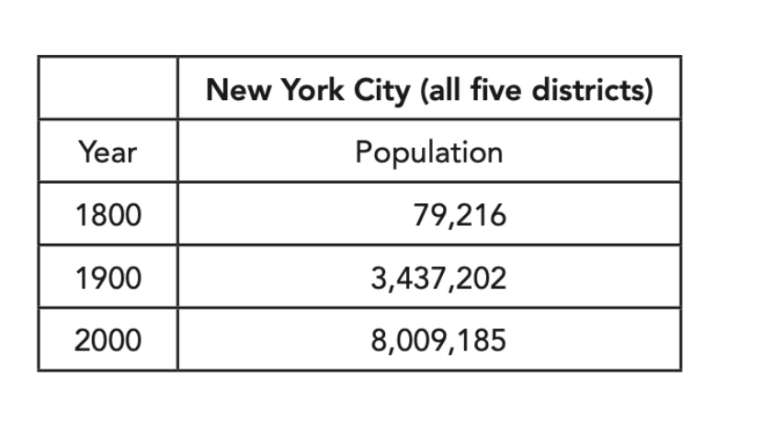
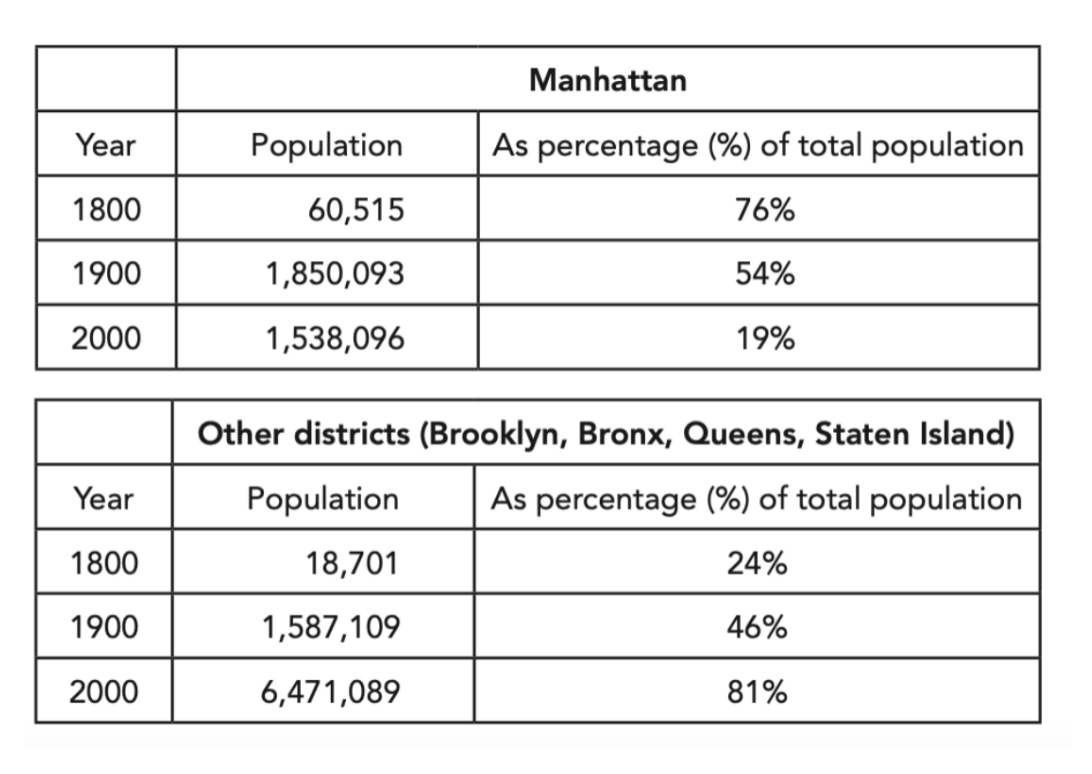
The first table below shows changes in the total population of New York City from 1800 to 2000. The second and third tables show changes in the population of the five districts of the city (Manhattan, Brooklyn, Bronx, Queens, Staten Island) over the same period.
Summarise the information by selecting and reporting the main features, and make comparisons where relevant.
Student answer (Band 5.5)
The fisrt table compares the otherall population growth of all five districts in New York from 1800 to 2000. The second and third table shows the population of five districts and it's percentage in these years.
The total population of New York City is grew massively over the 200 year period. There are massive demographic shift: Manhattan started as the dominant populated area in 1800, but by 2000, the vast majority of the population lived in other districts.
In 1800, the population of NYC is 79,216. By the time, it grow very rapidly and significently. Then in 1900, the population grew to 3,437,202 people and in 2000, we can see a massive difference with 5 million plus people.
The population of on district of NYC "Manhattan" is 76% from it's total poplation, its population grew from 60,515 in 1800 to a peek of 1,850,093in 1900. Then it's dropping slightly to 1,538,096 in 2000.
On the other hand, the population of other four districts Brooklyn, Bronx, Queens and Staten Island are surged from a mere 18,701 with 24% in 1800, then 1,587,109 with 46% in 1900 and with a clear difference from previous year, the populaion is double in 2000 with 81% population that's 6,471,089.
AI examiner evaluation
| Criterion | Band |
|---|---|
| Task Achievement / Task Response | 5.5 |
| Coherence and Cohesion | 5.5 |
| Lexical Resource | 5.5 |
| Grammatical Range and Accuracy | 5.0 |
| Overall | 5.5 |
Task Achievement / Task Response: Band 5.5
You identify the main overall pattern: New York’s population increased greatly, while Manhattan’s share fell and the other districts’ share rose. Several figures are reported accurately, including the 1800 total, Manhattan’s 1900 peak, and the other districts’ 2000 population and share. However, the 2000 city total is misreported as “5 million plus” rather than 8,009,185, and the claim that the other districts’ population “is double” in 2000 is inaccurate: it rose to more than four times its 1900 level. The response also gives limited detail on the total-population trend and does not clearly distinguish population counts from percentages in places. More precise reporting and a fuller comparison of the three years would strengthen coverage.
Coherence and Cohesion: Band 5.5
The response has a recognisable structure: an introduction, an overview, and paragraphs describing the total population and the district figures. The contrast introduced by “On the other hand” is relevant, and the sequence from 1800 to 2000 is generally understandable. However, progression is uneven: the total-population paragraph gives little detail, while the final paragraph combines several figures in a long, awkward sentence. Some references are unclear, such as “these years” and “with a clear difference from previous year,” and linking words such as “Then” are repeated. Organise the data into clearer comparisons and use explicit references—for example, “the city’s total” or “the combined population of the four other districts”—to make relationships easier to follow.
Lexical Resource: Band 5.5
You use some suitable vocabulary for describing trends, including “dominant,” “demographic shift,” “grew,” and “surged,” and the main meaning is usually recoverable. However, the range is limited and several choices or combinations are inaccurate or unnatural, such as “otherall population growth,” “massive difference,” and “the population of on district.” Repetition of “massive” also reduces precision. Spelling errors—including “fisrt,” “significently,” “poplation,” and “populaion”—are noticeable and detract from clarity. Aim for accurate, conventional Task 1 language such as “overall population,” “increased substantially,” and “accounted for,” and check spelling carefully. More precise vocabulary would also help distinguish population totals from percentage shares.
Grammatical Range and Accuracy: Band 5.0
You attempt both simple and more extended sentences, and the broad meaning can usually be understood. However, errors occur frequently in verb forms, agreement, articles, and sentence construction. For example, “The total population … is grew” should be “grew” or “has grown,” while “The second and third table shows” needs plural agreement. In “the population … is 76% from its total population,” the grammatical relationship is unclear; use a structure such as “Manhattan accounted for 76% of the total.” The final sentence also joins several clauses without clear control. Practise accurate past-tense reporting and build longer sentences around one clear comparison at a time, with careful punctuation and possessive forms.
See this exact question answered at other band scores. The same prompt compared across bands.
Browse more IELTS Writing model answers or get your own writing scored by the same AI examiner.