Band 4.5 IELTS Writing Task 1 Model Answer
Overall Band Score: 4.5 · Cambridge IELTS 20 · 2026-11-07
IELTS Writing Task 1 question
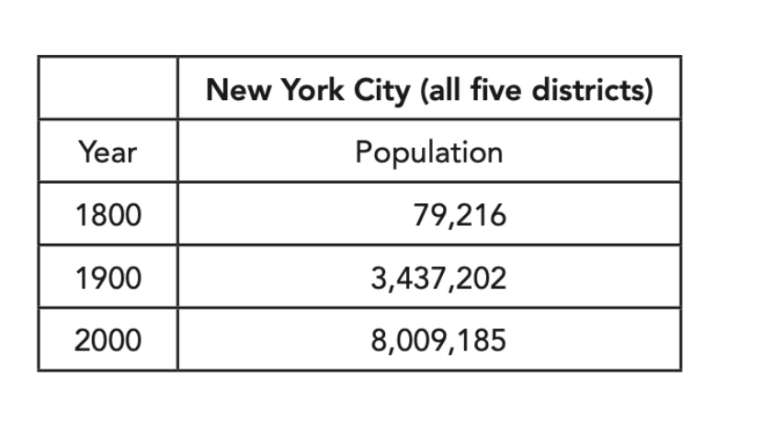
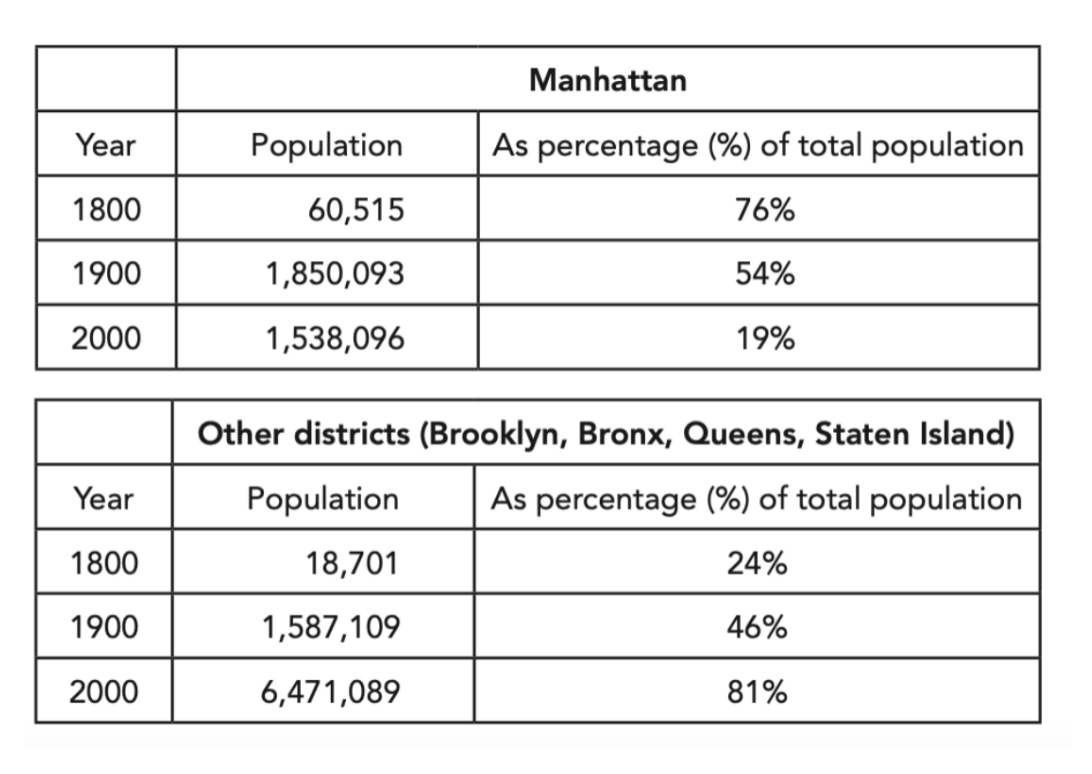
The first table below shows changes in the total population of New York City from 1800 to 2000. The second and third tables show changes in the population of the five districts of the city (Manhattan, Brooklyn, Bronx, Queens, Staten Island) over the same period.
Summarise the information by selecting and reporting the main features, and make comparisons where relevant.
Student answer (Band 4.5)
The information provided the changes in the total population of New york, Manhattan, and other districts, such as Brooklyn, Bronx, Queens, and Staten Island. The table provides the statistical information of population change between the year of 1800 to 2000. The data shows population starting from 79,216 at the year of 1800 for New York city inclduing all five districts. Following by the year 1900, which has the value of 3,437,202. As compare to Manhattan, the greatest value found in the year of 1900 for New York, where as percentage distrubution increased in Manhattan at the rate of 76. Moreover, other districts has the highest percentage at the year of 2000, which contributes 81%, resulting in highest value in other districts. In conclusion, the comparision between three tables provides valuable insight data of population change in three different districts. So, starting from 1800, the lowest value is shown by other districts, and highest value figured by Manhattan.
AI examiner evaluation
| Criterion | Band |
|---|---|
| Task Achievement / Task Response | 4.0 |
| Coherence and Cohesion | 4.0 |
| Lexical Resource | 5.0 |
| Grammatical Range and Accuracy | 5.0 |
| Overall | 4.5 |
Task Achievement / Task Response: Band 4.0
The response identifies the broad topic and includes some relevant figures, such as the city’s population of 79,216 in 1800 and the other districts’ 81% share in 2000. However, it does not accurately or clearly summarise the main trends. The claim that Manhattan’s percentage “increased” to 76% is incorrect: its share fell from 76% in 1800 to 54% in 1900 and 19% in 2000. The conclusion also reverses the 1800 comparison: Manhattan, not the other districts, had the larger population. The overall rise in the city’s population and the shift in population share away from Manhattan are not clearly presented. The response is one word below the 150-word minimum; the eight words copied from the prompt are excluded.
Coherence and Cohesion: Band 4.0
There is a basic attempt to organise the response, moving from an introduction to figures and then a conclusion. However, the ideas are not arranged in a coherent progression, and the reader has difficulty following the comparisons. For example, “As compare to Manhattan” does not establish a clear relationship between the city total and Manhattan, while “where as percentage distrubution increased in Manhattan at the rate of 76” is difficult to interpret. The conclusion introduces a comparison that conflicts with the earlier information rather than summarising a clear overview. Linking expressions such as “Following by,” “Moreover,” and “In conclusion” are used, but they do not reliably connect the ideas. Group the overview and key comparisons into clear paragraphs and use links that express the intended relationship.
Lexical Resource: Band 5.0
The response uses some task-related vocabulary, including “population,” “percentage,” “value,” and “districts,” so the topic is generally recognisable. However, the range is limited and several word choices or collocations are inaccurate, which sometimes makes the meaning unclear. Examples include “valuable insight data,” “highest value figured by Manhattan,” and “at the rate of 76,” which do not naturally describe population figures or shares. Spelling errors such as “New york,” “inclduing,” “distrubution,” and “comparision” also reduce accuracy. Aim for precise terms such as “population share,” “accounted for,” and “rose to,” and check spelling carefully. Avoid repeating “value” when describing population totals or percentages.
Grammatical Range and Accuracy: Band 5.0
The response attempts a few longer sentence forms, but control is uneven, and several sentence structures are incomplete or faulty. “Following by the year 1900, which has the value of 3,437,202” is a fragment rather than a complete sentence. In “As compare to Manhattan,” the comparative construction is not grammatically formed, and “other districts has” has a subject–verb agreement error. Articles and prepositions are also awkward in phrases such as “between the year of 1800 to 2000” and “at the year of 1800.” Most sentences rely on simple patterns, with limited accurate variety. Practise writing complete sentences that directly compare figures, and check agreement, tense, and sentence boundaries.
See this exact question answered at other band scores. The same prompt compared across bands.
Browse more IELTS Writing model answers or get your own writing scored by the same AI examiner.