Band 6.0 IELTS Writing Task 1 Model Answer
Overall Band Score: 6.0 · Cambridge IELTS 20 · 2026-11-08
IELTS Writing Task 1 question
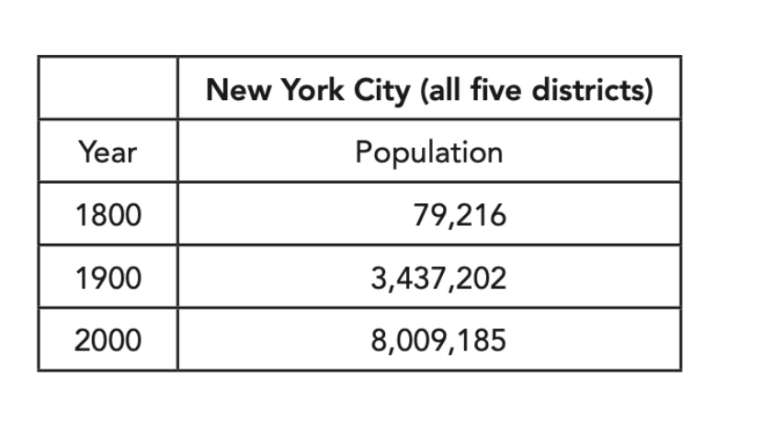
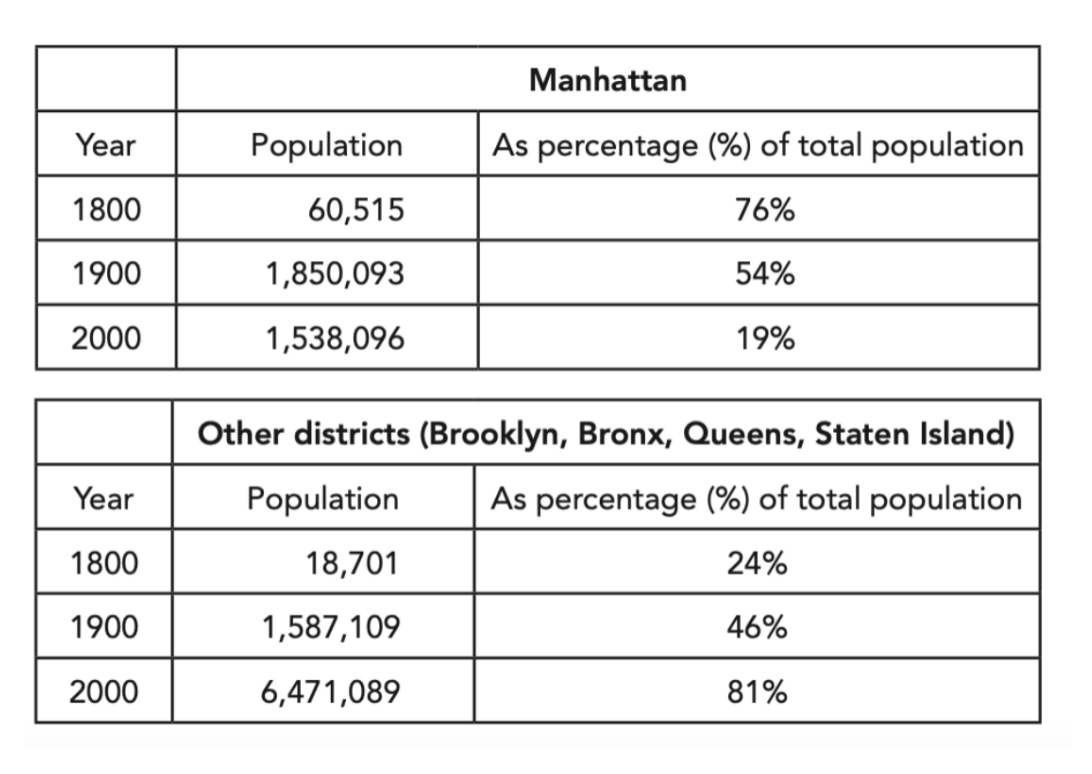
The first table below shows changes in the total population of New York City from 1800 to 2000. The second and third tables show changes in the population of the five districts of the city (Manhattan, Brooklyn, Bronx, Queens, Staten Island) over the same period.
Summarise the information by selecting and reporting the main features, and make comparisons where relevant.
Student answer (Band 6.0)
The tables belows indicates the total population of new york city, the population of manhathan and the other new york city and the percentage of the their population in relation to the total population.
Overall, there was a massive jump in the population of new york city over the 200 years perood. However in relation to other cities, manhattan population reduced drastically over the years while the population of other districts improved significantly over the years.
From the first table, the total population of the five districts in the new york city improved significantly, from 79 216 in 1800, to [redacted phone] in 1900 and a whooping [redacted phone] in 2000.
Mahanthan which had a population of 60,515, grew to [redacted phone] in 1900 however in 2000, the population of manhathan dropped to [redacted phone]. In relation to the population of other cities, the propotion of the population of manhanthan dropped significantly from 76% in 1800, to 54% in 1900 and by 2000 the proportion of manhattan city had dropped to only 19%.
The percentage of brooklyn, bronx, queens, and staten island's population in relation to the total population which started at 24% in 1800 grew gradually and by 2000 it became 81% of the total population. Similarly, their poplation in relation to the total population grew from 18,701 in 1800 to a peak of 6, 471, 089 in 2000.
AI examiner evaluation
| Criterion | Band |
|---|---|
| Task Achievement / Task Response | 7.0 |
| Coherence and Cohesion | 6.5 |
| Lexical Resource | 5.5 |
| Grammatical Range and Accuracy | 5.5 |
| Overall | 6.0 |
Task Achievement / Task Response: Band 7.0
The response identifies the main trends accurately: New York City’s total population rose sharply, Manhattan’s population peaked in 1900 and then fell, and the other districts’ share grew to become dominant by 2000. It supports these points with relevant figures, including the total of 8,009,185 and Manhattan’s decline from 1,850,093 to 1,538,096. The overview is clear and the tables’ key comparisons are covered. However, the final sentence misdescribes the other districts’ population as growing “in relation to the total population” from 18,701 to 6,471,089; these are absolute population figures, not proportions. Also, “grew gradually” is imprecise for the change across only three reported years. More exact distinctions between population and percentage would strengthen the report.
Coherence and Cohesion: Band 6.5
The response has a clear overall progression: an introduction, an overview, and then details about the total population, Manhattan, and the other districts. Linking expressions such as “Overall,” “From the first table,” “however,” and “Similarly” help guide the reader, and the information is generally grouped sensibly. To make the organisation more controlled, avoid repeating the same trend in slightly different terms and ensure that each comparison is placed where it is easiest to follow. In the final sentence, “their population in relation to the total population” is an unclear reference, especially because the figures that follow are absolute totals. A more precise transition and reference would make the cohesion less mechanical and the progression more fluent.
Lexical Resource: Band 5.5
The response uses some suitable trend vocabulary, including “massive jump,” “reduced drastically,” “grew significantly,” and “proportion.” However, the range is limited and several choices are inaccurate or informal for an academic report. “Whooping” is too conversational, while “improved” suggests a positive evaluation rather than simply an increase in population. “Other cities” is also an inaccurate label for the other districts, and “population … improved” is an awkward collocation. Spelling errors such as “manhathan,” “propotion,” and “poplation” are noticeable and reduce precision. Aim for neutral, exact terms such as “increased,” “declined,” “accounted for,” and “the remaining four districts,” and check spelling carefully.
Grammatical Range and Accuracy: Band 5.5
The response attempts a mixture of simple and more complex sentences, including a contrast with “however” and a relative clause beginning “which started at 24%.” Meaning is usually recoverable, but errors recur in agreement, articles, and sentence construction. For example, “The tables belows indicates” has incorrect plural agreement and form; “the population of manhattan population reduced” is structurally confused; and “the percentage … which started at 24% … grew” does not clearly match the subject and meaning. There are also inconsistent capitalisation and punctuation, including the comma after “Mahanthan” and the spacing around figures. Use shorter, well-controlled sentences when comparing values, then check subject–verb agreement and clause boundaries.
See this exact question answered at other band scores. The same prompt compared across bands.
Browse more IELTS Writing model answers or get your own writing scored by the same AI examiner.