Band 5.5 IELTS Writing Task 1 Model Answer
Overall Band Score: 5.5 · Cambridge IELTS 20 · 2026-11-08
IELTS Writing Task 1 question
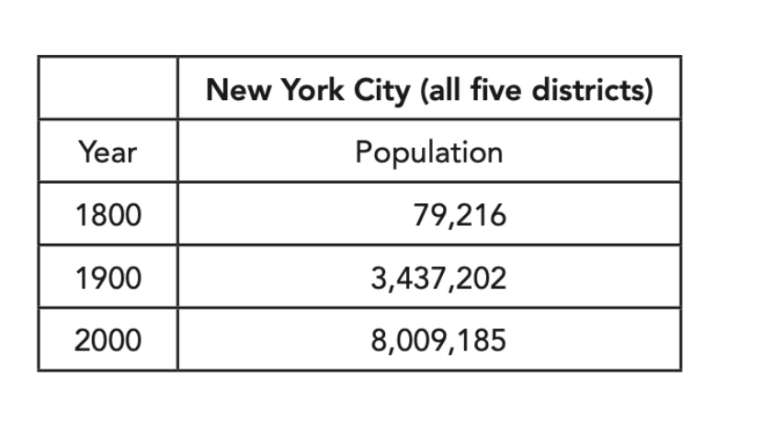
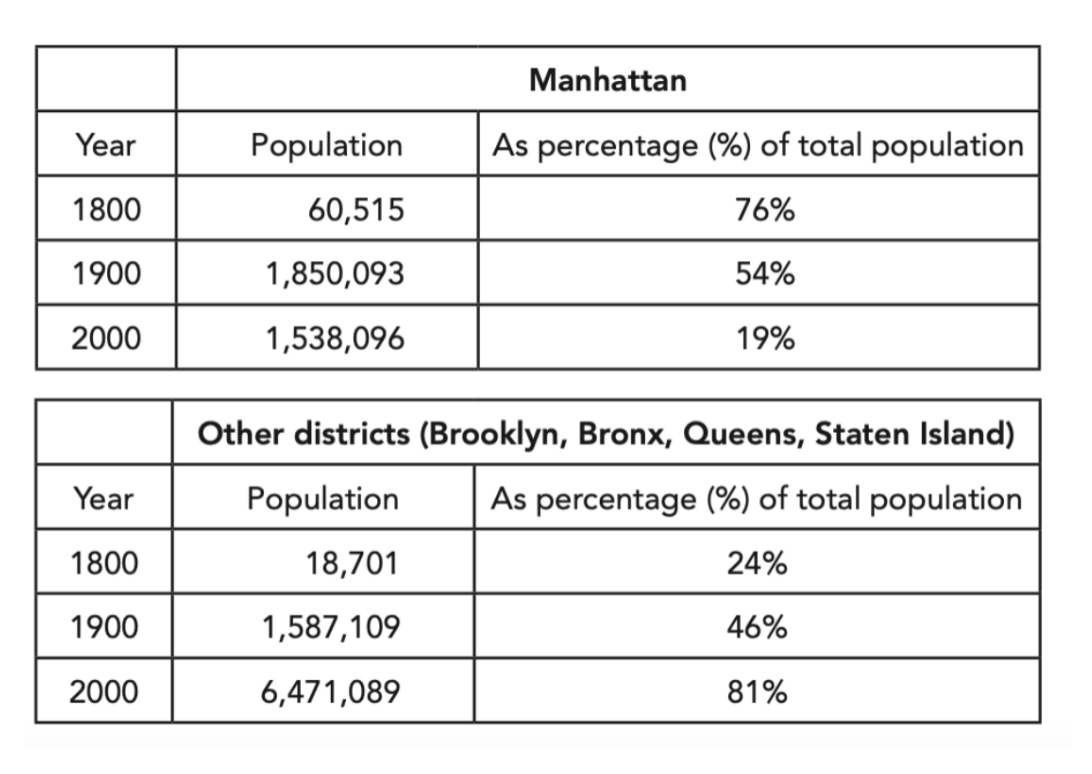
The first table below shows changes in the total population of New York City from 1800 to 2000. The second and third tables show changes in the population of the five districts of the city (Manhattan, Brooklyn, Bronx, Queens, Staten Island) over the same period.
Summarise the information by selecting and reporting the main features, and make comparisons where relevant.
Student answer (Band 5.5)
The first table contains revolution of the total population of New York City between the years 1800 and 2000. The other two table comes with the population over the years of other five districts.
New York City carried the lowest number of citizens in the year 1800 then it surprisingly hit the highest in 2000. Then the Manhattan district got a particular table to show its population where in 1800 it had the highest number of citizens.But the other four district seems highly populated in 2000 with the opposite of Manhattan's population ratio pattern.
Starting with New York City,in 1800 it had the lowest ration of population.But in the year it made a huge jump and reached [redacted phone].Then in 2000 it dramatically increased to [redacted phone]. There is seen a noticible gap of ratios over the years in New York City.
Secondly, I would like to mention the biggest district Manhattan's population rate. It carried 76 parcent of population of New York in 1800.Then it gradually decreased over the years and dropped to 19% in 2000.
Finally, the third table holds the population number and ratio of share of other four districts,which are Brooklyn, Bronx, Queens, Staten Island.They followed the opposite sequence of Manhattan's.In the first year1800 they carried lowest ration of citizens 24%. Then in 1900 it almost doubled and remained 46%. In th efinal year 2000 it holds the highest ratio of New York City,which is 81% of its population.
AI examiner evaluation
| Criterion | Band |
|---|---|
| Task Achievement / Task Response | 5.5 |
| Coherence and Cohesion | 5.5 |
| Lexical Resource | 5.5 |
| Grammatical Range and Accuracy | 5.0 |
| Overall | 5.5 |
Task Achievement / Task Response: Band 5.5
You identify the broad trends: New York City’s population rose substantially, Manhattan’s share fell, and the other districts’ combined share increased. The percentages you give for Manhattan and the other districts match the tables, and you include the 1900 and 2000 city totals. However, the account is only partial because it omits key comparisons in actual population: Manhattan grew from 60,515 to 1,850,093 by 1900, then declined to 1,538,096, while the other districts rose throughout. The overview is also unclear in places, such as saying Manhattan had the “highest number” without specifying the comparison. Select the main changes more precisely and support them with the population figures as well as percentages.
Coherence and Cohesion: Band 5.5
The response has a recognisable structure, moving from an introduction and broad summary to separate paragraphs on the city, Manhattan, and the other districts. Sequencing words such as “Starting with,” “Secondly,” and “Finally” help signal these sections. However, progression is sometimes weakened by repetitive phrasing and unclear references: “Then in the year” does not identify which year, and “the opposite sequence” requires the reader to infer what is being contrasted. The opening overview also repeats ideas that are revisited in the body. Organise the overview around the two central trends, then use each body paragraph to compare the relevant figures in chronological order, with clearer links between sentences.
Lexical Resource: Band 5.5
You use some relevant vocabulary for describing change, including “increased,” “decreased,” “dropped,” and “population ratio.” However, the range is limited and several choices or spelling errors make the report less precise. “Revolution” is not suitable for describing a table’s data, while “lowest ration” appears to mean the lowest share. There are also misspellings such as “noticible,” “parcent,” and “th efinal,” and phrases such as “carried the lowest number of citizens” sound unnatural in this context. Use standard demographic terms consistently, such as “population,” “proportion,” and “accounted for,” and check spelling and collocations before submitting.
Grammatical Range and Accuracy: Band 5.0
You attempt both simple and more extended sentences, including contrasts such as “They followed the opposite sequence of Manhattan’s.” However, grammatical errors are frequent and sometimes make relationships between ideas difficult to follow. Examples include “The other two table comes,” where the noun and verb do not agree, and “in the year it made a huge jump,” which lacks a clear time reference and has an unclear subject. Articles, plurals, and punctuation also need attention: “the other four district” should use a plural form, and several sentences run words together after full stops or commas. Practise building accurate sentences with clear subjects and past-tense verbs, then proofread agreement, articles, and sentence boundaries.
See this exact question answered at other band scores. The same prompt compared across bands.
Browse more IELTS Writing model answers or get your own writing scored by the same AI examiner.