Band 5.0 IELTS Writing Task 1 Model Answer
Overall Band Score: 5.0 · Cambridge IELTS 20 · 2026-11-09
IELTS Writing Task 1 question
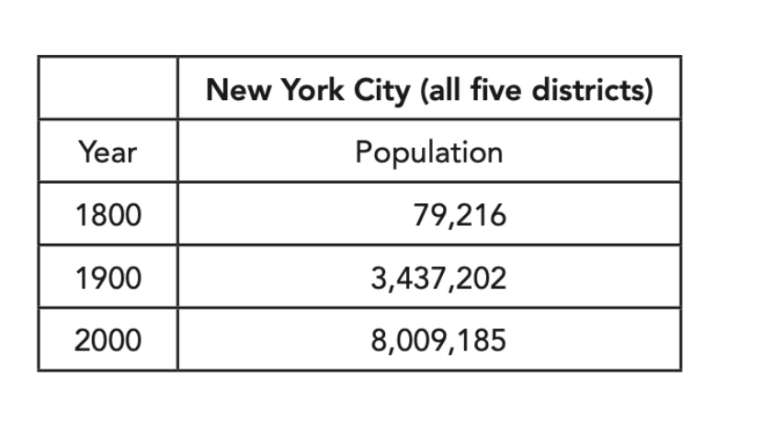
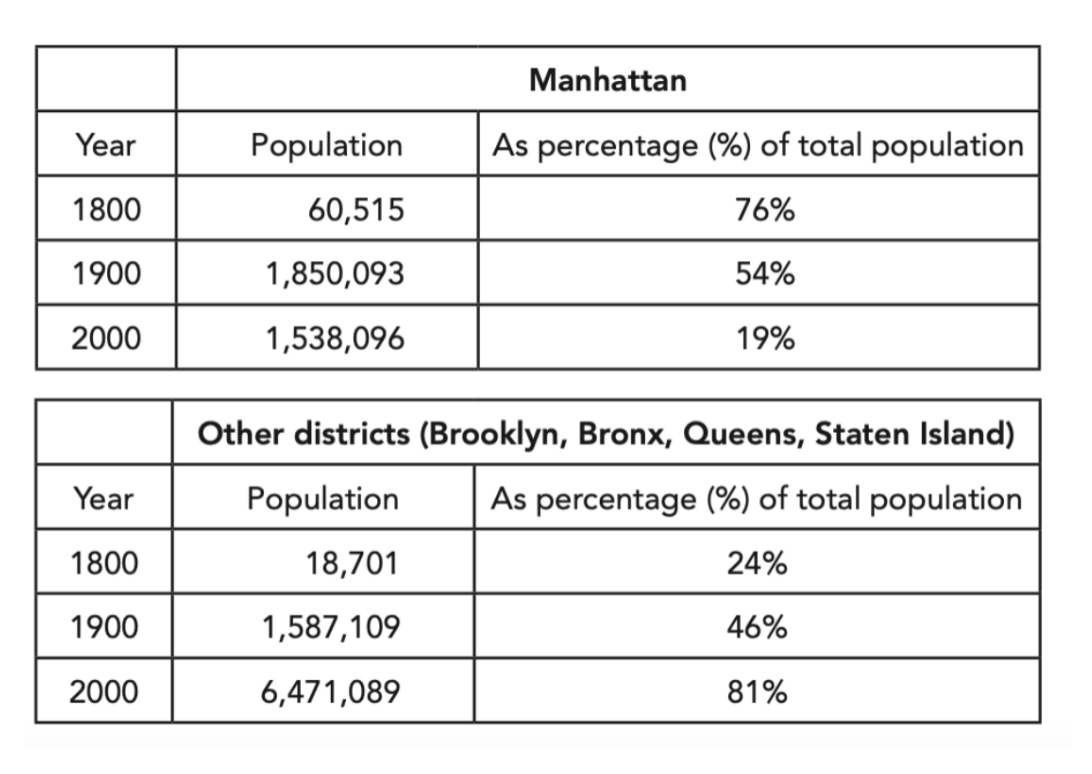
The first table below shows changes in the total population of New York City from 1800 to 2000. The second and third tables show changes in the population of the five districts of the city (Manhattan, Brooklyn, Bronx, Queens, Staten Island) over the same period.
Summarise the information by selecting and reporting the main features, and make comparisons where relevant.
Student answer (Band 5.0)
The study illustrates the change in population of New York City from 1800 to 2000. and it provides three tables woth the details of the study. The first table shows the change in population for the whole city, While the second table focuses on Manhattan district and the third table for Bronx, Brooklyn, queens and staten island.
In 1800, New york city had a total population of nearly 18,000 which later after a century almost made an astonishing increase in population that made the total population around 3.4 million. And it continued to increase for the next 100 years making the total population to 8 million in the year 1900.
Among New yorks five major districs, Manhattan covers most of the number of population. For that reason Manhattan has its own table if statistics. Manhattan had 60,000 residents almost 76% of the total population of New york city, Making it the largest distric in the city.
The rest 4 disticts shared the rest 24% of the population, having almost similar number of population.
AI examiner evaluation
| Criterion | Band |
|---|---|
| Task Achievement / Task Response | 4.5 |
| Coherence and Cohesion | 5.0 |
| Lexical Resource | 5.0 |
| Grammatical Range and Accuracy | 5.0 |
| Overall | 5.0 |
Task Achievement / Task Response: Band 4.5
You identify the topic and report some relevant figures, including Manhattan’s 60,000 residents and 76% share in 1800, as well as the city’s growth to about 3.4 million. However, the response only partially covers the tables and contains important inaccuracies: the city had 79,216 people in 1800, not nearly 18,000, and its population reached 8 million in 2000, not 1900. The claim that Manhattan had the largest population is true only for 1800; by 2000, the other four districts together accounted for 81% of the total, while Manhattan’s share fell to 19%. Include a clear overview of these contrasting trends and report the figures accurately.
Coherence and Cohesion: Band 5.0
The response has a basic sequence: it introduces the tables, then discusses the city total and Manhattan. This gives the reader some sense of the topic, and phrases such as “In 1800” and “For that reason” attempt to connect ideas. However, the progression is incomplete: the discussion stops before explaining the 2000 figures or the growth of the other districts, and the final sentence is not developed into a comparison. Some linking is also awkward or unclear, such as “which later after a century almost made an astonishing increase.” Organise the response into a clear introduction, an overview of the main trends, and paragraphs comparing the figures across the three years.
Lexical Resource: Band 5.0
You use some relevant vocabulary, including “total population,” “residents,” “district,” and “increase,” so the subject is generally understandable. However, the range is limited and several word choices or collocations are inaccurate or unnatural, such as “covers most of the number of population,” “table if statistics,” and “shared the rest 24%.” Spelling and capitalisation errors—including “woth,” “districs,” “queens,” and “New york”—also make the writing less controlled. Choose precise terms for describing data and shares, and check spelling and proper nouns carefully. For example, “accounted for” and “population share” would express the comparisons more naturally.
Grammatical Range and Accuracy: Band 5.0
You attempt both simple and longer sentence forms, for example, “The first table shows…” and the sentence beginning “In 1800…”. However, the longer constructions are often difficult to follow because clauses are joined or punctuated incorrectly. The opening has an unnecessary full stop before “and,” while “While” is incorrectly capitalised mid-sentence. The phrase “making the total population to 8 million” also uses an incorrect verb pattern, and “the third table for…” is not a complete parallel clause. Use shorter, complete sentences when describing each year, and practise accurate clause linking, verb patterns, and punctuation before attempting more elaborate structures.
See this exact question answered at other band scores. The same prompt compared across bands.
Browse more IELTS Writing model answers or get your own writing scored by the same AI examiner.