Band 6.0 IELTS Writing Task 1 Model Answer
Overall Band Score: 6.0 · Cambridge IELTS 20 · 2026-11-09
IELTS Writing Task 1 question
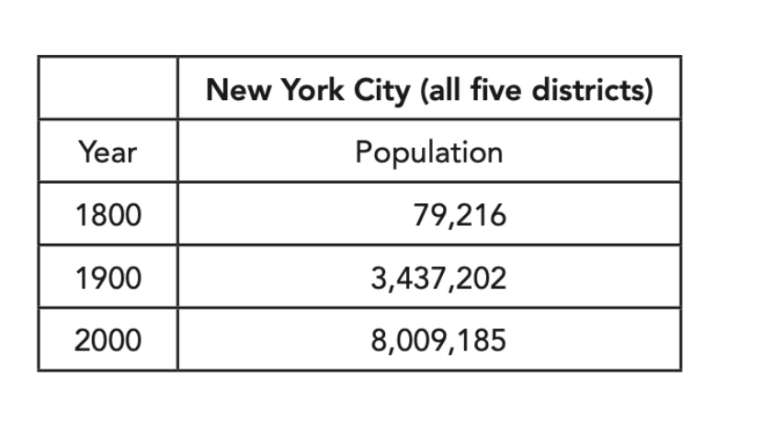
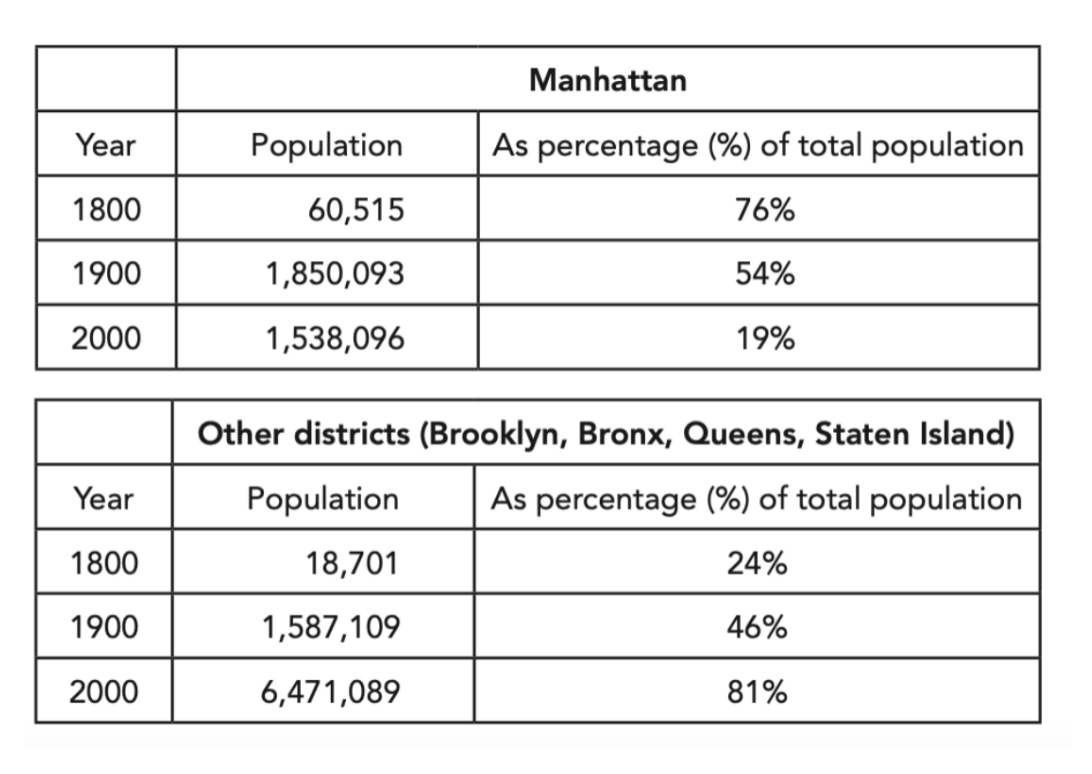
The first table below shows changes in the total population of New York City from 1800 to 2000. The second and third tables show changes in the population of the five districts of the city (Manhattan, Brooklyn, Bronx, Queens, Staten Island) over the same period.
Summarise the information by selecting and reporting the main features, and make comparisons where relevant.
Student answer (Band 6.0)
The tables provide information regarding an increase in population between 1800 and 2000 for the New York city (Including all five districts), Manhattan district, and other four districts (Brooklyn, Bronx, Queens, Staten island) combined in a table.
Overall, the population of the whole New York City was rose significantly across all district except Manhattan, which shows that the percentage population increased in 1900s and declined in 2000s.
In 1800s, the most populated district of New York was Manhattan, which contains 76% population of the whole city. Out of 79,216 people of New York, 60,515 people belongs to the Manhattan, and rest of all four district combinely possessed 18,701 people.
In 1900s, the population of the New York and its all district increased rapidly, but contribution came from the Manhattan city reduced from 76% to 54%, while contribution from other four district rose to 46%. This trend was remain the same during 2000s as well, during that period contribution of the Manhattan went below to 20%, while proportion of other four districts rose to 81%.
AI examiner evaluation
| Criterion | Band |
|---|---|
| Task Achievement / Task Response | 6.0 |
| Coherence and Cohesion | 6.0 |
| Lexical Resource | 6.0 |
| Grammatical Range and Accuracy | 5.5 |
| Overall | 6.0 |
Task Achievement / Task Response: Band 6.0
You identify the main contrast: Manhattan accounted for most of the city’s population in 1800, while the other four districts together dominated by 2000. The figures you give for 1800 and the percentages for 1900 and 2000 are consistent with the tables, and the overview recognises Manhattan’s declining share. However, the overview is unclear when it says the population “increased in 1900s and declined in 2000s”; this seems to refer to Manhattan’s population, which rose to 1,850,093 in 1900 before falling to 1,538,096 in 2000. You also omit the total city populations for 1900 and 2000 and do not report the other districts’ actual populations in those years. Including these key figures would make the comparison more complete and precise.
Coherence and Cohesion: Band 6.0
The response has a clear overall structure: an introduction, an overview, and chronological paragraphs for 1800 and the later years. This makes the main comparison easy to follow, and phrases such as “while” help contrast Manhattan with the other districts. However, the overview’s reference to population rising and then declining is not sufficiently clear about which population it describes. The repeated opening pattern “In 1800s” and “In 1900s” also makes the progression somewhat mechanical, while “This trend was remain the same” does not clearly connect the two periods. Organise the body around the changing shares and population totals, and use clearer references such as “Manhattan’s population” or “the combined population of the other districts” to guide the reader.
Lexical Resource: Band 6.0
You use an adequate range of vocabulary for describing tables, including “population,” “contribution,” “percentage,” “increased rapidly,” and “declined.” These choices communicate the general trends, and the district names are handled clearly. Some word choices and collocations are inaccurate or unnatural, however: “possessed 18,701 people” is not an appropriate way to describe a population, and “contribution came from the Manhattan city” is awkward. “The most populated district” is understandable but less precise than “the most populous district.” There are also inconsistent capitalisations in “New York city” and “Staten island.” Aim for standard data-reporting expressions such as “accounted for,” “stood at,” and “the combined population,” and check proper nouns and spelling.
Grammatical Range and Accuracy: Band 5.5
You attempt both simple and complex sentences, including a relative clause in “Manhattan, which contains 76%” and contrastive clauses using “while.” The overall meaning is generally recoverable, but some grammatical errors recur. For example, “the whole New York City was rose” combines incompatible verb forms; use “the population of New York City rose.” In “which contains,” the past-tense account requires “contained,” and “people belongs” needs subject–verb agreement and a past form (“people belonged”). The sentence “This trend was remain the same” also has an incorrect verb construction; write “This trend remained similar.” Review tense consistency, agreement, and verb forms, while continuing to use a mix of sentence structures.
See this exact question answered at other band scores. The same prompt compared across bands.
Browse more IELTS Writing model answers or get your own writing scored by the same AI examiner.