Band 5.5 IELTS Writing Task 1 Model Answer
Overall Band Score: 5.5 · Cambridge IELTS 20 · 2026-11-09
IELTS Writing Task 1 question
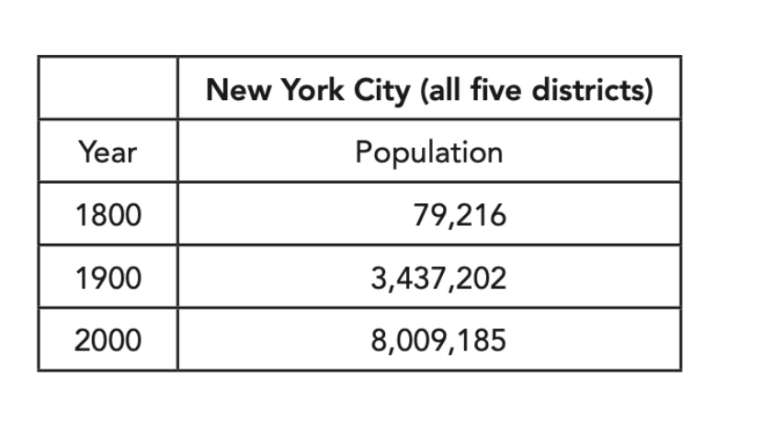
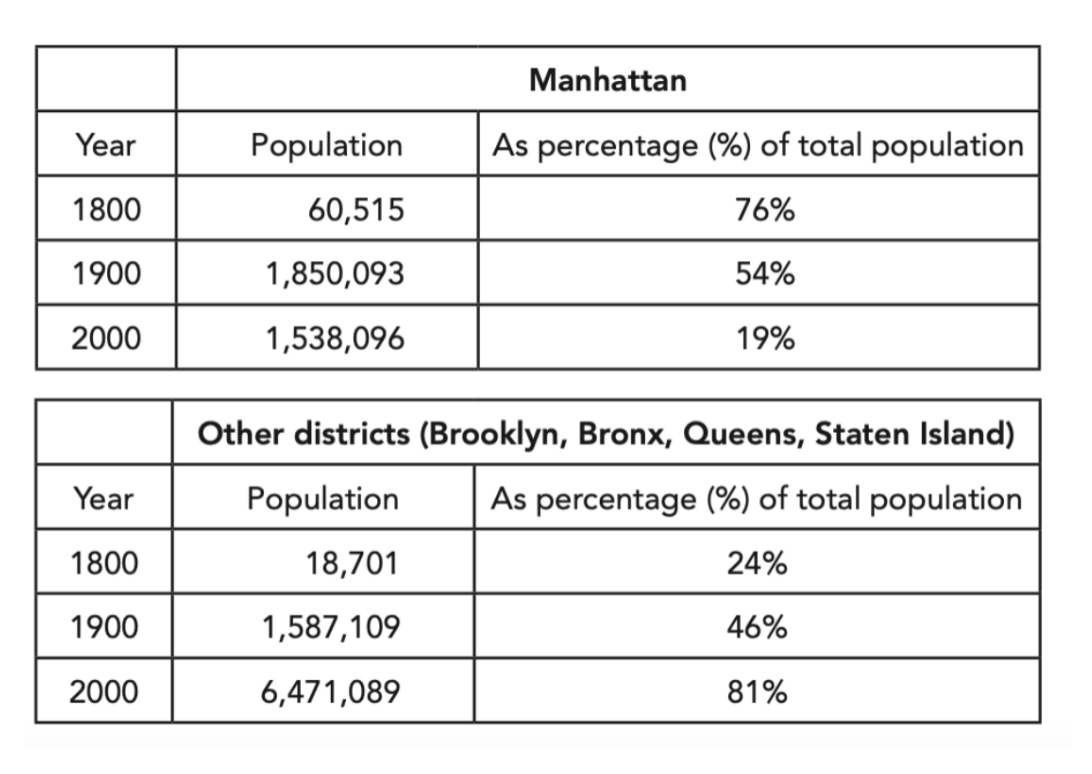
The first table below shows changes in the total population of New York City from 1800 to 2000. The second and third tables show changes in the population of the five districts of the city (Manhattan, Brooklyn, Bronx, Queens, Staten Island) over the same period.
Summarise the information by selecting and reporting the main features, and make comparisons where relevant.
Student answer (Band 5.5)
In this tables we can see the changes of population in new york city between the 19th century to the begining of the 21st century.As we can see the population in 1800 is around 80000 people,76% is locataed in Manhattan while the reste is in rest of the cities like Brooklyn Bronx.But in the early 1900 we can see that the population in New York has become [redacted phone] its a huge developpment but what is more intresting that only half of the population is in Manhattan and the other half is in the other cities.in the early 2000 the population in New york has become 8 million but the funny thing that right now Manhattan population is decreasing and only 19% of the major population of New York. while Brooklyn ,Bronx and the others have the lion part of the population.
AI examiner evaluation
| Criterion | Band |
|---|---|
| Task Achievement / Task Response | 5.5 |
| Coherence and Cohesion | 5.0 |
| Lexical Resource | 5.5 |
| Grammatical Range and Accuracy | 5.0 |
| Overall | 5.5 |
Task Achievement / Task Response: Band 5.5
You identify the main overall pattern: New York’s population grew substantially, while Manhattan’s share fell and the other districts’ share rose. The figures you include are broadly accurate, including the 1800 share and the 1900 total. However, the response is under the required 150 words, and several key comparisons are only briefly stated. For example, Manhattan’s population actually peaked at 1,850,093 in 1900 before declining to 1,538,096 in 2000, while the other districts grew to 6,471,089; these absolute changes would strengthen the summary. The overview is also informal and imprecise (“the funny thing”), and the districts are not all named. Develop the main trends with clearer, more complete comparisons.
Coherence and Cohesion: Band 5.0
The response follows a broadly chronological order, moving from 1800 to 1900 and then 2000, so the reader can follow the time sequence. However, it is presented as one long paragraph, with little separation between an overview and supporting details. Linking is repetitive, especially the repeated use of “but” and “while,” and some transitions do not clearly show how the figures relate. The final sentence adds a comparison but does not provide a clear concluding overview. Organise the response into an introduction, a concise overview, and one or two detail paragraphs. Use linking expressions selectively and make references such as “the other districts” clear throughout.
Lexical Resource: Band 5.5
You use some relevant vocabulary for describing change, including “population,” “decreasing,” and “the other half,” and the main message remains understandable. However, the range is limited and several choices are informal or imprecise for an academic report: “the funny thing,” “huge development,” and “the lion part” do not suit this task. There are also noticeable spelling errors, such as “begining,” “locataed,” “reste,” “developpment,” and “intresting,” which reduce accuracy. Use precise reporting language such as “increased,” “accounted for,” “declined,” and “the majority.” Check spelling carefully and avoid conversational expressions when describing statistical trends.
Grammatical Range and Accuracy: Band 5.0
You attempt to connect ideas in longer sentences, for example by using “while” to contrast Manhattan with the other districts. However, sentence structures are often faulty or run together, and punctuation does not reliably mark sentence boundaries. The opening begins “In this tables,” and the sentence starting “As we can see” continues through several clauses without clear stops. There are also errors with articles, agreement, and sentence construction, as in “the population in New York has become 3.437.202 its a huge development.” These problems sometimes make relationships between ideas difficult to follow. Practise writing shorter, complete sentences first, then add controlled comparisons using “whereas” or “while,” with accurate punctuation and consistent past-tense forms.
See this exact question answered at other band scores. The same prompt compared across bands.
Browse more IELTS Writing model answers or get your own writing scored by the same AI examiner.