Band 6.0 IELTS Writing Task 1 Model Answer
Overall Band Score: 6.0 · Cambridge IELTS 20 · 2026-11-09
IELTS Writing Task 1 question
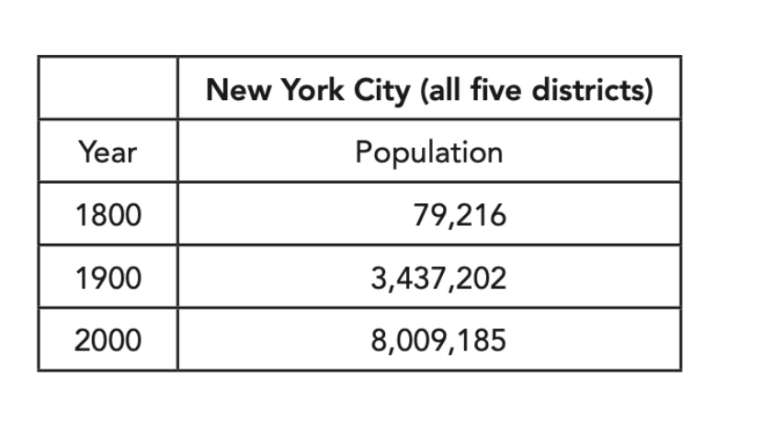
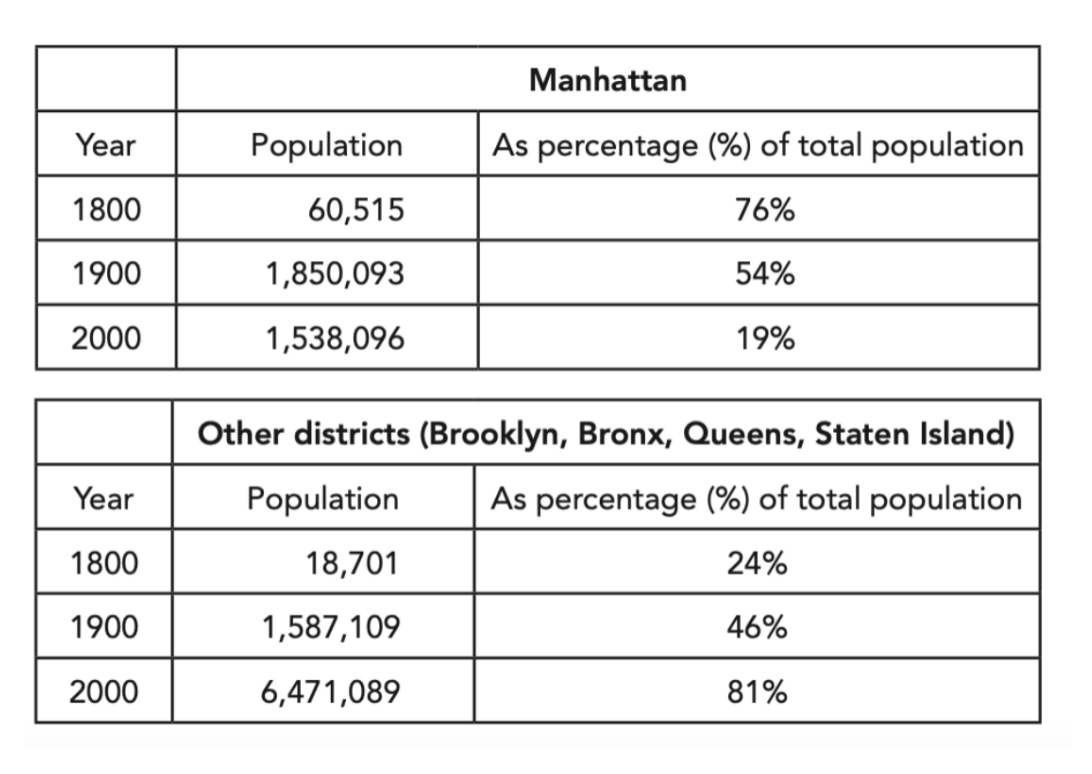
The first table below shows changes in the total population of New York City from 1800 to 2000. The second and third tables show changes in the population of the five districts of the city (Manhattan, Brooklyn, Bronx, Queens, Staten Island) over the same period.
Summarise the information by selecting and reporting the main features, and make comparisons where relevant.
Student answer (Band 6.0)
The data demonstrates the variation in the overall population of New York City between 1800 and 2000.
Overall, The residents of New York City grew astronomically higher every century. Comparatively, Manhattan's total population decreased over the past three centuries especially the 20th century, whereas the other four district grew rapidly over the three centuries having 18th century being the lowest population for the latter districts.
The rate of New York City's inhabitants over the last three centuries has been grown increasingly fast. From 18th Century to the 19th century, the population went from being below 100k to 3 million and in the 2000s, it went up to 8 million people. Moving on to the Manhattan district, it was the main populated city in the 1800s consisting of 76% of the total population and in 1900 it became half of the total population, recording the lowest in percentage in the 2000s having only 19% of total popluation.
The other districts of New york (Brooklyn, Bronx, Queens, Staten Island) comprised of 18,701 inhabitants, having 24 percent of total population which can be considered really low compared to Manhattan in the 18th Century and in 19th century the population grew in the millions having 1.5 million residents, which was 46% of total population and it grew even more in the 20th century having 6.4 million residents and sharing 81 percent of the total population of New york.
AI examiner evaluation
| Criterion | Band |
|---|---|
| Task Achievement / Task Response | 6.0 |
| Coherence and Cohesion | 6.0 |
| Lexical Resource | 5.5 |
| Grammatical Range and Accuracy | 5.5 |
| Overall | 6.0 |
Task Achievement / Task Response: Band 6.0
You cover the main changes and provide a clear overview: the city’s population rose substantially, while Manhattan’s share fell and the other districts’ share increased. The figures you select are generally accurate, including Manhattan’s 76% in 1800 and 19% in 2000, and the other districts’ 81% share in 2000. However, some comparisons are less fully developed. For example, you say Manhattan’s population “decreased over the past three centuries,” but it first rose sharply from 60,515 to 1,850,093 before falling to 1,538,096. Clarifying this absolute-population trend would make the account more precise. Also distinguish the city’s total population from the districts’ proportions, and avoid describing 1900 as “half” when the table gives 54%.
Coherence and Cohesion: Band 6.0
The response has a recognisable structure: an introduction, an overview, and separate paragraphs covering Manhattan and the other districts. This makes the main comparisons reasonably easy to follow, and transitions such as “Moving on to” and “whereas” help connect ideas. At times, however, the progression is less clear because information is repeated or expressed in a confusing way. The overview says Manhattan’s population decreased across the whole period, while the later paragraph shows that it increased greatly before declining. Phrases such as “the rate … has been grown increasingly fast” also make the relationship between the figures difficult to follow. Organise the details consistently by year or by population share versus absolute population, and use clearer references to the figures.
Lexical Resource: Band 5.5
You use a reasonable range of vocabulary for describing change, including “grew,” “decreased,” “comprised,” and “sharing,” and the reader can understand the main trends. Some choices are imprecise or unnatural for a data report, however. “Grew astronomically higher” is an awkward collocation, and “main populated city” does not accurately express that Manhattan had the largest share. There are also informal or inconsistent forms such as “popluation,” “pop,” and “New york.” Aim for precise terms such as “population,” “accounted for,” and “proportion,” and check spelling and capitalisation. More accurate collocations would make your comparisons sound clearer and more appropriately academic.
Grammatical Range and Accuracy: Band 5.5
You attempt a mix of simple and complex sentences, including contrast clauses with “whereas” and time clauses beginning “From … to …”. Most of the meaning remains understandable, but some grammatical errors affect clarity. For example, “the population … has been grown” uses an incorrect verb form; write “has grown” or “grew.” In “the other four district grew,” the noun needs to be plural, and “Manhattan's total population decreased … whereas the other four district grew” needs more controlled parallel phrasing. Capitalisation and punctuation are also inconsistent, as in “Overall, The residents” and “New york.” Review verb forms, subject–verb agreement, articles, and sentence boundaries while retaining your attempts at complex structures.
See this exact question answered at other band scores. The same prompt compared across bands.
Browse more IELTS Writing model answers or get your own writing scored by the same AI examiner.