Band 5.5 IELTS Writing Task 1 Model Answer
Overall Band Score: 5.5 · Cambridge IELTS 20 · 2026-11-10
IELTS Writing Task 1 question
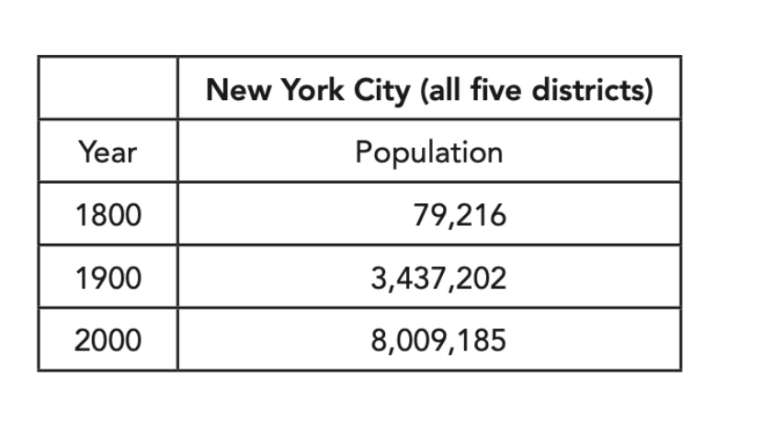
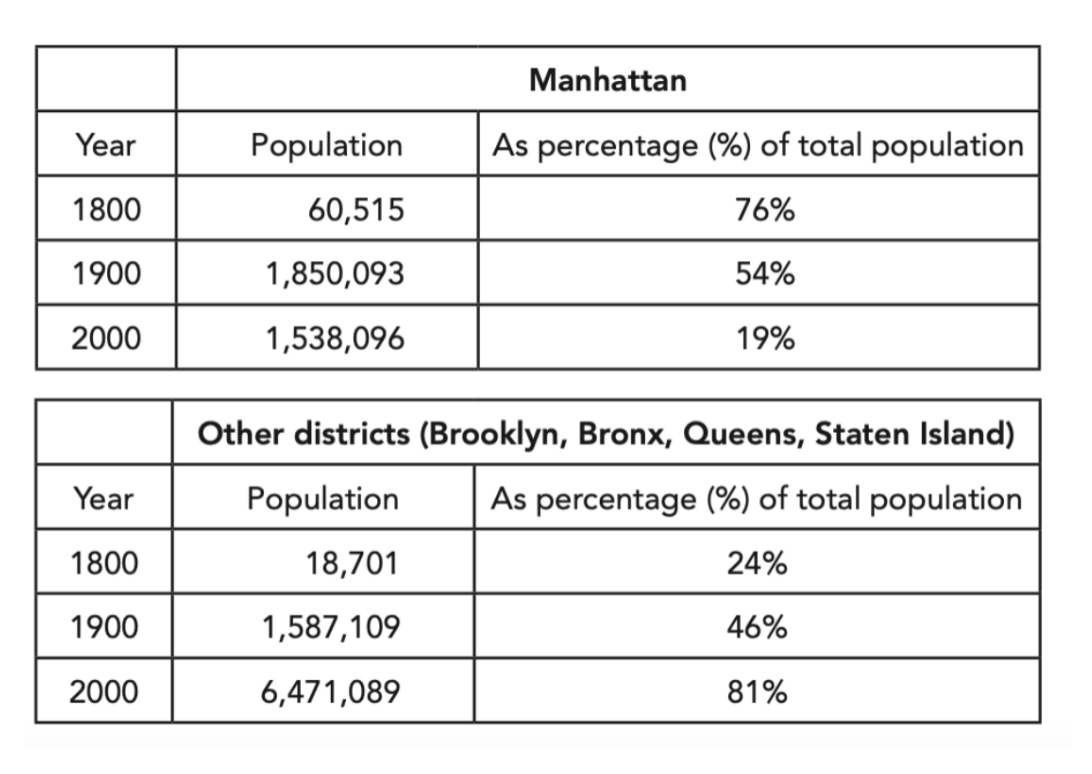
The first table below shows changes in the total population of New York City from 1800 to 2000. The second and third tables show changes in the population of the five districts of the city (Manhattan, Brooklyn, Bronx, Queens, Staten Island) over the same period.
Summarise the information by selecting and reporting the main features, and make comparisons where relevant.
Student answer (Band 5.5)
These tables elaborates the total population comparison of New York City and it's all five districts from the year 1800 to 2000. First tables shows us the total population change in the New York City from 1800 to 2000.In the year 1800, The total population of the New York City was 79,216, In 1900 that number recorded as 3,437,202 and Finally in the year 2000, The total Population of the City was 8,009,185 with a significant increase in total number. In the total Population of The New York City there is a major contribution of Manhattan's total Population percentage i.e 76%, 54% and 19% for the years 1800, 1900 and 2000 respectively.
The Other remaining districts (Brooklyn, Bronx, Queens, Staten Island) recorded their cumulative total Population percentages as 24%, 46% and 81% for the years 1800, 1900 and 2000 respectively. This gives us a clear picture of which district of the New York City is most Populous and which has major contribution in the total Population.
AI examiner evaluation
| Criterion | Band |
|---|---|
| Task Achievement / Task Response | 5.0 |
| Coherence and Cohesion | 6.0 |
| Lexical Resource | 5.5 |
| Grammatical Range and Accuracy | 5.0 |
| Overall | 5.5 |
Task Achievement / Task Response: Band 5.0
You report the overall population figures accurately and identify the key shift in the districts’ shares: Manhattan’s proportion falls from 76% to 19%, while the other districts’ combined share rises from 24% to 81%. However, the response only partly summarises the tables. It does not clearly state the overall pattern that New York City’s population grew substantially across the period, and it gives no district population figures or comparison showing that Manhattan’s population rose by 1900 before declining by 2000. The final claim about which district is most populous is also unclear, since the table groups four districts together rather than giving their individual populations. A fuller overview and more selective comparisons would make the main features clearer.
Coherence and Cohesion: Band 6.0
The response has a generally understandable two-paragraph arrangement: the first discusses the city total and Manhattan’s shares, while the second covers the other districts. Time markers such as “In the year 1800,” “In 1900,” and “for the years 1800, 1900 and 2000” help readers follow the data. However, the progression is somewhat mechanical, with repeated references to “total Population” and a long first paragraph that combines several figures without a clear overview. The concluding sentence does not develop the comparison and its reference to “which district” is unclear because the figures are combined for four districts. Organise the response around an overview followed by the most important comparisons, and use clearer referencing between ideas.
Lexical Resource: Band 5.5
You use some relevant task vocabulary, including “significant increase,” “cumulative,” “percentage,” and “most populous,” and the main data remain understandable. However, the range is limited and several expressions are awkward or imprecise for describing tables. For example, “These tables elaborates the total population comparison” is not a natural way to introduce the information, and “major contribution” does not clearly describe a population share. Repetition of “total Population” also makes the account less fluent. Aim for precise collocations such as “the city’s population,” “accounted for,” and “the combined population of the other districts.” More varied, accurate phrasing would improve clarity without requiring unnecessarily complex vocabulary.
Grammatical Range and Accuracy: Band 5.0
The response communicates its main points, but grammatical control is inconsistent, and the sentence structures are mostly simple or joined by basic connectors. There are errors in agreement and articles, as in “These tables elaborates” and “First tables shows us”; the verb should agree with the plural subject, and the article use needs correction. The opening phrase “New York City and it's all five districts” also has an incorrect possessive form and an unclear grammatical relationship. Several sentences run together or use commas where full stops are needed, particularly in the sequence beginning “In the year 1800.” These errors sometimes make the information harder to process. Practise accurate sentence boundaries and a wider range of controlled comparison structures.
See this exact question answered at other band scores. The same prompt compared across bands.
Browse more IELTS Writing model answers or get your own writing scored by the same AI examiner.