Band 4.5 IELTS Writing Task 1 Model Answer
Overall Band Score: 4.5 · Cambridge IELTS 20 · 2026-11-10
IELTS Writing Task 1 question
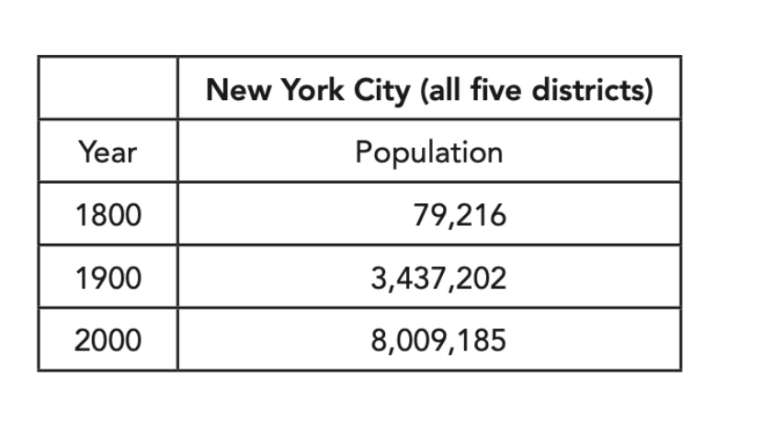
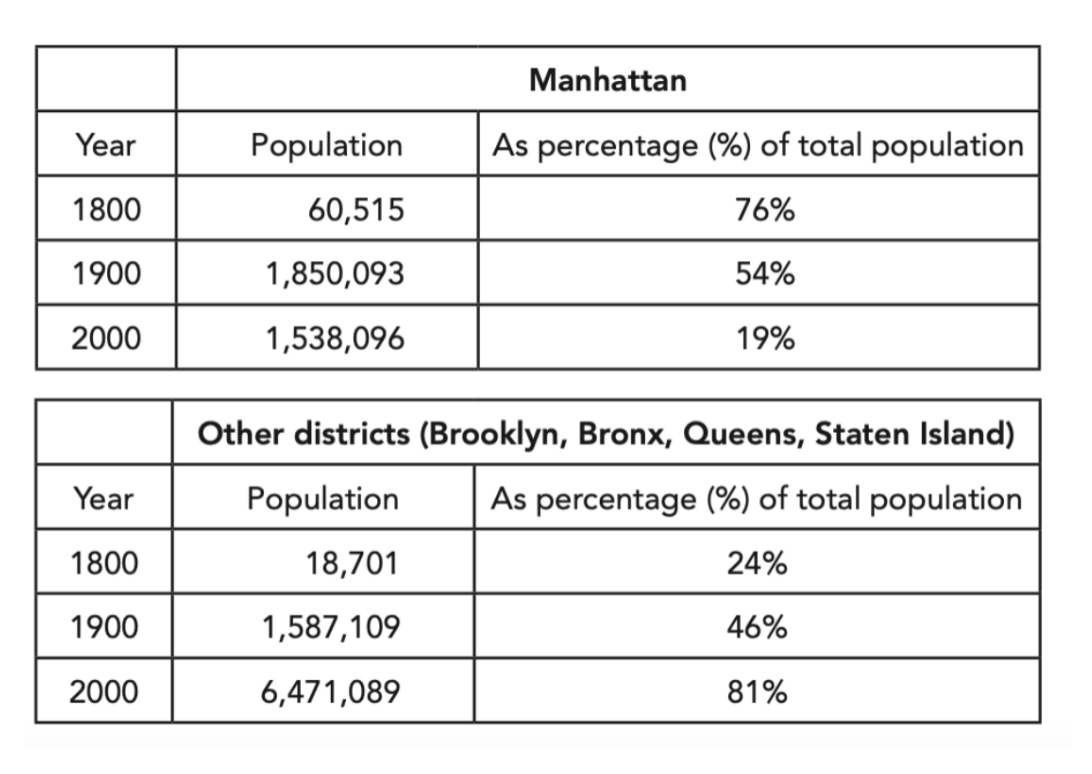
The first table below shows changes in the total population of New York City from 1800 to 2000. The second and third tables show changes in the population of the five districts of the city (Manhattan, Brooklyn, Bronx, Queens, Staten Island) over the same period.
Summarise the information by selecting and reporting the main features, and make comparisons where relevant.
Student answer (Band 4.5)
the table represents the change in the Total population of new york city from the 1800 to 2000 involving a second and third table showing the five districts inthe city
overall in the 1800 the population was 79216 which later serged in the 1900 with a population of about [redacted phone] followed by the 2000 whoes population was at its peek with about [redacted phone].
in the second and third table in the 1800 the percentage of Total population was at76percent with about 60515 inhabitants that took a down ward turn with a drop in the population percentage to 24pecent and about 18701 inhabitants however in the 1900
AI examiner evaluation
| Criterion | Band |
|---|---|
| Task Achievement / Task Response | 4.0 |
| Coherence and Cohesion | 4.5 |
| Lexical Resource | 5.0 |
| Grammatical Range and Accuracy | 4.5 |
| Overall | 4.5 |
Task Achievement / Task Response: Band 4.0
You identify the overall rise in New York City’s population and report several figures accurately, including 79,216 in 1800 and 8,009,185 in 2000. You also note Manhattan’s 76% share in 1800. However, the response is incomplete: it stops while introducing 1900, so it does not report the key shift by 2000, when Manhattan’s share fell to 19% and the other districts accounted for 81%. The 1900 total is also misstated as about 343,720 rather than 3,437,202. The overview is limited, and the main comparisons are not developed. The response is 97 words, below the required 150; this leaves important information unreported.
Coherence and Cohesion: Band 4.5
There is a basic attempt to organise the response, beginning with an introduction, followed by an overall statement and then details about the district tables. Linking expressions such as “overall,” “which later,” and “however” show an effort to connect information. However, the progression is difficult to follow because the final sentence breaks off at “however in the 1900,” and the comparison is left unfinished. The long, loosely connected sentences also make relationships between figures unclear. Use separate paragraphs for the overview and selected comparisons, and complete each comparison before moving on. Clear sequencing across all three years would make the report easier to understand.
Lexical Resource: Band 5.0
The response uses some relevant vocabulary for describing data, including “population,” “percentage,” “inhabitants,” “drop,” and “peak.” These choices show awareness of the task’s subject. However, the range is limited and several expressions are inaccurate or awkward, such as “serged” and “took a down ward turn.” Capitalisation and spelling are also inconsistent, for example “Total” and “new york city.” These errors sometimes make the intended meaning less clear, particularly when describing changes. Aim for precise, conventional data-reporting language and check spelling and word forms. For example, describe a figure as “rose sharply” or a share as “declined,” rather than using informal or unclear phrasing.
Grammatical Range and Accuracy: Band 4.5
You attempt to combine information using clauses, as in “which later … followed by,” and you use time references to distinguish years. However, sentence structures are often incomplete or difficult to control. The opening is a fragment, and the final clause ends without completing its meaning. In “the 2000 whoes population was at its peek,” the relative clause is not formed correctly; “the population in 2000 reached its peak” would be clearer. Articles, prepositions, and punctuation are also inconsistent, and several clauses run together without clear sentence boundaries. Practise writing complete sentences with a clear subject and verb, then use a small range of accurate comparison structures.
See this exact question answered at other band scores. The same prompt compared across bands.
Browse more IELTS Writing model answers or get your own writing scored by the same AI examiner.