Band 4.5 IELTS Writing Task 1 Model Answer
Overall Band Score: 4.5 · Cambridge IELTS 20 · 2026-11-11
IELTS Writing Task 1 question
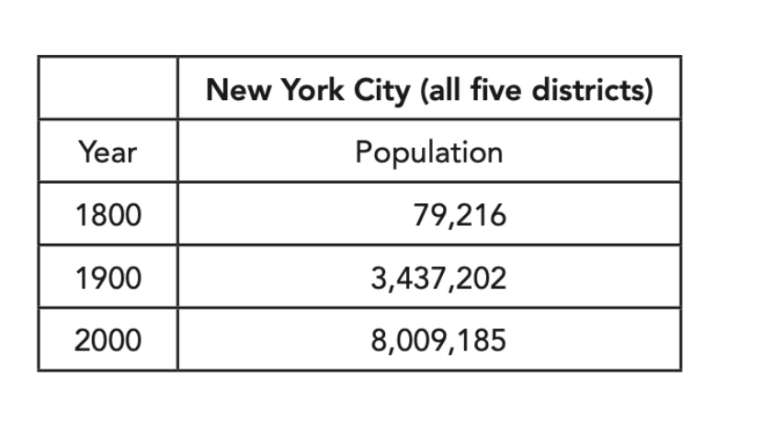
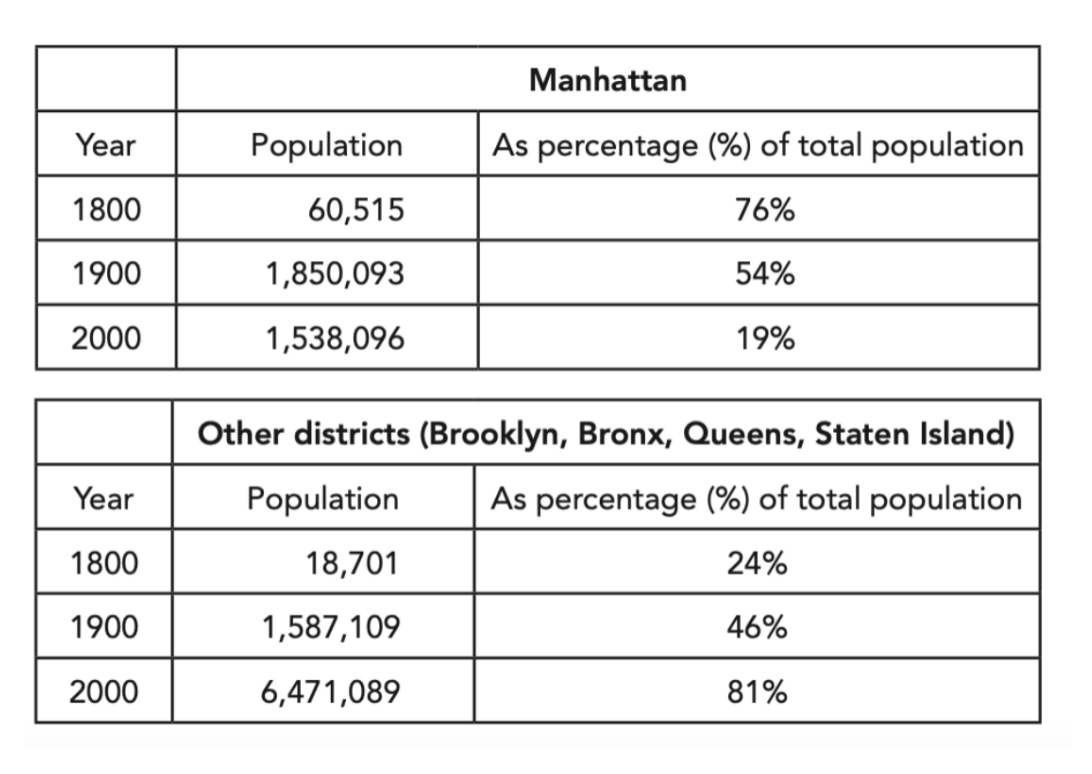
The first table below shows changes in the total population of New York City from 1800 to 2000. The second and third tables show changes in the population of the five districts of the city (Manhattan, Brooklyn, Bronx, Queens, Staten Island) over the same period.
Summarise the information by selecting and reporting the main features, and make comparisons where relevant.
Student answer (Band 4.5)
The first table gives information about the total number of number of people living in New York City in 1800 to 2000 while the other tables shows the difference in the number of people of the five districts of the city over same period. Overall, in all the districts, the largest population is 2000 while least population is in 18000.
To begin, in 1800, there is a total pupulation of 79,219 accounting to 76% of Manhattan and other districts accounting to 24% which is a total population of 18,701. In 1900 there is total population of 3,437,202.
AI examiner evaluation
| Criterion | Band |
|---|---|
| Task Achievement / Task Response | 3.5 |
| Coherence and Cohesion | 5.0 |
| Lexical Resource | 5.0 |
| Grammatical Range and Accuracy | 5.0 |
| Overall | 4.5 |
Task Achievement / Task Response: Band 3.5
The response identifies the topic and gives a brief overall statement, but it reports only a small part of the tables and does not provide a meaningful summary of the main changes. The claim that the largest population was in 2000 and the smallest in “18000” is unclear and does not compare Manhattan with the other districts. Some figures are also misreported: the 1800 city total was 79,216, not 79,219, and 76% refers to Manhattan’s share, not the total population. The response stops after giving the 1900 city total, omitting the 2000 figures and the key shift in population towards the other districts. It is also 53 words below the required minimum. Include an overview and accurate comparisons across all three years.
Coherence and Cohesion: Band 5.0
There is a basic attempt to organise the response: an opening sentence introduces the tables, an overview follows, and “To begin” signals the start of detail. However, the progression is not sustained. The response moves from a general claim about district populations to 1800 figures and then the 1900 total, without completing the comparison or moving through the data in a clear sequence. The opening also repeats “number of,” and the overview is difficult to interpret, so the reader cannot easily follow the intended point. Use separate paragraphs for the overview and the main comparisons, and organise the details consistently by year or by Manhattan versus the other districts. Linking phrases should clarify relationships, not merely announce a new point.
Lexical Resource: Band 5.0
The response uses some relevant task vocabulary, including “total population,” “districts,” and “accounting to,” so the topic is generally recognisable. However, the range is limited and several choices or forms are inaccurate: “pupulation” is misspelled, “accounting to” is not the natural phrase for describing a share, and “the difference in the number of people” is vague for changes over time. Repetition of “population” and “number of” also limits precision. Use terms such as “population,” “proportion,” “share,” and “increased/decreased” accurately, and vary the wording where possible. Careful proofreading would correct spelling and help the reader understand the figures without hesitation.
Grammatical Range and Accuracy: Band 5.0
The response communicates its general subject through mostly simple sentence patterns, but control is uneven and the range is limited. For example, “the other tables shows” has a subject–verb agreement error, while “in 1800 to 2000” uses an incorrect time construction. The sentence beginning “Overall” is also grammatically awkward, particularly “the largest population is 2000 while least population is in 18000,” which makes the comparison unclear. There is an attempt to use a longer sentence with “while,” but the relationships between its clauses are not expressed accurately. Practise clear comparative structures, such as “The population rose from … to …,” and check agreement, articles, and prepositions. Short, accurate sentences are preferable to longer sentences whose meaning becomes uncertain.
See this exact question answered at other band scores. The same prompt compared across bands.
Browse more IELTS Writing model answers or get your own writing scored by the same AI examiner.