Band 5.0 IELTS Writing Task 1 Model Answer
Overall Band Score: 5.0 · Cambridge IELTS 20 · 2026-11-11
IELTS Writing Task 1 question
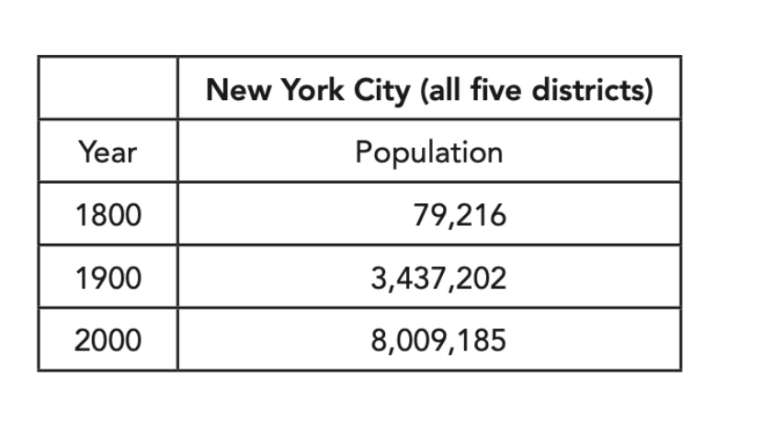
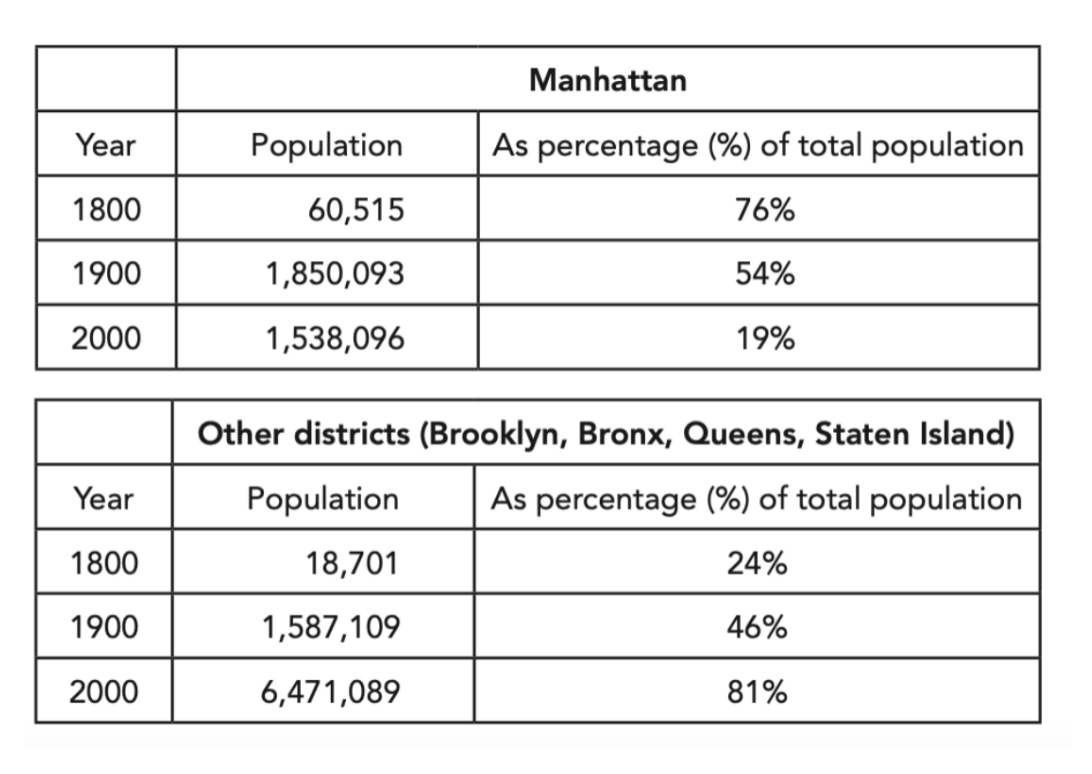
The first table below shows changes in the total population of New York City from 1800 to 2000. The second and third tables show changes in the population of the five districts of the city (Manhattan, Brooklyn, Bronx, Queens, Staten Island) over the same period.
Summarise the information by selecting and reporting the main features, and make comparisons where relevant.
Student answer (Band 5.0)
The first table illustrates that total population of New York City are change from 1800 to 2000. The other two tables represents the changes in population of five different areas of the city over the time.
overall, we can see the population change from 1800 to 2000 and we compare the Manhattan population with other districts population over the same time.
First of all, the population of five districts of New York City is rapidly increase year by year. We see in 1800 and its 79,216 only but in 2000 it's increase to [redacted phone]. The population in Manhattan is significally increase but at the end it decline a little bit.
Secondly, the other four districts population are increase rapidly. It is start from 18,701 and grow to the 6,471,089. The percentage are 24% in 1800 but in 2000 it becomes 81%. In Manhattan
AI examiner evaluation
| Criterion | Band |
|---|---|
| Task Achievement / Task Response | 5.0 |
| Coherence and Cohesion | 4.5 |
| Lexical Resource | 5.0 |
| Grammatical Range and Accuracy | 5.0 |
| Overall | 5.0 |
Task Achievement / Task Response: Band 5.0
You identify the broad trends: New York City’s population grew substantially, while Manhattan’s share fell and the other districts’ share rose. You also include several accurate figures, such as the total of 79,216 in 1800 and 8,009,185 in 2000, and the other districts’ 81% share in 2000. However, the response only partially covers the tables: it omits the important 1900 figures and does not clearly report that Manhattan’s population peaked in 1900 before falling by 2000. The overview is vague and repeats that the population changed rather than summarising the main contrast. The response is also 7 words below the required minimum. Develop the overview and compare all three years more clearly.
Coherence and Cohesion: Band 4.5
There is a basic attempt to organise the response with an introduction, an overview, and sequencing phrases such as “First of all” and “Secondly.” This gives the reader some sense of structure. However, progression is limited: the overview largely repeats the introduction, and the final paragraph stops abruptly at “In Manhattan,” leaving the comparison unfinished. Connections between ideas are often mechanical, and references such as “it” in “it’s increase” are not always clear. Group the information into a complete overview and focused comparisons, and use linking phrases to show contrasts between Manhattan and the other districts rather than simply listing points.
Lexical Resource: Band 5.0
You use some relevant task vocabulary, including “total population,” “districts,” “percentage,” and “decline,” so the main subject is generally understandable. However, the range is limited and several word choices or forms are inaccurate, including “significally,” “rapidly increase,” and “it becomes 81%.” Repetition of “population,” “increase,” and “change” also makes the account less precise. Choose verbs that describe the data accurately, such as “rose,” “grew,” “accounted for,” and “fell,” and use “share” when discussing percentages. Check spelling and collocations so that the reader can follow the comparisons without having to interpret awkward phrases.
Grammatical Range and Accuracy: Band 5.0
The response mainly uses short, simple statements and attempts a few longer structures, but grammatical errors are frequent and sometimes make the meaning difficult to follow. For example, “total population … are change” has problems with agreement and verb form, while “the other two tables represents” also has subject–verb disagreement. “It is start from 18,701” shows an incorrect verb construction, and “the population … is rapidly increase” combines incompatible forms. Articles and sentence punctuation also need attention, as in the lowercase “overall” after a full stop. Practise forming accurate past-tense comparisons, for example, “The total population rose from … to …,” before attempting more complex sentences.
See this exact question answered at other band scores. The same prompt compared across bands.
Browse more IELTS Writing model answers or get your own writing scored by the same AI examiner.