Band 6.0 IELTS Writing Task 1 Model Answer
Overall Band Score: 6.0 · Cambridge IELTS 20 · 2026-11-11
IELTS Writing Task 1 question
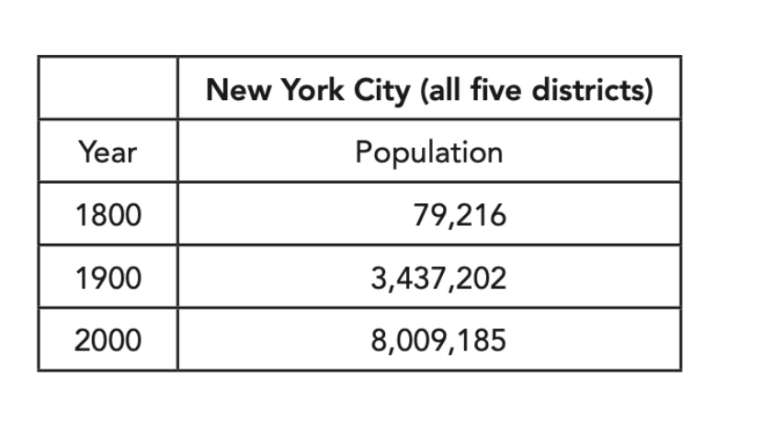
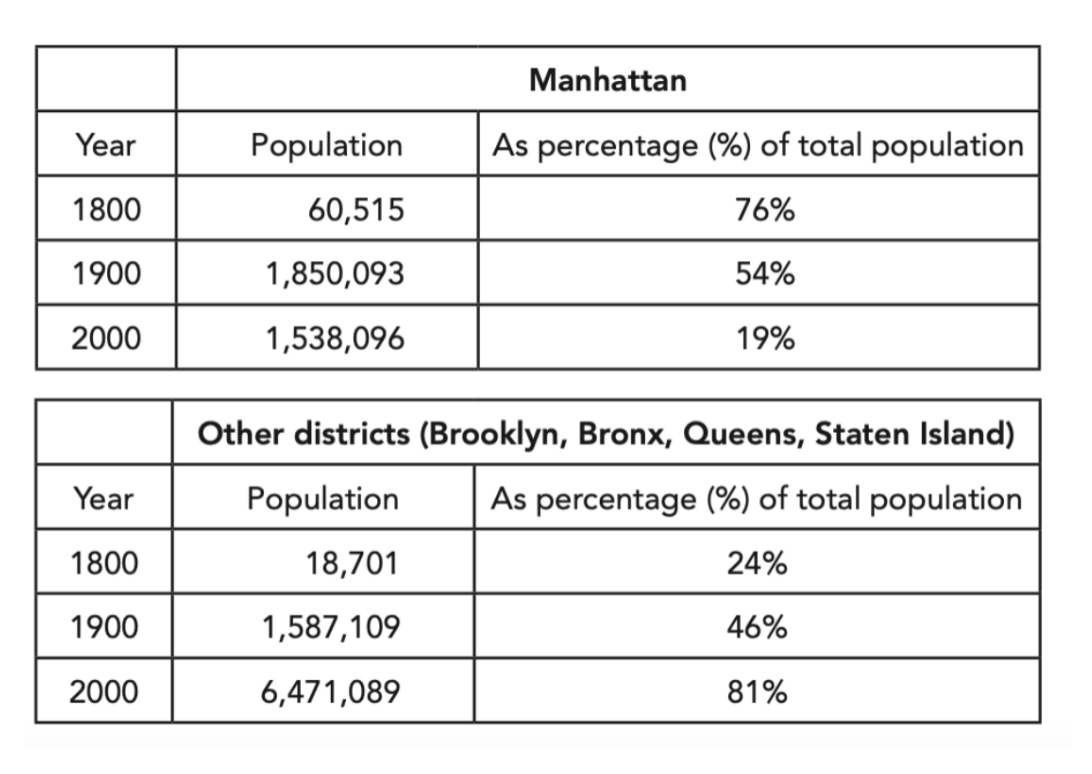
The first table below shows changes in the total population of New York City from 1800 to 2000. The second and third tables show changes in the population of the five districts of the city (Manhattan, Brooklyn, Bronx, Queens, Staten Island) over the same period.
Summarise the information by selecting and reporting the main features, and make comparisons where relevant.
Student answer (Band 6.0)
The first table gives information about total residents of New York city from 1800 to 2000, where second and third table show, how the population of the New York city distributed among Manhattan, Brooklyn, Bronx, Queens and Staten Island over the same time period.
In 1800, 79216 people were living in New York where 76% of the polulation centered in Manhattan and remained 18,701 lived in other districts. The population increased to 3,437,202 in New York, where 1,850,093(54%) people were Manhattan residents and 46% lived in other districts in year 1900.
Until 2000 New York had 8,009,185 residents, 19%(1,538,096)of them were lived in Manhattan and 6,471,089(81%) lived in other districts.
In summary, residents of New York city has been increased throught the time period. Noticebly, Most of the population of New York city have been lived in Manhattan city from 1800 to 1900 but after 1900, residents preferred to live in Brooklyn, Bronx, Queens and Staten Island with 81% population in the end of 2000 year.
AI examiner evaluation
| Criterion | Band |
|---|---|
| Task Achievement / Task Response | 6.0 |
| Coherence and Cohesion | 6.0 |
| Lexical Resource | 5.5 |
| Grammatical Range and Accuracy | 5.5 |
| Overall | 6.0 |
Task Achievement / Task Response: Band 6.0
You report the main figures for all three years and accurately show the shift in population share: Manhattan falls from 76% to 19%, while the other districts rise from 24% to 81%. The overall increase in New York’s population is also identified, so the response addresses the task and includes a relevant overview. However, the overview’s claim that most residents lived in Manhattan “from 1800 to 1900” is imprecise: Manhattan held a majority in both years, but its population actually declined between 1900 and 2000, even as the city total grew. The tables group the four outer districts together, so avoid implying that the data show residents’ preferences. A clearer overview of the contrasting trends would make the key features more fully developed.
Coherence and Cohesion: Band 6.0
The response has a clear overall sequence: it introduces the tables, reports the figures for 1800 and 1900, then covers 2000 and ends with a summary. This makes the information generally easy to follow. Some connections are less smooth, however. The opening sentence is long and its link between the tables is awkward, while “In summary” repeats information rather than adding a concise synthesis of the main contrast. The phrase “where” is also used repeatedly to connect clauses, which makes the progression feel mechanical. Grouping the data into a more purposeful comparison—overall growth alongside Manhattan’s declining share and the other districts’ rise—would strengthen cohesion and paragraph development.
Lexical Resource: Band 5.5
You use relevant vocabulary for describing population data, including “residents,” “population,” “increased,” and “percentage,” and the meaning is generally clear. However, some word choices and collocations are inaccurate or unnatural, such as “population centered in Manhattan,” “remained 18,701 lived,” and “residents preferred to live.” The last phrase suggests a preference that the tables do not establish. There are also spelling errors in “polulation,” “Noticebly,” and “throught,” and “New York city” is not consistently capitalised. Aim for precise, neutral reporting language such as “accounted for,” “the remaining population,” and “the share living in the other districts.”
Grammatical Range and Accuracy: Band 5.5
You attempt both simple and more complex sentence forms, including clauses linked with “where” and a concluding sentence beginning “In summary.” The main figures and comparisons remain understandable, but some grammatical errors recur. For example, “where second and third table show” needs articles and plural agreement, and “19%(1,538,096)of them were lived” has faulty word order and verb construction. In the overview, “residents … has been increased” has an agreement and verb-form problem, while “have been lived” is not a correct passive construction. Review articles, subject–verb agreement, and the difference between active and passive forms. More accurate control of these patterns would make your varied sentences clearer.
See this exact question answered at other band scores. The same prompt compared across bands.
Browse more IELTS Writing model answers or get your own writing scored by the same AI examiner.