Band 5.0 IELTS Writing Task 1 Model Answer
Overall Band Score: 5.0 · Cambridge IELTS 20 · 2026-11-11
IELTS Writing Task 1 question
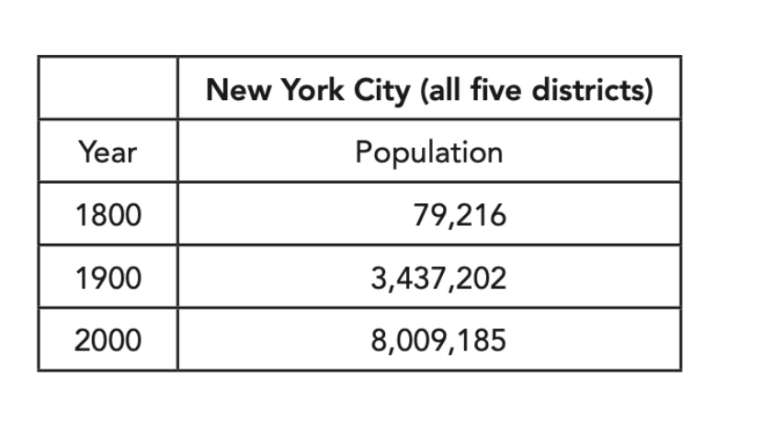
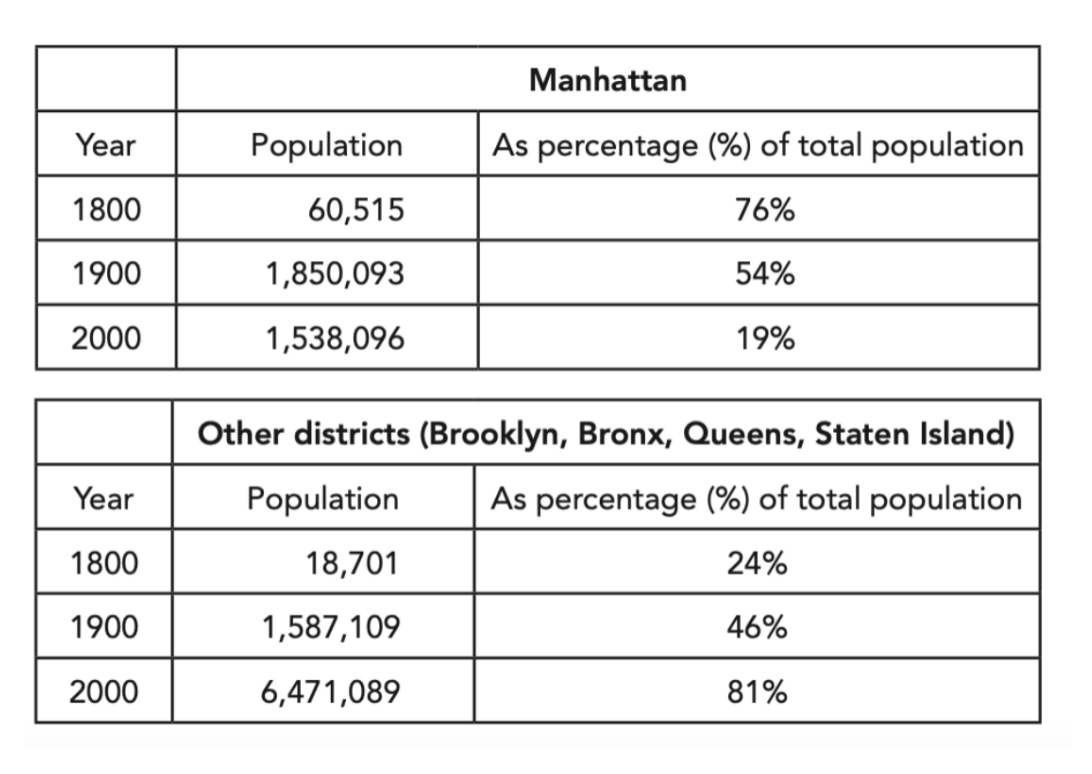
The first table below shows changes in the total population of New York City from 1800 to 2000. The second and third tables show changes in the population of the five districts of the city (Manhattan, Brooklyn, Bronx, Queens, Staten Island) over the same period.
Summarise the information by selecting and reporting the main features, and make comparisons where relevant.
Student answer (Band 5.0)
In the first table, we can see how the changes happen in the population in NEW YORK city of USA. The second and third table show the population change in each district. To start with, in 1800, the total population label in first tabel is seventy nine thousand two hundred and sixteen. On the other hand, the population of Manhattan is 60,515 which is lower than NY. While talking about other districts, total population is 18,701, which is quite low as compare to New York and Manhattan. However, between 1800 to 1900, the population of NY and Manhattan rise sharply. In 2000, Manhattan's population decrease by 19% however, New york population rise sharply from 3,437,202 to 8,009,185. In contrast, the population of other districts also increase wisely from 1,587,109 to 6,471,089 which is around 81% of their total population. In contrast with all, the population of both New York and other districts rise in 1900 but manhattan's population did not.
AI examiner evaluation
| Criterion | Band |
|---|---|
| Task Achievement / Task Response | 5.0 |
| Coherence and Cohesion | 4.5 |
| Lexical Resource | 5.0 |
| Grammatical Range and Accuracy | 5.5 |
| Overall | 5.0 |
Task Achievement / Task Response: Band 5.0
You identify the broad rise in New York City’s population and the shift in the population share from Manhattan to the other districts. However, the response does not give a clear, accurate overview of the main pattern across all three years. The statement that Manhattan’s population “decrease by 19%” misreads the table: 19% is its share of the city total in 2000, while its population fell from 1,850,093 in 1900 to 1,538,096 in 2000. The final claim that Manhattan’s population “did not” rise in 1900 also conflicts with the figures, which show a sharp increase from 1800. Select the key comparisons and distinguish population totals from percentages to make the summary more complete and reliable.
Coherence and Cohesion: Band 4.5
The response follows a broadly chronological order and uses linking expressions such as “To start with,” “However,” and “In contrast.” This gives the reader some sense of how the figures relate. However, the progression is difficult to follow because the response moves between the city total, Manhattan, and the other districts without a consistent comparison structure. Several transitions are repetitive or do not express a genuine contrast, and the final sentence repeats earlier information while introducing an unclear claim. Organise the report into a brief overview followed by a paragraph comparing the figures in 1800 and 1900, then the changes by 2000. Clearer referencing would also help readers distinguish the city total from district figures.
Lexical Resource: Band 5.0
You use some relevant vocabulary for describing data, including “population,” “rise sharply,” “decrease,” and “in contrast,” so the topic is generally understandable. However, the range is limited and several choices are inaccurate or unnatural. “Increase wisely” does not describe a numerical rise, and “quite low as compare to” is an awkward comparison. Repeated use of “population” and “rise sharply” also makes the report less precise. Use terms such as “accounted for,” “share,” “declined,” and “grew substantially” to distinguish totals from proportions and describe trends more naturally. Check spelling and capitalisation of place names, including “New York” and “Manhattan,” for a more controlled presentation.
Grammatical Range and Accuracy: Band 5.5
You attempt a mixture of simple and more complex sentences, including clauses beginning with “While” and “However,” and the main topic is usually understandable. Nevertheless, errors in sentence construction and verb forms occur throughout. For example, “the population of NY and Manhattan rise sharply” needs past-tense agreement (“rose sharply”), while “the population of other districts also increase” should be “increased.” The opening phrase “we can see how the changes happen” is also awkwardly formed for a report about past data. Some sentences join contrasting ideas without clear punctuation, and “between 1800 to 1900” uses an incorrect preposition pattern. Practise accurate past-tense reporting and build complete, clearly punctuated comparison sentences.
See this exact question answered at other band scores. The same prompt compared across bands.
Browse more IELTS Writing model answers or get your own writing scored by the same AI examiner.