Band 5.5 IELTS Writing Task 1 Model Answer
Overall Band Score: 5.5 · Cambridge IELTS 20 · 2026-11-11
IELTS Writing Task 1 question
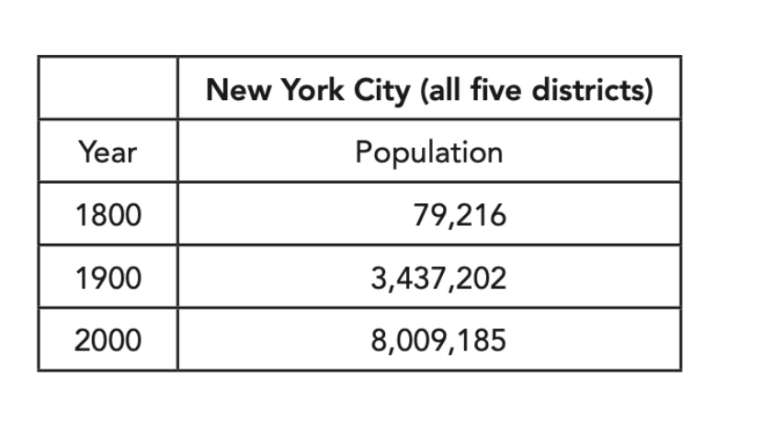
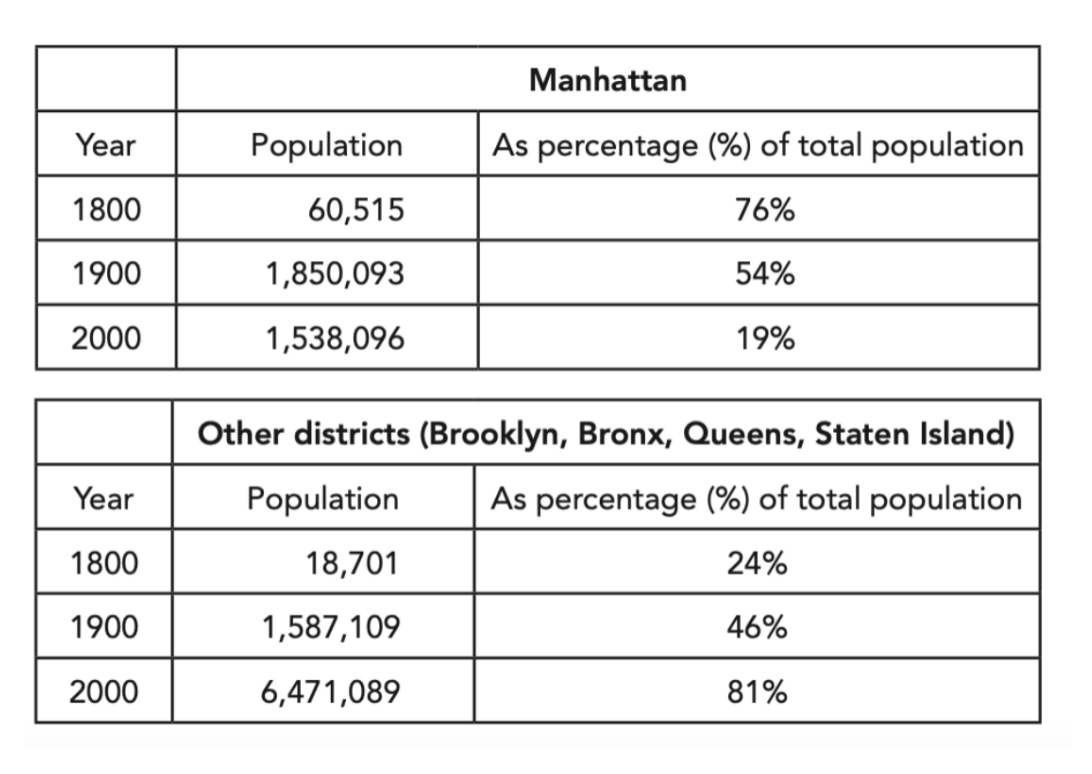
The first table below shows changes in the total population of New York City from 1800 to 2000. The second and third tables show changes in the population of the five districts of the city (Manhattan, Brooklyn, Bronx, Queens, Staten Island) over the same period.
Summarise the information by selecting and reporting the main features, and make comparisons where relevant.
Student answer (Band 5.5)
The first table illustrates changes in the toal population of New york from 1800 to 2000 while other two tables tells about the changes in the population of the five districts of the city.
overall, The population surged to 8,009,185 in 2000. and it was remained lower in 1800.
If we talk about the proportional changes in the each district of New York. Manhattan experienced the highest percentage of total population in 1800 constituting 76 percent of total population.in 1900, it reduced to 54 percent and in 2000, it has dropped to 19 percent.
on the other hand, other districts: Brooklyn, Bronx, Queens, and staten island had the highest percentage of total population, in 2000, estimating around 6,471,089. it was 46 percent in 1900 and in 1800 it was very low to 24 percent of overall population
overall, the total population of New York increased dracasically from 1800 to 2000
AI examiner evaluation
| Criterion | Band |
|---|---|
| Task Achievement / Task Response | 5.5 |
| Coherence and Cohesion | 5.0 |
| Lexical Resource | 5.5 |
| Grammatical Range and Accuracy | 5.0 |
| Overall | 5.5 |
Task Achievement / Task Response: Band 5.5
You identify the overall rise in New York’s population and the major shift in population share from Manhattan to the other districts. The figures for Manhattan’s shares (76%, 54%, and 19%) are accurate, as are the other districts’ 2000 population and 1800 share. However, the overview is incomplete: it does not report the total population figures or explain that Manhattan’s population itself rose to 1,850,093 in 1900 before falling by 2000. The claim that the other districts had their highest percentage in 2000 is broadly supported, but the 2000 share of 81% is omitted. The response is 139 words, below the required 150, which limits the development of the summary. Add the key total figures and clarify the contrasting population trends.
Coherence and Cohesion: Band 5.0
The response has a basic sequence: an introduction, comments on Manhattan, a comparison with the other districts, and a concluding statement. Linking phrases such as “on the other hand” help signal contrast. However, the progression is not consistently clear because the overview is repeated at the end, while the main body focuses on percentages without first establishing the overall population trend in detail. Some connections are awkward, particularly “it was 46 percent in 1900 and in 1800 it was very low,” where the reader must infer that “it” refers to the other districts’ share. Organise the response into a concise overview followed by two clearly developed comparisons, and use explicit references such as “their share” to make relationships easier to follow.
Lexical Resource: Band 5.5
You use some relevant vocabulary for describing data, including “population,” “percentage,” “constituting,” “reduced,” and “dropped.” These choices make the general subject clear, and “surged” conveys a strong increase. However, the range is limited and several choices are inaccurate or awkward: “toal” and “dracasically” are misspelled, “very low to 24 percent” is not a natural collocation, and “estimating around” is unsuitable for a precise table value. Capitalisation of place names is also inconsistent, as in “New york” and “staten island.” Use precise reporting language such as “accounted for,” “declined to,” and “stood at,” and check spelling and collocations carefully.
Grammatical Range and Accuracy: Band 5.0
The response attempts some longer sentence forms, including “while” clauses and time comparisons, but most sentences rely on simple patterns and several contain errors. For example, “other two tables tells” has incorrect agreement and is missing an article; “it was remained lower” combines incompatible verb forms; and “in the each district” uses an unnecessary article. Sentence boundaries and punctuation are also unreliable, as shown by the full stop after “2000” followed by lowercase “and,” and by missing spaces after full stops. These errors sometimes make relationships between ideas harder to follow. Practise accurate past-tense reporting and subject–verb agreement, and use shorter, correctly punctuated sentences before attempting more complex structures.
See this exact question answered at other band scores. The same prompt compared across bands.
Browse more IELTS Writing model answers or get your own writing scored by the same AI examiner.