Band 5.5 IELTS Writing Task 1 Model Answer
Overall Band Score: 5.5 · Cambridge IELTS 20 · 2026-11-11
IELTS Writing Task 1 question
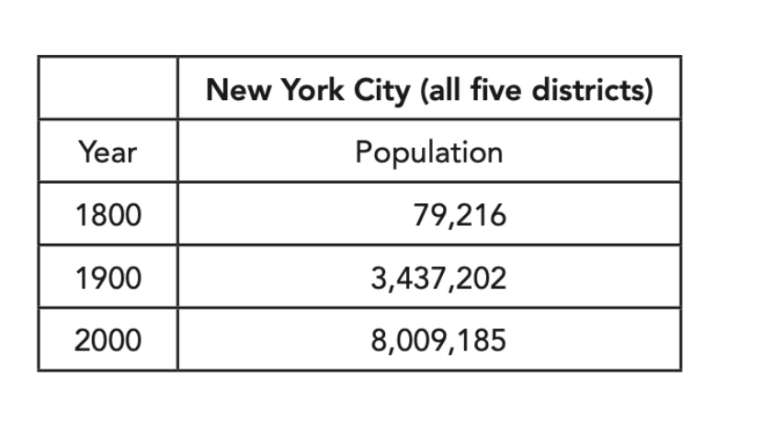
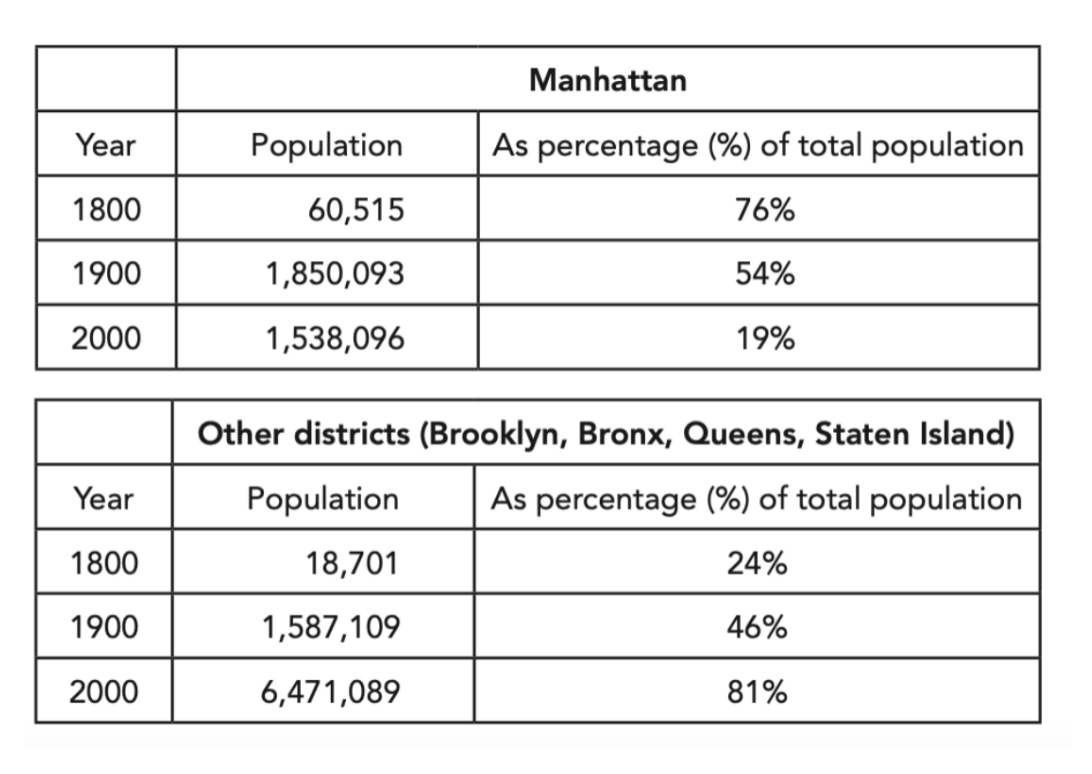
The first table below shows changes in the total population of New York City from 1800 to 2000. The second and third tables show changes in the population of the five districts of the city (Manhattan, Brooklyn, Bronx, Queens, Staten Island) over the same period.
Summarise the information by selecting and reporting the main features, and make comparisons where relevant.
Student answer (Band 5.5)
The tables illustrates the amount of total population changed in New York City and five districts in the city namely Manhattan,Brooklyn,Bronox,Queens,Staten island from 1800 to 2000.
It is evident from the data that, the population in New York City of all five districts has became 10 times more than that in the starting year.
According to the first table, in 1800 the population is 79,216 it has showed a significant increase in the year 2000 it has been went to 8,009,185.
From table two and three other four districts has accounted for change in large population percentage because in 1800 it was 24 percent, but when coming to 2000 it reached near 100 percent, it was 81% in 2000.By contrast,manhattan population has showed decline as the population in 2000 reached to 19% from 76% in 1800.
In conclusion,the change in population in manhattan has been declined, whereas other districts underwent flucatuations.
AI examiner evaluation
| Criterion | Band |
|---|---|
| Task Achievement / Task Response | 6.0 |
| Coherence and Cohesion | 6.0 |
| Lexical Resource | 5.5 |
| Grammatical Range and Accuracy | 5.0 |
| Overall | 5.5 |
Task Achievement / Task Response: Band 6.0
You identify the broad trends: New York City’s population grew substantially, Manhattan’s share fell, and the other districts’ combined share rose. The figures you give for 1800 and 2000, including the 24%, 81%, 76% and 19% shares, match the tables. However, the overview is imprecise: the total population did not become “10 times more” but increased from 79,216 to just over 8 million, and the response omits the important 1900 figures. Manhattan’s population actually rose to 1,850,093 in 1900 before falling to 1,538,096 by 2000; the conclusion that it “has been declined” misses this pattern. The other districts’ share rose steadily, rather than fluctuating. More accurate coverage of the middle year and clearer comparisons would strengthen the summary.
Coherence and Cohesion: Band 6.0
The response has a recognisable structure, moving from an introduction to an overview, supporting details and a conclusion. This gives the reader a coherent overall arrangement. Some links between ideas are useful, particularly “By contrast,” which signals the difference between Manhattan and the other districts. However, progression is weakened by repeating the same broad population-change point and by presenting the conclusion as a new, inaccurate claim about “fluctuations.” References such as “it” and “it was 24 percent” are not always clear, and the transition “when coming to 2000” is awkward. Organise the body around the total population and then the contrasting district trends, using explicit subjects and more precise linking phrases.
Lexical Resource: Band 5.5
You use relevant vocabulary for describing data, including “significant increase,” “percentage,” “decline” and “By contrast.” These choices show an attempt to vary language rather than simply list figures. However, several word choices and collocations are inaccurate or unnatural, such as “amount of total population changed,” “accounted for change in large population percentage,” and “fluctuations” for a steady rise in the other districts’ share. Spelling errors in “Bronox,” “flucatuations” and “manhattan” also reduce accuracy. Aim for standard chart language and check district names and spelling carefully. More precise terms such as “combined share” and “population rose” would make the comparisons clearer.
Grammatical Range and Accuracy: Band 5.0
You attempt both simple and more complex sentences, including a contrast introduced by “whereas” and a comparison beginning “By contrast.” Meaning is generally recoverable, but errors in verb forms, agreement, articles and sentence construction occur across the response. For example, “The tables illustrates” has subject–verb disagreement, while “has became” and “it has been went” use incorrect verb forms. The sentence beginning “According to the first table” also joins several clauses without clear punctuation, and “other four districts has” has incorrect agreement. Practise forming accurate past-tense comparisons and separating long sentences into clear clauses. Greater control of these patterns would make your data reporting easier to follow.
See this exact question answered at other band scores. The same prompt compared across bands.
Browse more IELTS Writing model answers or get your own writing scored by the same AI examiner.