Band 6.0 IELTS Writing Task 1 Model Answer
Overall Band Score: 6.0 · Cambridge IELTS 20 · 2026-11-12
IELTS Writing Task 1 question
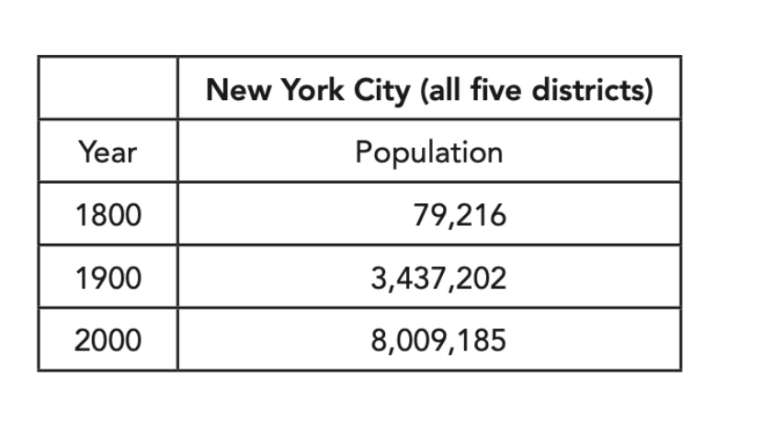
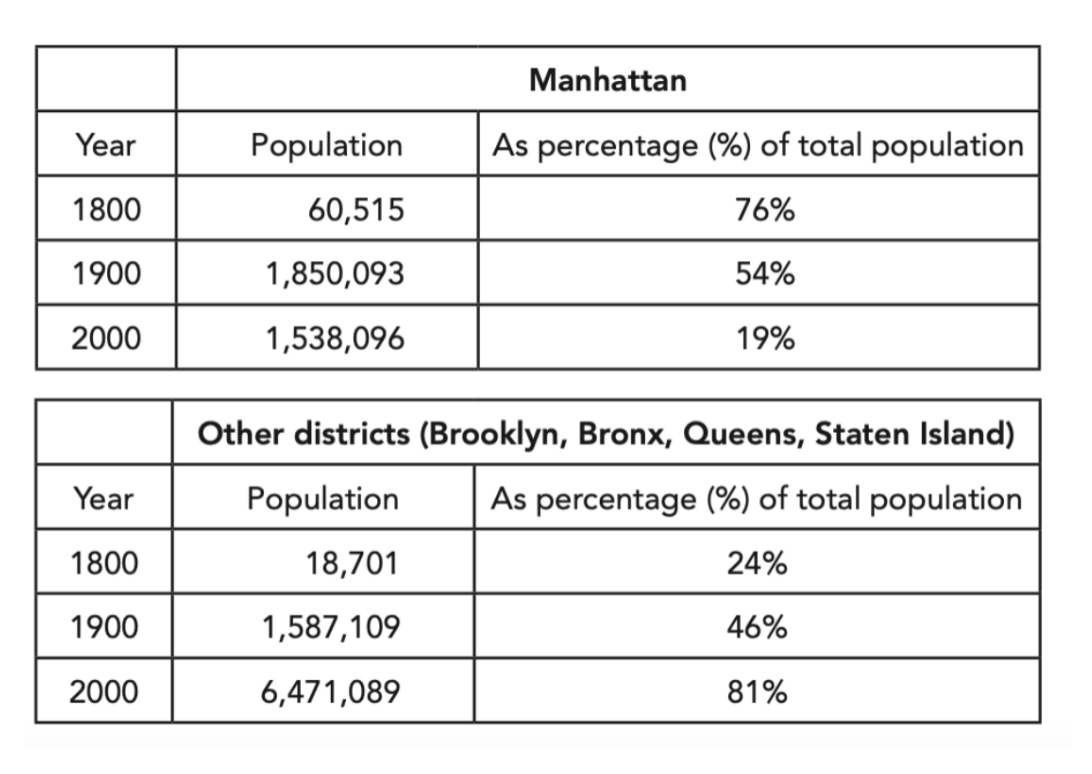
The first table below shows changes in the total population of New York City from 1800 to 2000. The second and third tables show changes in the population of the five districts of the city (Manhattan, Brooklyn, Bronx, Queens, Staten Island) over the same period.
Summarise the information by selecting and reporting the main features, and make comparisons where relevant.
Student answer (Band 6.0)
The first table illustrates changes in the overall population of New York city. and the second and third table demonstrate the changes in five districts of the city from 1800 to 2000.
Overall, population in New York city witness increased over the time period. Manhattan had the highest population and then experience decline, whereas other districts started from lowest and now recorde the highest population.
Looking at the total population of New York city, at the start population of this city accounted for 79,216 in 1800, then increased gradually to 3,437,202 in 1900, subsequently population rose sharply to 8,009,185.
Population in five districts, Manhattan had the highest percentage at 79% in 1800. then decrease sligtly to 54% in 1900, after that experience dramatic fall to 19% in 2000, while other districts (Brooklyn, Bronx, Queens, Staten Island) show opposite trend started 24% in 1800, and they made up to 46%, then rose significantlly to 81% in 2000.
AI examiner evaluation
| Criterion | Band |
|---|---|
| Task Achievement / Task Response | 6.5 |
| Coherence and Cohesion | 6.5 |
| Lexical Resource | 6.0 |
| Grammatical Range and Accuracy | 5.0 |
| Overall | 6.0 |
Task Achievement / Task Response: Band 6.5
You identify the main overall pattern: New York’s population grew substantially, while Manhattan’s share fell and the other districts’ share rose. The total figures are accurately reported, and the comparison between 1900 and 2000 is clear. However, one key figure is inaccurate: Manhattan accounted for 76%, not 79%, in 1800. The overview also says Manhattan had the highest population, but it would be more precise to distinguish its early dominance from its later decline. You report the percentage trends but omit the district population figures, including Manhattan’s fall from 1,850,093 to 1,538,096 and the other districts’ rise to 6,471,089. Including one or two of these would make the comparison more fully developed.
Coherence and Cohesion: Band 6.5
The response has a clear four-part structure: an introduction, an overview, and separate paragraphs for the total population and district shares. This makes the main information easy to locate, and linking expressions such as “whereas,” “then,” and “after that” help show change over time. The progression is generally logical, but some connections feel mechanical, particularly the repeated sequence of “then” and “after that.” Punctuation also interrupts the flow in places, as in “1800. then decrease,” where the new sentence begins with a lowercase word. Improve cohesion by linking related changes within complete sentences and varying the time expressions; clearer references to the two groups would also help the final comparison read more smoothly.
Lexical Resource: Band 6.0
You use a suitable range of vocabulary for describing data, including “overall population,” “percentage,” “dramatic fall,” and “opposite trend.” These choices communicate the main comparisons, and the meaning remains clear despite some inaccurate forms. However, several spelling and word-choice errors reduce precision: “recorde,” “sligtly,” and “significantlly” should be corrected, while “increased gradually” does not accurately describe the sharp rise from 79,216 to 3,437,202. Some collocations are also awkward, such as “made up to 46%” and “population … witness increased.” Aim for accurate, conventional chart language and check spelling carefully; this will make your descriptions more natural and precise.
Grammatical Range and Accuracy: Band 5.0
You attempt both simple and complex sentences, including a contrast with “whereas” and a longer comparison beginning “while other districts…”. However, control is uneven, and errors in verb forms, sentence boundaries, and punctuation sometimes make the writing less fluent. For example, “population … witness increased” needs a past-tense verb, and “Manhattan … then experience decline” should use a consistent past form. The opening also contains an incorrect sentence break after “city,” and the sentence beginning “Population in five districts, Manhattan…” lacks a clear grammatical structure. Practise forming complete sentences with a clear subject and verb, and maintain past tense when reporting historical data. More accurate control of these patterns would strengthen the response.
See this exact question answered at other band scores. The same prompt compared across bands.
Browse more IELTS Writing model answers or get your own writing scored by the same AI examiner.