Band 5.0 IELTS Writing Task 1 Model Answer
Overall Band Score: 5.0 · Cambridge IELTS 20 · 2026-11-12
IELTS Writing Task 1 question
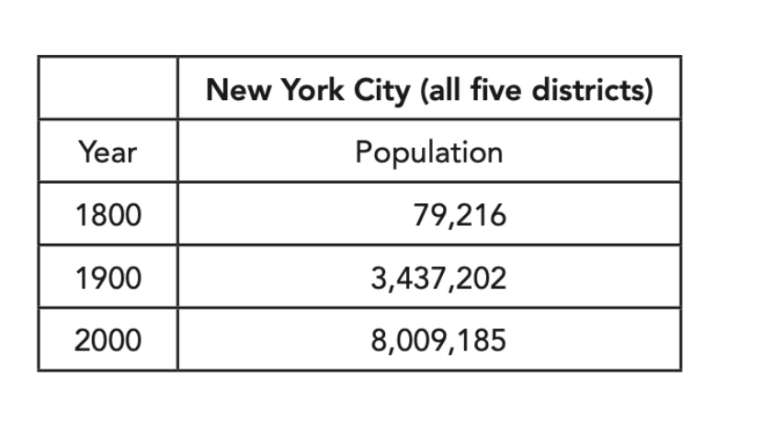
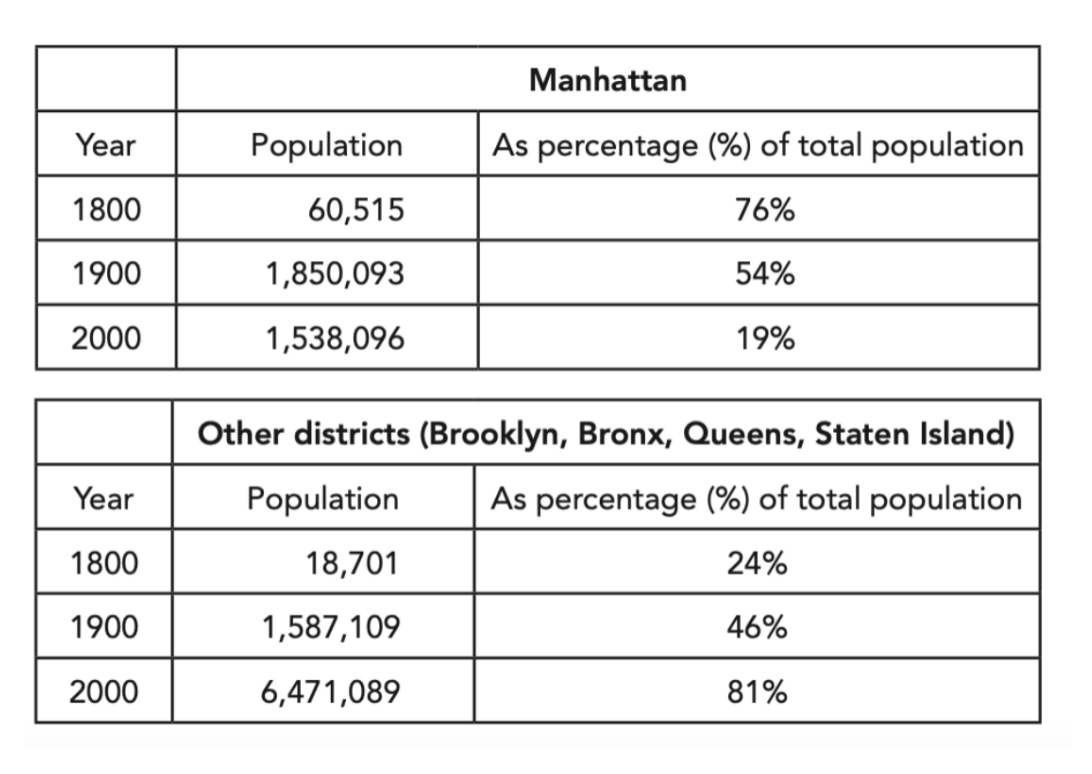
The first table below shows changes in the total population of New York City from 1800 to 2000. The second and third tables show changes in the population of the five districts of the city (Manhattan, Brooklyn, Bronx, Queens, Staten Island) over the same period.
Summarise the information by selecting and reporting the main features, and make comparisons where relevant.
Student answer (Band 5.0)
The first table represent changes of the New York population from 1800 individuals to 2000 individuals .As well as the second and third table shows changes in the five districts of the city including Manhattan within 200 years.
The first box give the population analysis of the New York city over a period of 200 years. In 1800 the amount of individuals is about 79,216. In 1900 these numbers slightly increase to 3,437,202 and in 2000 the population arise to 8,009,185.
The second table shows the population with their percentage scale. In Manhattan the population increase in 1800 with 18,701 people total of 76% , in 1900 population increase with 1,850,093 people with 54% and in 2000 the population decrease to 19%.
The third table represent others district including Brooklyn, Bronx, Queens etc with a rise of 24% in 1800, 46% in 1900 and the population in 2000 shows a slightly increase of 81%.
AI examiner evaluation
| Criterion | Band |
|---|---|
| Task Achievement / Task Response | 5.0 |
| Coherence and Cohesion | 5.5 |
| Lexical Resource | 5.0 |
| Grammatical Range and Accuracy | 5.0 |
| Overall | 5.0 |
Task Achievement / Task Response: Band 5.0
You report the overall city population at all three dates and identify the changing shares of Manhattan and the other districts, so the response includes relevant information from each table. However, the overview is not clearly stated, and several key comparisons are incomplete or inaccurate. For example, Manhattan’s 1800 population was 60,515, not 18,701; that figure belongs to the other districts. You also say Manhattan’s population increased in 1800 and 1900, without explaining that it fell by 2000, while the other districts’ population figures are omitted. The main pattern—that the city grew greatly and its population shifted away from Manhattan—is only partly conveyed. Select the most important trends and compare both population totals and percentages accurately.
Coherence and Cohesion: Band 5.5
The response follows a basic sequence, moving from the citywide table to Manhattan and then the other districts, and phrases such as “In 1800” and “in 2000” help locate the data. However, the progression is mostly a series of table-by-table statements rather than a clearly organised summary with an overview and supporting comparisons. The opening repeats what the tables show, while the final paragraph gives percentages without linking them to the population shift described earlier. Some references, such as “these numbers,” are vague, and the use of “the second table” and “the third table” does not make the relationships between the figures clear. Group the main trends together and use explicit comparisons to connect the details.
Lexical Resource: Band 5.0
You use relevant basic terms such as “population,” “percentage,” “increase,” and “decrease,” which allow the reader to recognise the topic. However, the range is limited and several word choices or collocations are inaccurate, sometimes making the data difficult to interpret. “The population arise to” is not a natural way to describe a rise, and “population increase in 1800 with 18,701 people total of 76%” is unclear. “Amount of individuals” is also less suitable than a direct reference to the population. Use precise reporting language, such as “stood at,” “rose to,” “accounted for,” and “declined,” and distinguish clearly between population totals and percentages.
Grammatical Range and Accuracy: Band 5.0
The response uses mostly simple sentence patterns, with some attempts to combine information using “as well as” and “including.” However, errors in sentence structure, agreement, articles, and punctuation occur frequently. For example, “The first table represent” should use a singular verb, while “the second and third table shows” needs plural agreement. The opening sentence also has a faulty construction: “from 1800 individuals to 2000 individuals” confuses years with people. Several sentences lack clear grammatical links between the population figure and its percentage, as in “with 18,701 people total of 76%.” Improve control of basic sentence patterns first, then practise accurate comparisons using structures such as “Manhattan’s population stood at…, accounting for…”.
See this exact question answered at other band scores. The same prompt compared across bands.
Browse more IELTS Writing model answers or get your own writing scored by the same AI examiner.