Band 6.0 IELTS Writing Task 1 Model Answer
Overall Band Score: 6.0 · Cambridge IELTS 20 · 2026-11-12
IELTS Writing Task 1 question
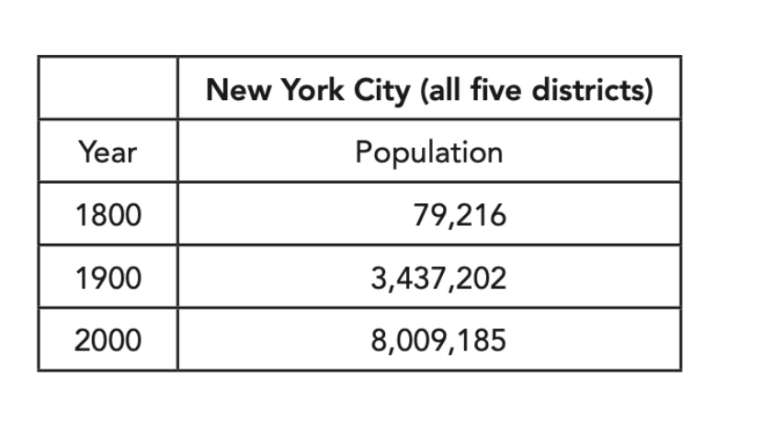
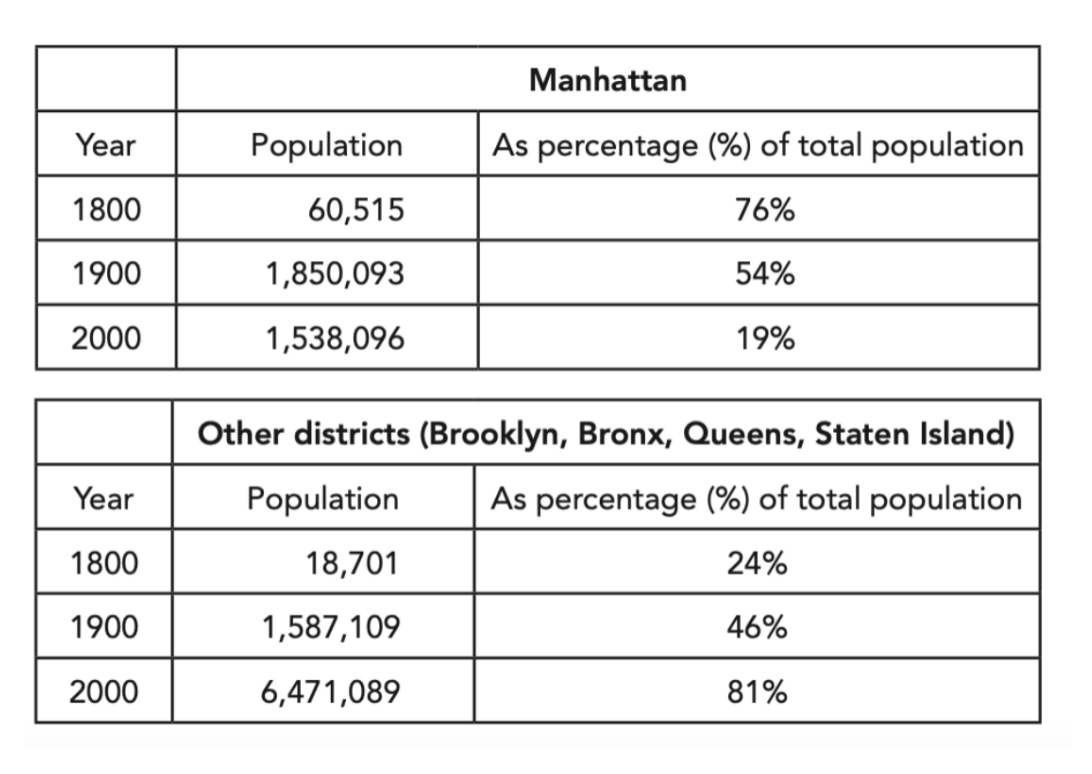
The first table below shows changes in the total population of New York City from 1800 to 2000. The second and third tables show changes in the population of the five districts of the city (Manhattan, Brooklyn, Bronx, Queens, Staten Island) over the same period.
Summarise the information by selecting and reporting the main features, and make comparisons where relevant.
Student answer (Band 6.0)
The tables demonstrate the growth that has occured in the total population of New York including all five districts of the city over the period of 1800 to 2000. Overall, there has been sharp increase in the total population, while the percentage associated with each district vary.
New York City is considered as one of the biggest cities in United States. New York had the highest population in 2000 as compare to 1800. In 1800, the city had the population of 79,216 which significantly increased to around 3.4million by 1900. The population of New York City skyrocketed in 2000 making it 8 million consisting of all 5 districts.
Manhattan had the highest ratio of total population i.e., 76% in the year 1800, where other 4 districts (Brooklyn, Bronx, Queens and Staten Island) had only 24%. In 2000, there has been a reverse difference where other districts covered the 81% of total population which makes above 6 million, while Manhattan had a very minimum ratio i.e., 19%.
In conclusion, it is important to mention that population cannot remain constant and it keeps on growing or decreasing in the future.
AI examiner evaluation
| Criterion | Band |
|---|---|
| Task Achievement / Task Response | 6.0 |
| Coherence and Cohesion | 6.0 |
| Lexical Resource | 6.0 |
| Grammatical Range and Accuracy | 5.5 |
| Overall | 6.0 |
Task Achievement / Task Response: Band 6.0
You identify the main overall rise in New York City’s population and the shift in population share from Manhattan to the other districts. The figures for 1800 and 2000 are reported accurately, and the comparison between Manhattan’s 76% and the other districts’ 24% in 1800 and their reversed shares in 2000 is relevant. However, the account is less complete for 1900: you give the city total but omit the district figures and shares, including Manhattan’s peak population and the fact that it still held a slight majority. The claim that the percentage associated with each district varies is also vague, and the final comment about future population change is not supported by the tables. A more focused overview and fuller comparison across all three years would strengthen the response.
Coherence and Cohesion: Band 6.0
The response has a clear overall arrangement: an introduction and overview are followed by paragraphs on the city total and district shares. Time markers such as “In 1800,” “by 1900,” and “In 2000” help readers follow the data, and the contrast between Manhattan and the other districts is easy to understand. However, the progression is not fully controlled. The paragraph about New York’s status as one of the biggest cities adds no table-based information, while the conclusion shifts to a general prediction about population rather than summarising the comparisons. Some linking is also mechanical, particularly “In conclusion” and “where.” Grouping the figures by time period and connecting the 1900 and 2000 changes more explicitly would make the report more cohesive.
Lexical Resource: Band 6.0
You use an adequate range of vocabulary for describing change, including “significantly increased,” “skyrocketed,” “ratio,” and “covered.” These choices make the main trends understandable, and the response generally communicates the intended comparisons. Some wording is imprecise or unnatural for a formal data report: “the percentage associated with each district vary,” “a very minimum ratio,” and “as compare to” do not express the comparisons cleanly. “Skyrocketed” is also rather dramatic for neutral statistical reporting, and “highest population” is unclear when comparing different years. Aim for precise terms such as “population share,” “accounted for,” and “rose to,” and check spelling and word forms, including “occurred” and “compared.”
Grammatical Range and Accuracy: Band 5.5
You attempt a mix of simple and more complex sentence forms, including the opening sentence with “while” and the comparison beginning “In 2000, there has been a reverse difference.” Most sentences remain understandable, but some grammatical errors reduce accuracy. For example, “there has been sharp increase” needs an article, and “the percentage … vary” has a subject–verb agreement error. The phrase “New York had the highest population in 2000 as compare to 1800” has an incorrect verb form and an awkward comparison structure. Tense use is also inconsistent in “there has been a reverse difference” when describing a completed historical period. Practise accurate articles, agreement, and past-tense reporting, while retaining varied sentence structures.
See this exact question answered at other band scores. The same prompt compared across bands.
Browse more IELTS Writing model answers or get your own writing scored by the same AI examiner.