Band 6.0 IELTS Writing Task 1 Model Answer
Overall Band Score: 6.0 · Cambridge IELTS 20 · 2026-11-12
IELTS Writing Task 1 question
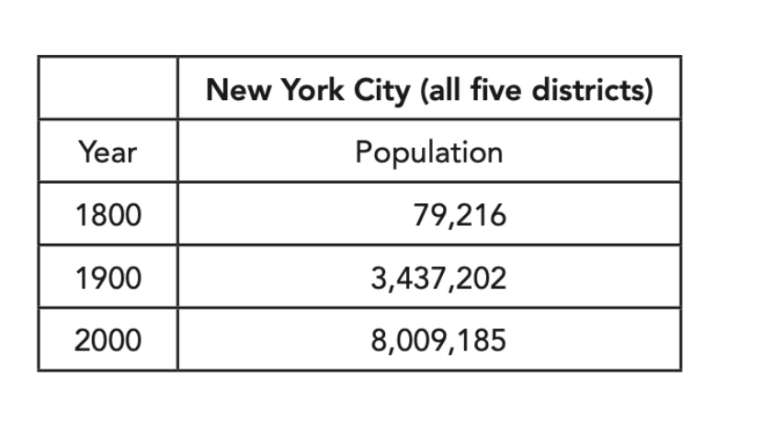
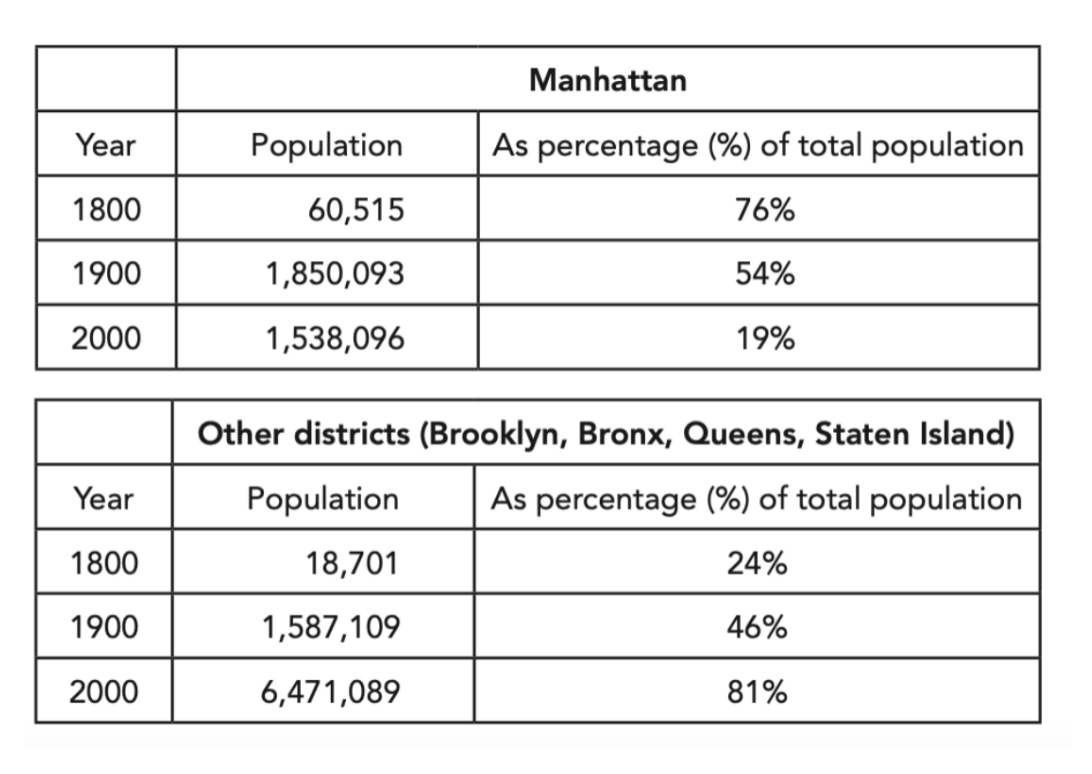
The first table below shows changes in the total population of New York City from 1800 to 2000. The second and third tables show changes in the population of the five districts of the city (Manhattan, Brooklyn, Bronx, Queens, Staten Island) over the same period.
Summarise the information by selecting and reporting the main features, and make comparisons where relevant.
Student answer (Band 6.0)
THE GIVEN TABLES SHOW GROWTH IN THE TOTAL POPULATION OF NEWYORK CITY AND ITS DISTRIBUTION IN MANHATTAN AND OTHER FOUR DISTRICTS IN 1800, 1900 AND 2000.
OVERALL, THE POPULATION OF NEW YORK CITY DRAMATICALLY INCREASED OVER THE PERIOD OF 200-YEAR. MANHATTAN POPULATION REMAINED HIGH BUT ITS CONTRIBUTION IN TOTAL POPULATION FELL SHARPLY BY 2000. MEANWHILE, BROOKLYN, BRONX, QUEENS AND STATEN PROPORTION IN COMBINED POPUALTION ROSE SIGNIFICANTLY BY THE YEAR 2000.
IN 1800, CITY HAD 79,216 POPULATION , OF THESE 60,515 PEOPLE LIVED IN MANHATTAN, ACCOUNTED 76% OF CITY'S TOTAL POPULATION. WHEREAS ONLY 18,701 RESIDENTS LIVED IN OTHER FOUR DISTRICTS AND CONTRIBUTED 24% IN TOTAL POPULATION.
BY 1900, MANHATTAN RESIDENTS ACCOUNTS DECREASED SHARPLY TO 54%, HOWEVER THE POPULATION INCREASED TO 1,850,093. IN CONTRAST. NEW YORK'S 46% OF PEOPLE LIVED IN OTHER DISTRICTS AND THE CITY'S POPULATION ROSE TO 3,437,202.
IN 2000, NEW YORK POPULATION REACHED TO 8,009,185. ONLY 1,538,096 PEOPLE RESIDED IN MANHATTAN AND PROPORTION SHARPLY DECREASED TO 19%. ON THE OTHER HAND, PEOPLE LIVED IN THE OTHER DISTRICTS INCREASED BY TWO FOLDS AND CONTRIBUTED 81% IN COMBINED POPULATION OF NEW YORK.
AI examiner evaluation
| Criterion | Band |
|---|---|
| Task Achievement / Task Response | 6.0 |
| Coherence and Cohesion | 6.5 |
| Lexical Resource | 6.0 |
| Grammatical Range and Accuracy | 5.5 |
| Overall | 6.0 |
Task Achievement / Task Response: Band 6.0
You cover the main changes and provide a clear overview: the city’s population grew substantially, while Manhattan’s share fell and the other districts’ share rose. The figures for 1800 and 1900, and the 2000 totals and percentages, are generally reported accurately. However, some comparisons are less fully developed. For example, “Manhattan population remained high” is vague and could be clarified by noting that its population peaked in 1900 before declining by 2000. Also, “increased by two folds” does not accurately describe the change in the other districts: their population rose from 1,587,109 to 6,471,089, or to more than four times its 1900 level. More precise comparisons would make the key trends clearer.
Coherence and Cohesion: Band 6.5
The response has a clear overall arrangement: an introduction, an overview, and chronological paragraphs for the three years. This makes the information easy to follow, and contrasts such as “Whereas” and “On the other hand” help signal comparisons. The overview also gives the reader a useful guide to the main trends. To make the progression more fluent, avoid abrupt or mechanically placed transitions, as in “In contrast. New York’s 46%...” where the full stop interrupts the comparison. Some references are also imprecise: “the city’s population rose” in the 1900 paragraph could be read as referring to the other districts rather than the city total. Use clearer links and explicit subjects to strengthen cohesion.
Lexical Resource: Band 6.0
You use an adequate range of task-related vocabulary, including “distribution,” “contribution,” “proportion,” “dramatically increased,” and “resided.” These choices help describe population changes and comparisons. However, some word choices and collocations are inaccurate or awkward, such as “Manhattan population remained high,” “contributed 24% in total population,” and “increased by two folds.” There are also spelling errors, including “Newyork,” “popualtion,” and “stat en” (in the district name, written as “Staten” in the task). Aim for precise collocations such as “accounted for 24% of the total” and “rose to more than four times its earlier level.” This would make the description more natural and exact.
Grammatical Range and Accuracy: Band 5.5
You attempt both simple and more complex sentence forms, including clauses introduced by “whereas” and “however,” and the main meaning is generally clear. Some grammatical errors remain, particularly with articles, agreement, verb forms, and sentence boundaries. For example, “In 1800, city had 79,216 population” needs an article and a more natural noun phrase; “Manhattan residents accounts decreased” has an incorrect verb form and structure; and “people lived in the other districts increased” needs a grammatical subject such as “the population of the other districts.” The fragment-like punctuation in “In contrast. New York’s...” also disrupts the sentence. Check each sentence for a clear subject and verb, and use commas and full stops to mark complete clauses.
See this exact question answered at other band scores. The same prompt compared across bands.
Browse more IELTS Writing model answers or get your own writing scored by the same AI examiner.