Band 5.5 IELTS Writing Task 1 Model Answer
Overall Band Score: 5.5 · Cambridge IELTS 20 · 2026-11-12
IELTS Writing Task 1 question
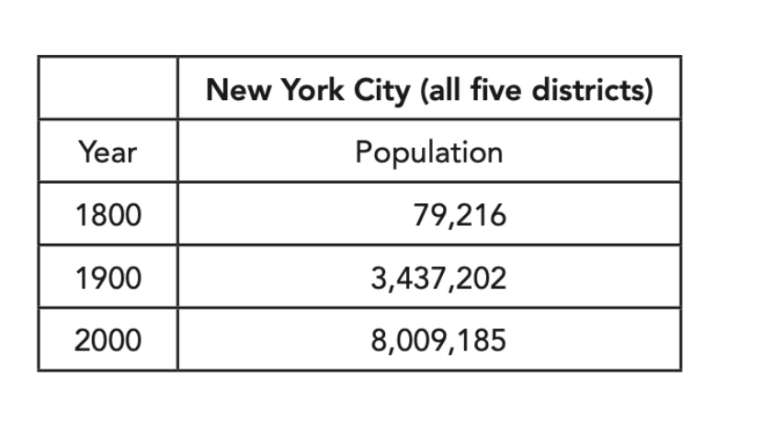
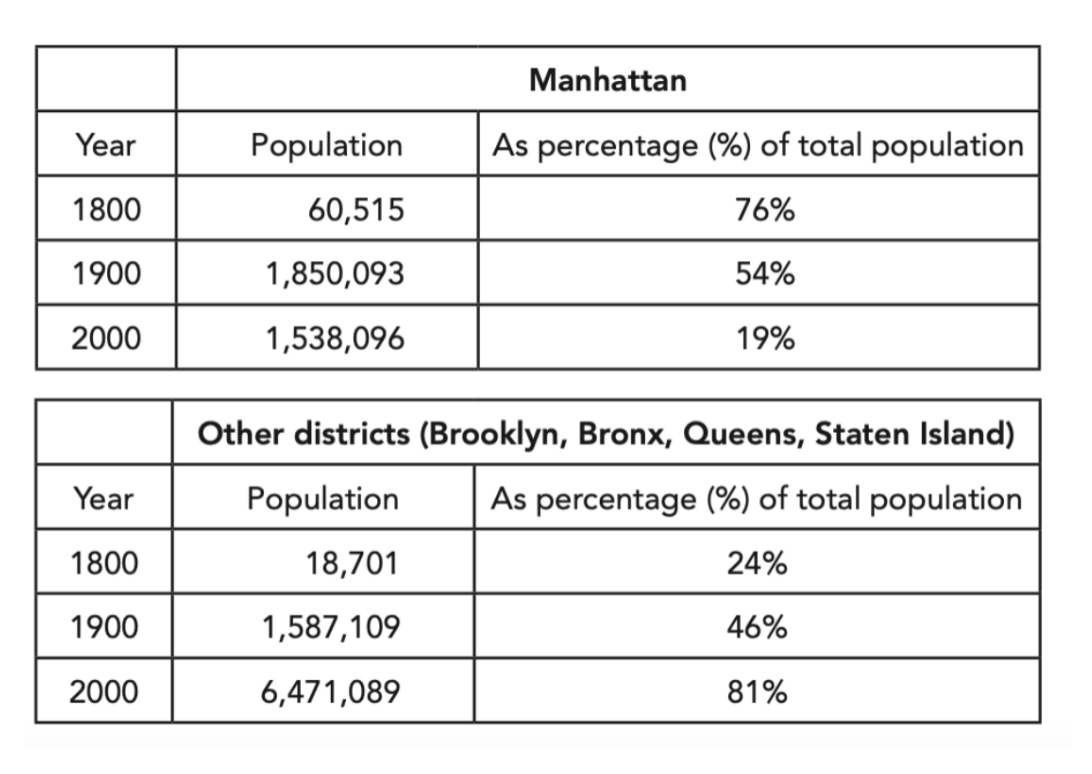
The first table below shows changes in the total population of New York City from 1800 to 2000. The second and third tables show changes in the population of the five districts of the city (Manhattan, Brooklyn, Bronx, Queens, Staten Island) over the same period.
Summarise the information by selecting and reporting the main features, and make comparisons where relevant.
Student answer (Band 5.5)
First table tells us the total population of New York city from 1800 to 2000 while second and third give population of other cities from Eighteen Century to Twenth Century with the percentages increases.
Intial population of New York city in 1800 was 79216 which is very small and its increses rapidly approx 400% in just 100 years .This population include all five district of New York city. After that popultion become approx double in the next century its value imcreases from [redacted phone] to [redacted phone] .
On the other side second and third table give the value of population with the percentage of total populations. Initially population of Manhattan and Other districts which included Brooklyn,Bronx,Queens and Staten Island is 75% and approx one fourth respectively. Therefore trends in populations in manhattan districts decreases and other districts increases at the end of 2000 population of manhattan districts one fourth of total population but in othe districs population increses and become 3/4 of total population.
Population of new york city increases rapidly in eighteen century to ninteenth century but become double in ninteenth to twenth century , population in manhataan districts decreses from 3/4 to 1/4 of total population and other districts population increases from 1/4 3/4 of total population.
AI examiner evaluation
| Criterion | Band |
|---|---|
| Task Achievement / Task Response | 5.5 |
| Coherence and Cohesion | 5.5 |
| Lexical Resource | 5.0 |
| Grammatical Range and Accuracy | 5.0 |
| Overall | 5.5 |
Task Achievement / Task Response: Band 5.5
You identify the main broad changes: New York City’s total population rose substantially, while Manhattan’s share fell and the other districts’ share grew. You also include relevant figures such as 79,216 and the 2000 proportions. However, the account is only partly accurate and developed. The total population rose from 79,216 to 3,437,202 between 1800 and 1900, not by approximately 400%; it then increased to 8,009,185, which is more than double. Manhattan’s share was 76%, not 75%, in 1800, and its population actually fell from 1,850,093 in 1900 to 1,538,096 in 2000, a key feature you omit. Clarify these comparisons and distinguish population totals from percentages.
Coherence and Cohesion: Band 5.5
The response has a recognisable sequence: it first discusses the citywide figures, then the district data, and ends with a brief summary. Phrases such as “On the other side” and “After that” attempt to guide the reader through the information. However, progression is not consistently clear, and the final paragraph repeats points already made rather than adding a focused overview. Some references are also vague: “this population” and “the value of population” do not always make clear which figures or districts are being discussed. Organise the response into a clear introduction, an overview of the main trends, and paragraphs comparing the data by period or district. Use linking expressions selectively and make each comparison explicit.
Lexical Resource: Band 5.0
You use some relevant vocabulary for describing data, including “total population,” “percentage,” “increases,” and “decreases,” and the fractions “one fourth” and “3/4” help convey changes in share. However, the range is limited and several choices are imprecise or repetitive, such as “value of population” and repeated uses of “increases.” There are also frequent spelling errors, including “Intial,” “increses,” “popultion,” and “manhataan,” which make the writing less clear and reduce control of vocabulary. Aim for accurate, task-specific terms such as “accounted for,” “population share,” and “rose,” while checking spelling carefully. Use “districts” consistently rather than calling them “cities.”
Grammatical Range and Accuracy: Band 5.0
You attempt both simple and more complex sentences, for example, “After that population become approx double in the next century,” and a sentence beginning “Therefore trends in populations…”. However, complex constructions are often faulty, and errors occur frequently enough to make some relationships difficult to follow. Examples include missing articles and verbs in “at the end of 2000 population of manhattan districts one fourth,” incorrect verb forms in “population become,” and unclear sentence boundaries where several ideas run together. Subject–verb agreement and tense also need attention. Practise forming complete sentences with a clear subject and verb, and use past-tense forms consistently when reporting historical data. Punctuation between clauses will also help separate comparisons.
See this exact question answered at other band scores. The same prompt compared across bands.
Browse more IELTS Writing model answers or get your own writing scored by the same AI examiner.