Band 5.5 IELTS Writing Task 1 Model Answer
Overall Band Score: 5.5 · Cambridge IELTS 20 · 2026-11-12
IELTS Writing Task 1 question
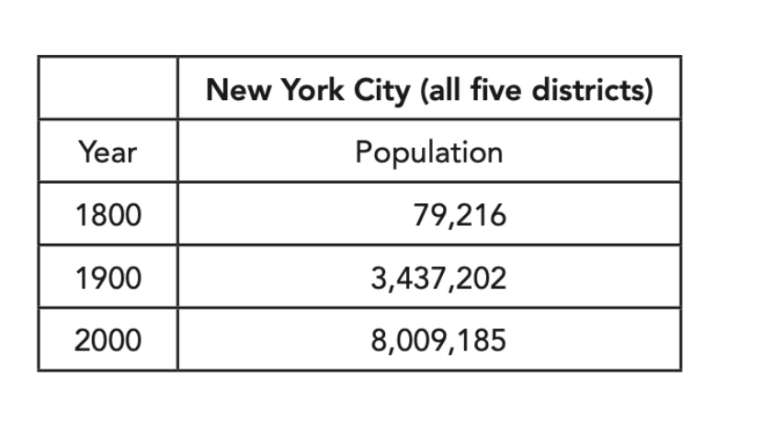
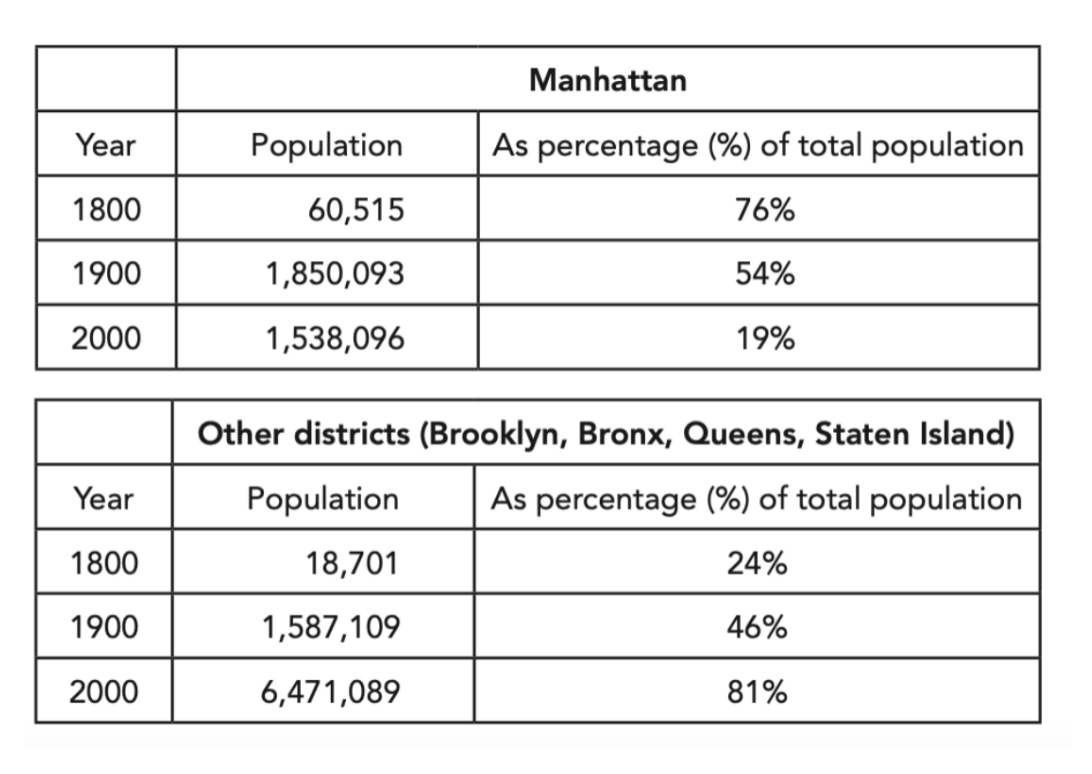
The first table below shows changes in the total population of New York City from 1800 to 2000. The second and third tables show changes in the population of the five districts of the city (Manhattan, Brooklyn, Bronx, Queens, Staten Island) over the same period.
Summarise the information by selecting and reporting the main features, and make comparisons where relevant.
Student answer (Band 5.5)
The illustration gives information about the changes in population of all five destricts of New York. Overall, the population of all four other destricts was increased to 81% in the final year.
In the year 1800, the total population of all five destricts of New York was almost 80,000. And among this population 76% of the people lived in destrict Manhattan and the remaining population was in all other four destricts.
By year 1900, the total population of New York was increased to almost 3.5 million and among these almost 54% of the population was living in Manhattan and the rest of the population was in all four other destricts of New York. And in the final year, 2000, the total population of New York was increased to almost 8 million people. And in this year, the 19% of the total population was living in Manhattan while the rest of population was living in all four other destricts of New York.
AI examiner evaluation
| Criterion | Band |
|---|---|
| Task Achievement / Task Response | 5.5 |
| Coherence and Cohesion | 5.5 |
| Lexical Resource | 5.5 |
| Grammatical Range and Accuracy | 5.5 |
| Overall | 5.5 |
Task Achievement / Task Response: Band 5.5
You identify the broad pattern: New York’s total population grew substantially, while Manhattan’s share fell and the other districts’ share rose. The percentages you report (76%, 54% and 19% for Manhattan) match the table, and the approximate totals are also accurate. However, the overview is incomplete and slightly imprecise: “the population of all four other districts was increased to 81%” confuses population growth with population share. The response also omits the important change in Manhattan’s actual population, which rose to about 1.85 million in 1900 before falling to about 1.54 million in 2000, while the other districts grew markedly. Develop these comparisons and distinguish figures from percentages more clearly.
Coherence and Cohesion: Band 5.5
The response follows a generally understandable chronological order, moving from 1800 to 1900 and then 2000, and the reader can follow the main comparisons. However, the organisation is repetitive: each period is introduced in a similar way, and several sentences begin with “And,” which makes the progression feel mechanical. The overview is only one sentence and does not clearly preview both the overall population increase and the contrasting district trends. Some references, such as “among these” and “the rest of the population,” are understandable but repeated rather than varied. Use a distinct overview, then group the figures into purposeful comparisons—for example, total growth first and the changing distribution between Manhattan and the other districts second.
Lexical Resource: Band 5.5
You use relevant basic terms such as “total population,” “remaining population” and “final year,” so the main information is usually clear. However, the vocabulary is repetitive and some word choices or collocations are inaccurate. “Was increased” is not a natural way to describe a population that grew, and “increased to 81%” incorrectly presents a share as though it were a population figure. The repeated spelling “destricts” also detracts from accuracy. Build a more precise range for describing trends and proportions, using terms such as “rose,” “declined,” “accounted for” and “share.” This would help you distinguish population totals from percentages and make the comparisons more concise and natural.
Grammatical Range and Accuracy: Band 5.5
Your sentences communicate the main timeline and comparisons, and you attempt longer structures using phrases such as “while” and “among this population.” However, the range is limited, with several long sentences joined by “And,” and recurring errors affect accuracy. For example, “the population … was increased” uses an unsuitable passive construction; “By year 1900” needs an article; and “the 19% of the total population” has an unnecessary article. The opening “And among this population…” is also a sentence fragment, while repeated coordination makes some sentences cumbersome. Practise forming concise comparisons with accurate past-tense verbs, articles and subordinate clauses, and check punctuation when separating complete sentences.
See this exact question answered at other band scores. The same prompt compared across bands.
Browse more IELTS Writing model answers or get your own writing scored by the same AI examiner.