Band 5.5 IELTS Writing Task 1 Model Answer
Overall Band Score: 5.5 · Cambridge IELTS 20 · 2026-11-12
IELTS Writing Task 1 question
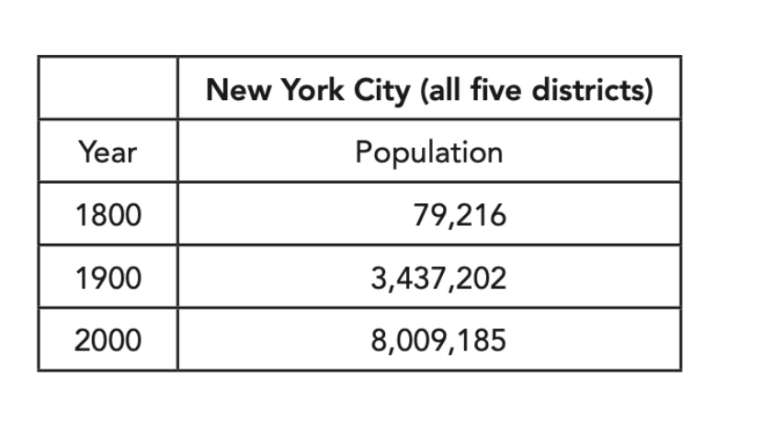
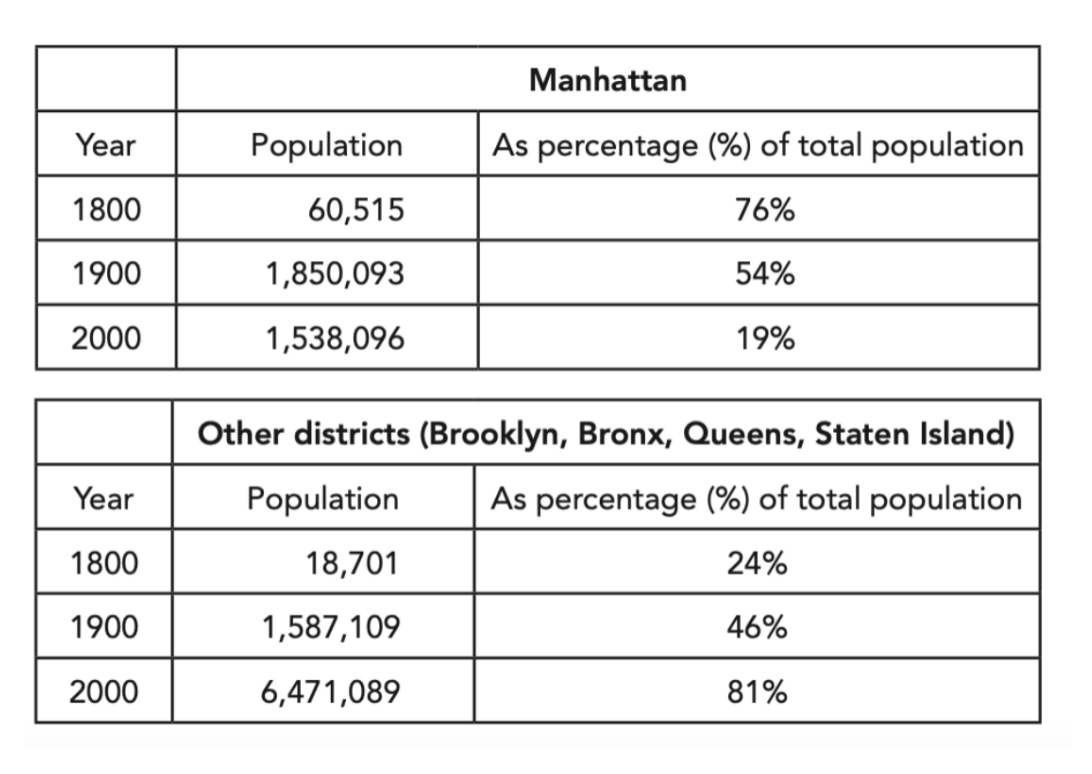
The first table below shows changes in the total population of New York City from 1800 to 2000. The second and third tables show changes in the population of the five districts of the city (Manhattan, Brooklyn, Bronx, Queens, Staten Island) over the same period.
Summarise the information by selecting and reporting the main features, and make comparisons where relevant.
Student answer (Band 5.5)
The first table shows the total population of all five districts of New York City, which are in 1800 it was around 79,216, in 1900 it increased to [redacted phone] and in 2000 it was around [redacted phone] which shows alot of change in the overall population.
As shown in the second table, Manhattan has the largest population among all that is in 1800 it was around 76% of the total population. While the other districts have around 24%.
In 1900, Manhattan had the largest number of population which is 54% and other districts have less which is 46% of the total population.
If we see the second and third table so in the year 2000 there's a shift which was made and the highest population is in the other districts which is 81% of the total population, while Manhattan population has been decreased a lot and became around 19% of the total population.
AI examiner evaluation
| Criterion | Band |
|---|---|
| Task Achievement / Task Response | 5.5 |
| Coherence and Cohesion | 5.5 |
| Lexical Resource | 5.5 |
| Grammatical Range and Accuracy | 5.0 |
| Overall | 5.5 |
Task Achievement / Task Response: Band 5.5
You report the main population figures and identify the key change in the districts’ shares: Manhattan’s proportion falls from 76% to 19%, while the other districts’ share rises from 24% to 81%. These comparisons are relevant and generally accurate. However, the response does not give a clear, concise overview of the overall trends, and the total population’s growth is only described as “alot of change.” The 1900 comparison is also phrased as Manhattan having the “largest number,” without clarifying that it still held a majority share at that point. Develop the overview by stating that the city’s population rose substantially overall, while population shifted from Manhattan to the other districts; then support it with selected figures and clearer comparisons.
Coherence and Cohesion: Band 5.5
The response is divided into paragraphs and follows a broadly chronological order, moving from the city total to 1800, 1900 and 2000. This gives the reader a basic route through the information. However, progression is not consistently clear: “As shown in the second table” and “If we see the second and third table” refer vaguely to the visuals, and the repeated “which” constructions make relationships between figures difficult to follow. The paragraph about 1900 also lacks a clear link to the changing pattern across the years. Organise the response around an overview followed by comparisons across the three dates, and use precise references such as “Manhattan’s share” and “the combined share of the other districts” rather than relying on table references.
Lexical Resource: Band 5.5
You use relevant basic terms such as “total population,” “increased,” “highest population” and “decreased,” so the main subject is understandable. However, vocabulary is repetitive and some choices are imprecise or informal for a data summary. “Alot of change” does not specify the scale or direction of the change, while “largest number of population” is an awkward collocation. “Shift which was made” also sounds unnatural and does not clearly describe the change in population distribution. Use more precise language for trends and proportions, such as “rose substantially,” “accounted for,” and “the population share shifted.” Check spelling and spacing, including “a lot,” and avoid repeating “population” where “share” or “proportion” is more accurate.
Grammatical Range and Accuracy: Band 5.0
The response attempts some longer sentence forms, including clauses introduced by “which” and “while,” but these are often not controlled successfully. For example, “which are in 1800 it was around…” combines incompatible sentence structures, and “Manhattan has the largest population among all that is in 1800…” has unclear clause relationships and tense. The sentence beginning “If we see…” also has a faulty conditional construction. Simple statements such as “In 1900, Manhattan had…” are easier to understand, but the overall range is limited and errors recur in sentence structure, agreement and punctuation. Build accurate simple sentences first, then add one comparison clause at a time; for example, “In 1800, Manhattan accounted for 76% of the city’s population, compared with 24% in the other districts.”
See this exact question answered at other band scores. The same prompt compared across bands.
Browse more IELTS Writing model answers or get your own writing scored by the same AI examiner.