Band 5.0 IELTS Writing Task 1 Model Answer
Overall Band Score: 5.0 · Cambridge IELTS 20 · 2026-11-12
IELTS Writing Task 1 question
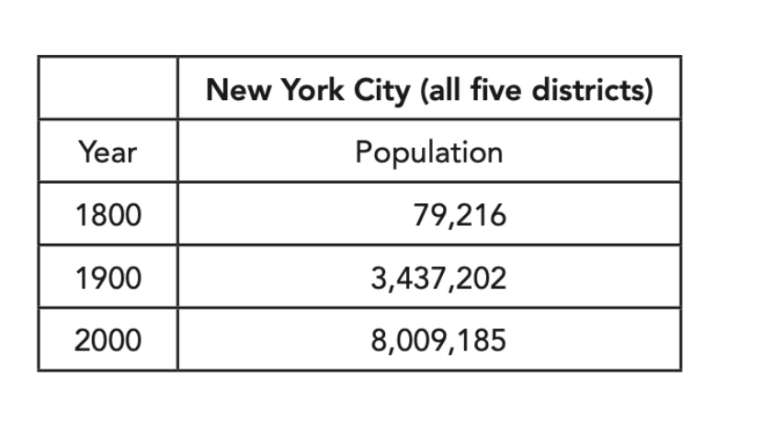
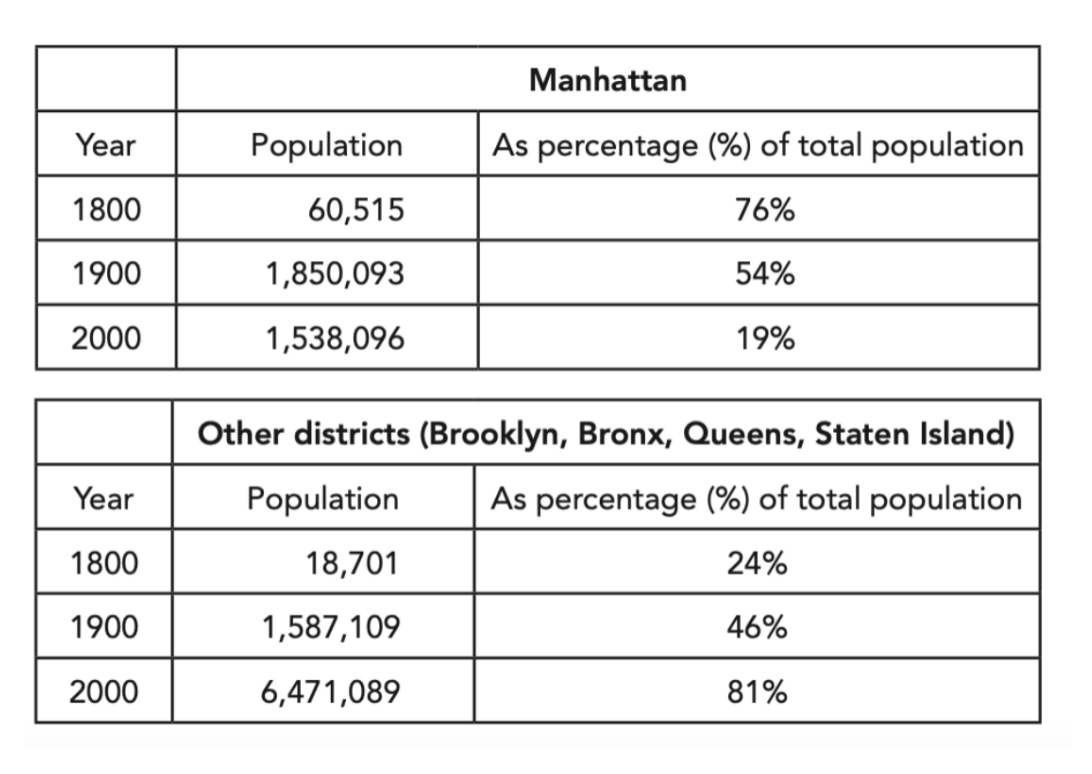
The first table below shows changes in the total population of New York City from 1800 to 2000. The second and third tables show changes in the population of the five districts of the city (Manhattan, Brooklyn, Bronx, Queens, Staten Island) over the same period.
Summarise the information by selecting and reporting the main features, and make comparisons where relevant.
Student answer (Band 5.0)
the table indicates the changes in total population of New York City from 1800 to 2000. the rest of the table shows the population of the five districts of the city.
Overall its clear that the Population in New York City rose dramatically, meanwhile Manhattan's proportion of the population decreased significantly, whereas the other four districts increased significantly.
in 1800 Manhatten accounted 76% of New York City's total population. however this proportion fell considerably to 54% over the following 100 years. between 1900 and 2000, mehatten's population decreased from approximately 1.8 million to 1.5 million, while the proportion of its city droped significantly from 54% to just 19%.
in the other districts from 1800 to 2000 the population of the cities increased slightly. from 1800 to 1900 the percentage of total population went up from 24% to 46%, in 2000 rose from 1.5 million to 6.4 million which is the highest population.
to sum up the New York City's population increased dramatically between 1800 to 2000. while Manhattan's population was high in 1800 by 76% but decreased to 19% of total population, however the other districts increased from 24% to 81%.
AI examiner evaluation
| Criterion | Band |
|---|---|
| Task Achievement / Task Response | 5.5 |
| Coherence and Cohesion | 5.0 |
| Lexical Resource | 5.0 |
| Grammatical Range and Accuracy | 5.0 |
| Overall | 5.0 |
Task Achievement / Task Response: Band 5.5
You identify the main overall contrast: New York City’s population grew, while Manhattan’s share fell and the other districts’ share rose. Several figures are reported accurately, including Manhattan’s 76%, 54% and 19% shares. However, some key information is missing or unclear, and one trend is misrepresented: the other districts’ population did not increase only “slightly”; it rose from 18,701 to 6,471,089. The sentence about 2000 also mixes population and percentage, making the comparison difficult to follow. Include the city’s total figures (79,216, 3.4 million and 8.0 million), and distinguish clearly between population counts and percentages. A concise overview plus accurate comparisons across all three years would make the summary more complete.
Coherence and Cohesion: Band 5.0
The response has an opening, an overview and separate paragraphs for Manhattan and the other districts, so there is some organisation. However, progression is weakened by unclear links and repeated conclusions. The final paragraph repeats the overview rather than adding a useful comparison, while “in 2000 rose from 1.5 million to 6.4 million” does not make clear what rose or which years are being compared. Connect each figure directly to its year and subject, and use a consistent sequence such as 1800, 1900, then 2000. Linking words such as “however” and “while” are attempted, but some are awkwardly placed or joined to incomplete sentences. Clearer referencing and less repetition would improve the flow.
Lexical Resource: Band 5.0
You use some relevant vocabulary for describing data, including “proportion,” “accounted,” “decreased” and “dramatically.” This gives the response a basic range suited to the task. However, vocabulary is repetitive, and several word choices or collocations make the data difficult to interpret: “the population of the cities increased slightly” understates the very large rise, and “the proportion of its city” is not a natural expression. There are also noticeable spelling errors, including “Manhatten,” “mehatten” and “droped.” Use precise terms consistently—“population,” “share” or “percentage”—and check spelling. More accurate data-reporting phrases would help you express comparisons without changing their meaning.
Grammatical Range and Accuracy: Band 5.0
You attempt both simple and more complex sentences, for example, “Manhattan’s population decreased … while the proportion …” This shows some ability to link comparisons. However, errors are frequent, and several sentences are incomplete or difficult to follow. Examples include “in 2000 rose from 1.5 million to 6.4 million,” which lacks a clear subject, and “Manhattan accounted 76%,” which needs a preposition after “accounted.” There are also problems with sentence boundaries and punctuation, such as the lower-case sentence openings and the fragment beginning “while Manhattan’s population was high.” Practise complete clauses, accurate verb forms and punctuation, then proofread each sentence to ensure its subject and comparison are clear.
See this exact question answered at other band scores. The same prompt compared across bands.
Browse more IELTS Writing model answers or get your own writing scored by the same AI examiner.