Band 5.5 IELTS Writing Task 1 Model Answer
Overall Band Score: 5.5 · Cambridge IELTS 20 · 2026-11-13
IELTS Writing Task 1 question
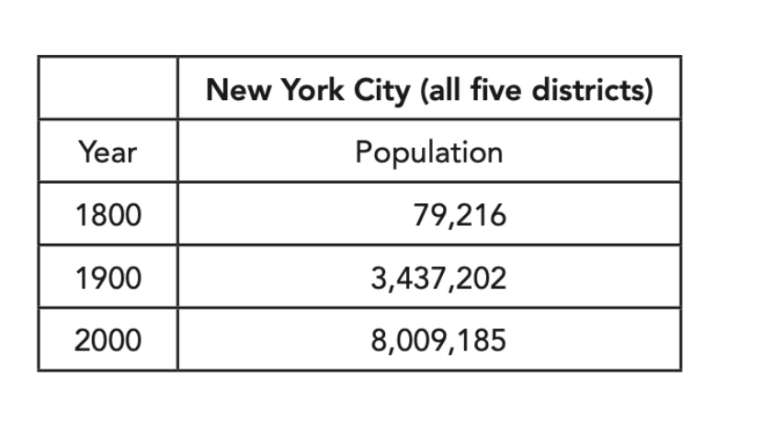
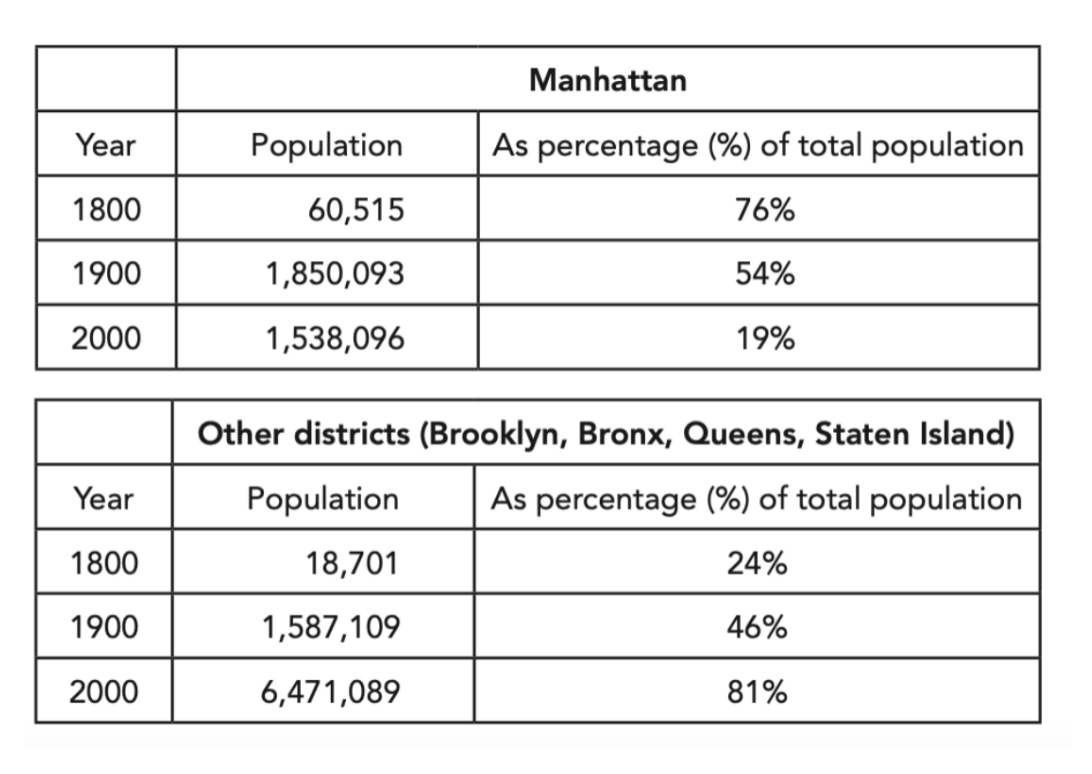
The first table below shows changes in the total population of New York City from 1800 to 2000. The second and third tables show changes in the population of the five districts of the city (Manhattan, Brooklyn, Bronx, Queens, Staten Island) over the same period.
Summarise the information by selecting and reporting the main features, and make comparisons where relevant.
Student answer (Band 5.5)
The three tables illustrade how the population of New York City has changed from 1800 to 2000. The fist one shows changes in the total population of the city while the other two tables show changes in the population of the five districts of the city (Manhattan, Brooklyn, Bronx, Queens, Staten Island) over the same period.
Since 1800 New York City has grown emensly. The five districts however, grew at different times and their percentage of the total population has changed drasticly.
New York City had only 79,216 inhabitants in 1800. In the next centurary it multiplied its population by more than four times to 3,437,202 inhibitants. In 2000 the city reached a population of 8,009,185 people.
All the districts grew as well but not at the same scale. For instance, in 1800 76% of New York Citys populatin was living in Manhatten. This nuber dropped to only 19% in 2000. This still population of 1,538,096 people but way less relevent to the howl population. The other four districts grew way quicker. Having ony 18,701 people living there in 1800 they more than doubeled their numbers. They started with 24% of the population and grew it to 81% in 2000.
AI examiner evaluation
| Criterion | Band |
|---|---|
| Task Achievement / Task Response | 6.0 |
| Coherence and Cohesion | 5.5 |
| Lexical Resource | 5.5 |
| Grammatical Range and Accuracy | 5.5 |
| Overall | 5.5 |
Task Achievement / Task Response: Band 6.0
You identify the overall rise in New York City’s population and the major shift in its population distribution: Manhattan’s share falls from 76% to 19%, while the other districts’ share rises from 24% to 81%. The figures you give for 1800 and 2000 are accurate, and the response covers both the city total and district patterns. However, some key information is omitted or unclear: Manhattan’s population peaked at 1,850,093 in 1900 before declining, and the other districts’ population in 2000 was 6,471,089. The statement that they “more than doubled” their numbers is inaccurate for the change from 18,701 to 6,471,089, and the 1900 shares are not discussed. Develop these comparisons more precisely and include the middle-year turning point.
Coherence and Cohesion: Band 5.5
The response has a recognisable structure: an introduction, a brief overview, and paragraphs reporting the total population and district changes. This gives the reader a basic route through the information. However, progression within the final paragraph is less clear, particularly in “This still population of 1,538,096 people but way less relevent to the howl population,” where the relationship between Manhattan’s absolute population and its share is difficult to follow. Some links, such as “however” and “For instance,” are used, but the comparisons are not consistently organised by year or by district. Grouping the figures systematically—for example, comparing 1800, 1900 and 2000—would make the relationships easier to track and reduce abrupt transitions.
Lexical Resource: Band 5.5
You use relevant vocabulary for describing trends, including “grown,” “multiplied,” “dropped,” and “percentage,” and the meaning is generally recoverable. There are also attempts at more precise language, such as “inhabitants” and “reached a population.” However, numerous spelling errors—“illustrade,” “emensly,” “centurary,” “populatin,” and “Manhatten”—are noticeable, and some word choices or collocations are inaccurate. “More than doubled” does not describe the scale of growth in the other districts, while “way less relevant to the whole population” is informal and imprecise for an academic report. Use accurate trend language such as “increased substantially” and distinguish population totals from population shares.
Grammatical Range and Accuracy: Band 5.5
You use a mixture of simple sentences and some more developed structures, including “while the other two tables show…” and “Since 1800 New York City has grown…”. Most of the intended meaning can be understood, but some grammatical errors make individual sentences unclear. For example, “This still population of 1,538,096 people but way less relevant…” lacks a clear verb and a complete comparison, and “Having only 18,701 people living there in 1800 they…” uses an awkward, poorly attached opening phrase. The sentence “They started with 24% of the population and grew it to 81%” also has an unclear pronoun reference. Build complete clauses, check subject–verb relationships, and use explicit subjects such as “the other districts’ share” to make comparisons grammatically clear.
See this exact question answered at other band scores. The same prompt compared across bands.
Browse more IELTS Writing model answers or get your own writing scored by the same AI examiner.