Band 6.0 IELTS Writing Task 1 Model Answer
Overall Band Score: 6.0 · Cambridge IELTS 20 · 2026-11-13
IELTS Writing Task 1 question
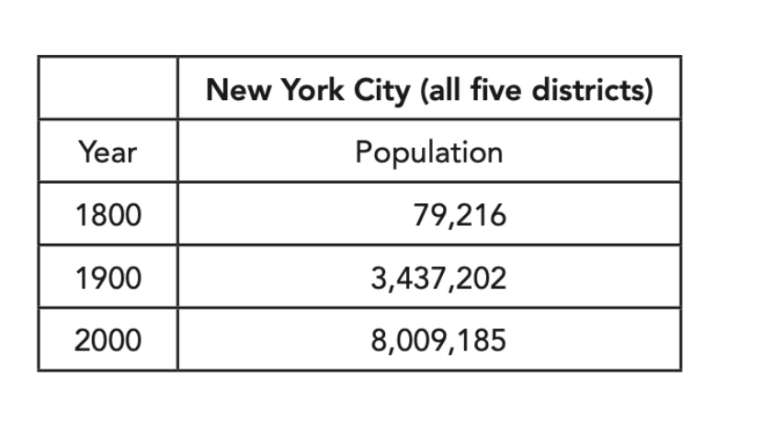
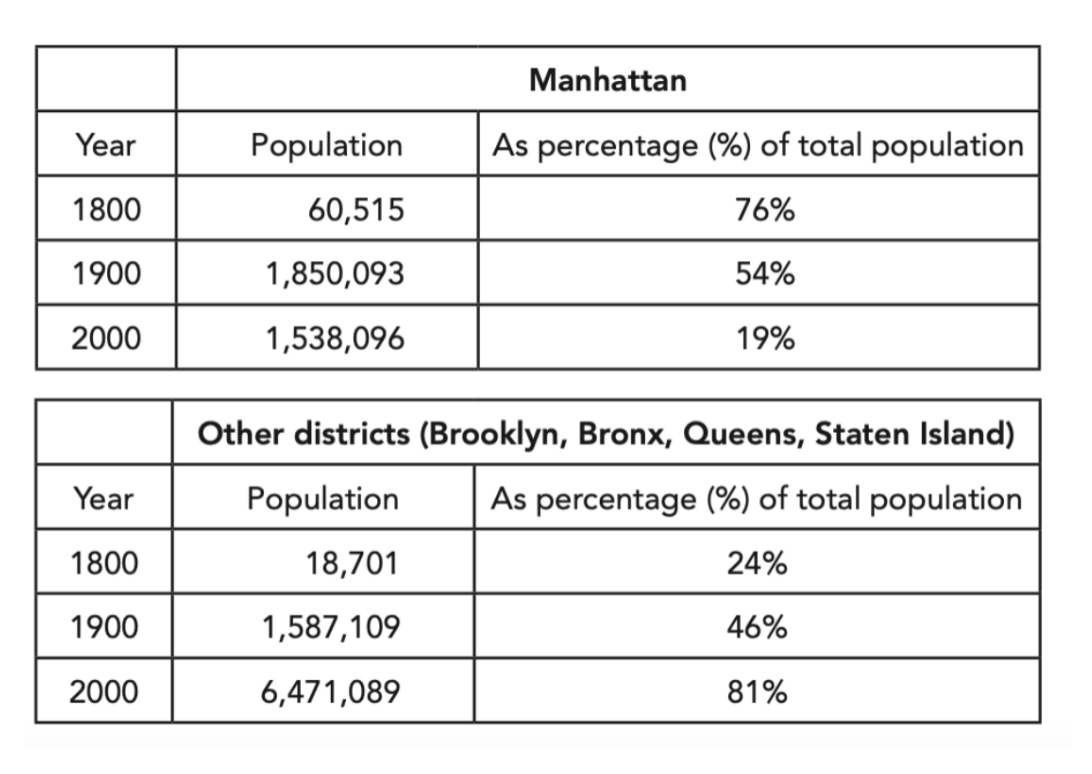
The first table below shows changes in the total population of New York City from 1800 to 2000. The second and third tables show changes in the population of the five districts of the city (Manhattan, Brooklyn, Bronx, Queens, Staten Island) over the same period.
Summarise the information by selecting and reporting the main features, and make comparisons where relevant.
Student answer (Band 6.0)
The first table represents the the variations in total number of individuals of New York City from 1800 to 2000. The other two tables show population changes in five districts of the city during the same period.
Overall, the population of New York City rose exponentially from 1800 to 2000. The Manhattan population decreases from three quarters to almost one-fifth of the total population over the course of 200 years. The other four cities population grew from one-fourth of toal population to almost 4/5 of total population
The total population of New York city was close to 80,000 in 1800, 76% of this population came from Manhattan having around 60,000 individuals and 24% from the remaining districts of the city, that is, 18,701 individuals exactly.
In 1800s, the population substantailly grew to 3.4 million in which 54% was from Manhattan of about 1.8 million. Even though the population of Manhattan grew in 1900 but the contribution to the population of city shrank. In the next 100 years, the poulation of the city reached to 8 million and 81% of this population came from the 4 districts having 6.4 million individuals and remaining 19% came from the Manhattan having 1.5 million people
AI examiner evaluation
| Criterion | Band |
|---|---|
| Task Achievement / Task Response | 6.0 |
| Coherence and Cohesion | 6.0 |
| Lexical Resource | 5.5 |
| Grammatical Range and Accuracy | 5.5 |
| Overall | 6.0 |
Task Achievement / Task Response: Band 6.0
You identify the main trends: New York’s total population rose substantially, while Manhattan’s share fell and the other districts’ share increased. The overview is relevant, and the response includes useful figures for all three years. Most data are accurate, including Manhattan’s 76%, 54% and 19% shares and the other districts’ 81% share in 2000. However, “rose exponentially” overstates the pattern, and “the other four cities” incorrectly describes districts as cities. Some comparisons are less fully developed: you could explicitly note that Manhattan’s population itself peaked in 1900 and then declined by 2000, while the other districts grew markedly. A more precise overview and clearer comparison of absolute populations as well as percentages would make the key features more complete and sharply reported.
Coherence and Cohesion: Band 6.0
The response has a clear overall arrangement: an introduction, an overview and then details moving from 1800 through 1900 to 2000. This chronological progression helps the reader follow the figures, and linking expressions such as “Even though” and “In the next 100 years” show attempts to connect comparisons. Some cohesion is less controlled, however. The overview’s final sentence is incomplete in punctuation, and the shift from “the other four cities” to “remaining districts” makes the reference less clear. The long final sentence also combines several figures and comparisons, making the relationships harder to process. Use separate, balanced sentences for Manhattan and the other districts, and ensure each paragraph has a clear concluding comparison.
Lexical Resource: Band 5.5
You use a reasonable range of task-related vocabulary, including “total population,” “contribution,” “shrank” and “reached,” and the meaning is generally clear. There are also attempts at more descriptive language, such as “substantially grew.” However, several choices are inaccurate or unnatural: “variations” is less suitable than “changes,” “individuals” is awkward for population figures, and “other four cities” mislabels the districts. Spelling errors such as “toal,” “substantailly” and “poulation” also reduce accuracy. Aim for precise collocations such as “population of the remaining districts” and “accounted for 54%,” and proofread carefully so spelling and word choice do not distract from the data.
Grammatical Range and Accuracy: Band 5.5
You attempt both simple and more complex sentence forms, including the contrast in “Even though the population of Manhattan grew in 1900 but the contribution … shrank.” The main comparisons remain understandable, but some errors in sentence construction and control are noticeable. For example, “The Manhattan population decreases” shifts into the present tense despite describing past data, and “the other four cities population grew” lacks a possessive or an appropriate noun phrase. The opening also repeats the article in “the the variations,” while the final sentence joins several clauses without clear punctuation. Keep the past tense consistent, check articles and possessives, and divide long sentences where needed. These revisions would improve accuracy while preserving your attempts at complex comparisons.
See this exact question answered at other band scores. The same prompt compared across bands.
Browse more IELTS Writing model answers or get your own writing scored by the same AI examiner.