Band 6.0 IELTS Writing Task 1 Model Answer
Overall Band Score: 6.0 · Cambridge IELTS 20 · 2026-11-13
IELTS Writing Task 1 question
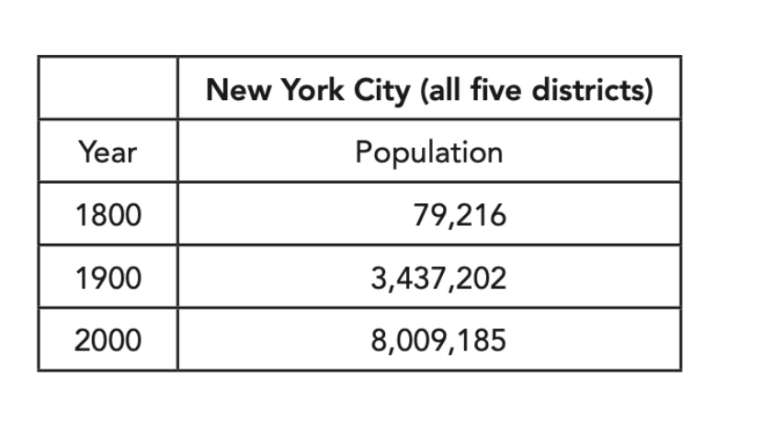
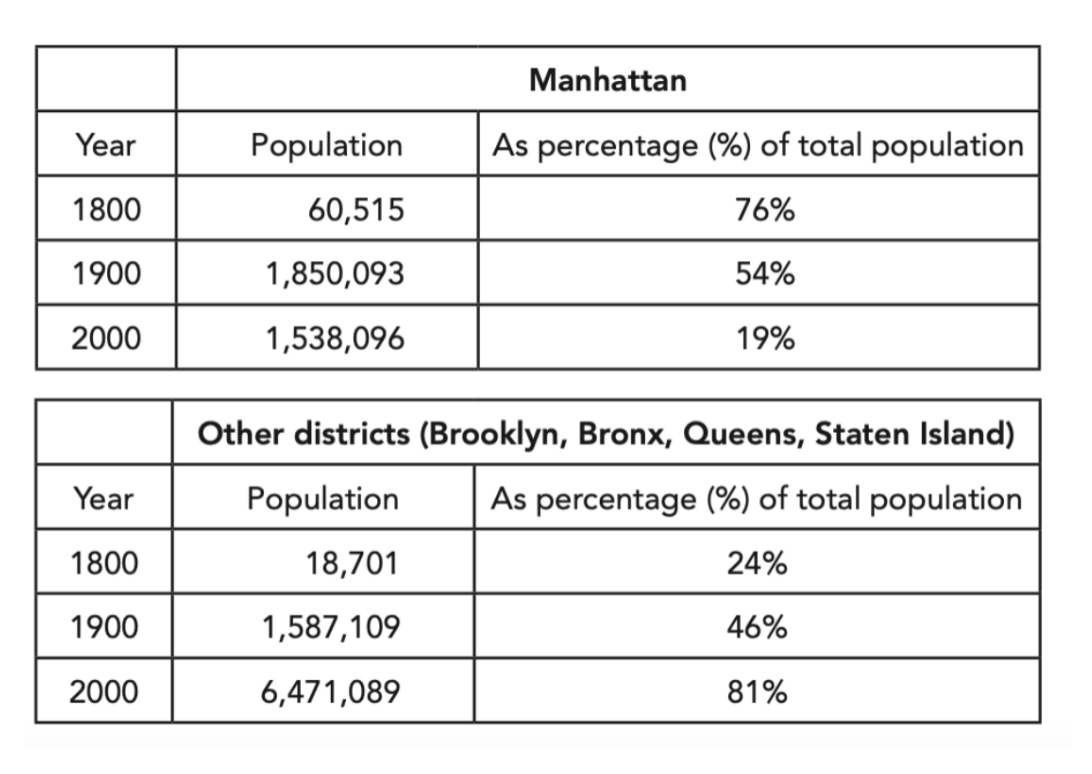
The first table below shows changes in the total population of New York City from 1800 to 2000. The second and third tables show changes in the population of the five districts of the city (Manhattan, Brooklyn, Bronx, Queens, Staten Island) over the same period.
Summarise the information by selecting and reporting the main features, and make comparisons where relevant.
Student answer (Band 6.0)
The tables detail population changes of New York City and other district's ( Manhattan, Brooklyn, Bronx, Queens, Staten Island) from 1800 to 2000.
Overall, New York City population scored over these two centuries.Manhattan popultaion share declined, other district's population and share scroed surged.
In 1800, the city had 79216 people.By 1900, this jumped to 3,437,202 and futher 8,009,185 in 2000.
Manhattan held 60,515 residents (76% of the total) in 1800. By 1900, its population grew to 1,850,093 but its share droped to 54%. By 2000, it fell to 1,538,096 and making up just 19% of the total.
The other districts had 18,701 people ( 24% of the total ) in 1800.In 1900, their population reached to 1,587,109 (46% of the total).By 2000, it scored to 6,471,089, accounting for 81% of the total city's population.
In short. New York City's overall population increased dramatically, Manhattan demographic influence warned. while other districts became far more poplous and dominat in the city's make up.
AI examiner evaluation
| Criterion | Band |
|---|---|
| Task Achievement / Task Response | 6.0 |
| Coherence and Cohesion | 6.0 |
| Lexical Resource | 5.5 |
| Grammatical Range and Accuracy | 5.5 |
| Overall | 6.0 |
Task Achievement / Task Response: Band 6.0
You cover the main changes and provide a clear overview: the city’s population rose substantially, while Manhattan’s share fell and the other districts’ share increased. The figures you report for 1800, 1900 and 2000 match the tables, and the comparison between Manhattan and the other districts is relevant. This addresses the task, although some features are more fully reported than others. In particular, the overview could state more precisely that Manhattan’s population itself peaked in 1900 and then declined, while the other districts grew continuously. The final sentence repeats the overview rather than adding a useful comparison. For a stronger response, make the overview more exact and use it to highlight the contrasting population trends as well as the changing shares.
Coherence and Cohesion: Band 6.0
The response has a coherent overall arrangement: an introduction and overview are followed by the city total, Manhattan, and the other districts. This sequence makes the data easy to follow, and time markers such as “By 1900” and “By 2000” help show change. However, cohesion is sometimes mechanical because the same time-led pattern is repeated in each paragraph, and the concluding “In short” restates the overview. Some punctuation also interrupts the flow, as in “In short. New York City's…” and the missing spaces after full stops in several places. Grouping the district comparisons more directly—for example, contrasting Manhattan’s decline after 1900 with the continued growth elsewhere—would create smoother progression and reduce repetition.
Lexical Resource: Band 5.5
You use relevant vocabulary for describing population and proportions, including “share,” “accounting for,” “declined,” and “increased dramatically.” These choices communicate the main trends, but several inaccurate or unnatural expressions weaken precision. “Population scored” and “share scroed surged” are not appropriate collocations for demographic data; “reached” or “rose” would be clearer. “Other district’s” uses an incorrect form, while “popultaion,” “droped,” “poplous,” and “domin at” contain spelling errors. “Demographic influence warned” also appears to be an unintended word choice and makes the final comparison unclear. Aim for accurate, conventional reporting language and check spelling and word forms carefully, especially in the overview.
Grammatical Range and Accuracy: Band 5.5
You use a mixture of simple statements and some more developed structures, such as “Manhattan held 60,515 residents (76% of the total) in 1800” and the clause beginning “By 2000.” The main comparisons are generally understandable, but some grammatical errors and punctuation problems remain. In “By 2000, it fell to 1,538,096 and making up just 19%,” the verb forms do not form a parallel construction; write “it fell … and made up” or “falling … and making up.” “In 1800, the city had 79216 people.By 1900” needs a space after the full stop, and “In short.” should not be a sentence fragment. Check sentence boundaries and keep verb forms consistent when joining actions. More accurate control of these patterns would make the response smoother.
See this exact question answered at other band scores. The same prompt compared across bands.
Browse more IELTS Writing model answers or get your own writing scored by the same AI examiner.