Band 6.0 IELTS Writing Task 1 Model Answer
Overall Band Score: 6.0 · Cambridge IELTS 20 · 2026-11-14
IELTS Writing Task 1 question
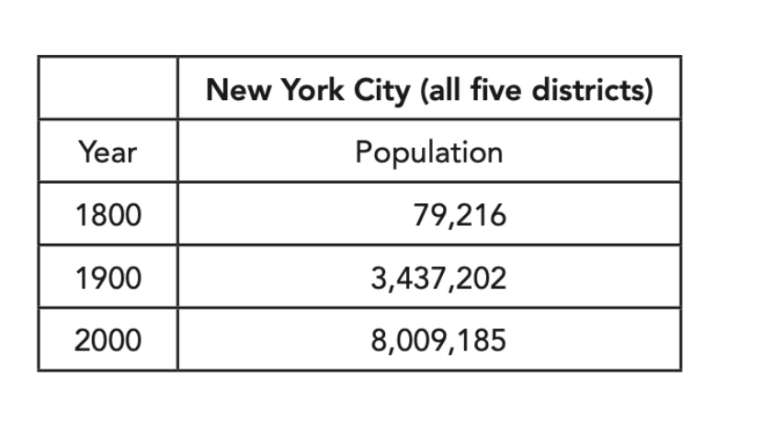
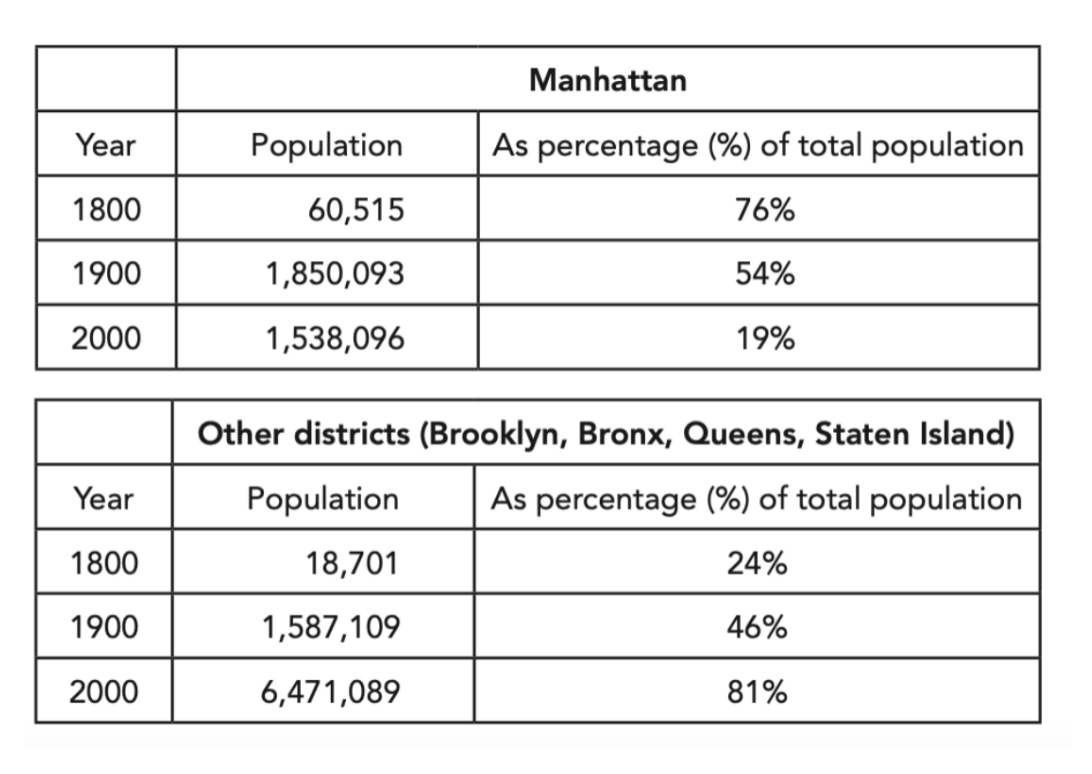
The first table below shows changes in the total population of New York City from 1800 to 2000. The second and third tables show changes in the population of the five districts of the city (Manhattan, Brooklyn, Bronx, Queens, Staten Island) over the same period.
Summarise the information by selecting and reporting the main features, and make comparisons where relevant.
Student answer (Band 6.0)
The first table illustrates how population in New York has changed from 1800 to 2000, while the second and third table displays changes in the population of Manhattan, Brooklyn, Bronx, Queens and Staten Island during the same time period.
Overall, there is an upward trend in population in New York city during the given time period. Although most people of New York lived in Manhattan district in 1800, the numbers drastically reduced by 2000, while New Yorkers choosing to live in Brooklyn, Bronx, Queens and Staten Island increased over the years.
In 1800, the total population of New York was 79,216 which shot upto 3,437,202 in 1900. This again peaked to 8,009,185 by 2000. Considering Manhattan, 76% of the total population of New York lived in Manhattan (60,515 people) in 1800. But by 2000 a major number of people moved out of Manhattan with only 19% of total New York population living in Manhattan (1,538,096).
While in other districts, in 1800, the total population was only 19% with 18,701 people living in Brooklyn, Bronx, Queens and Staten Island combined. In 1900 it almost doubled to 46% which again shot upto 81% in 2000 with 6,471,089 people living in all four districts.
AI examiner evaluation
| Criterion | Band |
|---|---|
| Task Achievement / Task Response | 6.0 |
| Coherence and Cohesion | 6.5 |
| Lexical Resource | 6.0 |
| Grammatical Range and Accuracy | 6.0 |
| Overall | 6.0 |
Task Achievement / Task Response: Band 6.0
You identify the main overall changes: New York’s population grew substantially, Manhattan’s share fell, and the combined share of the other districts rose. The figures for the city total and Manhattan are accurate, and you support the comparison with relevant numbers. However, there is an important inconsistency: the other districts accounted for 24% in 1800, not 19%; 19% is Manhattan’s share in 2000. Also, saying the other-district population “almost doubled” by 1900 is inaccurate: its share rose from 24% to 46%, while its population increased from 18,701 to 1,587,109. The response covers the main features, but this misreading and the limited development of the 1900 comparisons keep the account from being fully precise.
Coherence and Cohesion: Band 6.5
The response has a clear overall arrangement: an introduction, an overview, and paragraphs presenting the city total and district figures. The progression from the overall population to Manhattan and then the other districts is easy to follow. Linking expressions such as “Overall,” “Although,” and “While” help signal relationships, and the comparisons are generally grouped sensibly. However, the final paragraph begins with “While in other districts,” which does not connect smoothly to a complete main clause, and repeated time markers such as “in 1800” make some transitions feel mechanical. The 1900 figures are also not integrated consistently across the comparisons. More precise links between the years and a complete opening sentence for the final paragraph would make the progression more fluent.
Lexical Resource: Band 6.0
You use an adequate range of vocabulary for describing change, including “upward trend,” “drastically reduced,” “peaked,” and “combined.” These choices make the main trends understandable, and the response generally avoids excessive repetition. Some expressions are imprecise or too informal for a data summary: “shot upto” and “shot upto” are conversational, while “people moved out of Manhattan” claims migration that the tables do not establish. “The numbers drastically reduced” is also an awkward collocation, and “total population was only 19%” confuses a percentage with a population figure. Aim for neutral, data-focused wording and distinguish clearly between population totals and shares. More precise vocabulary would improve the accuracy and academic tone of the report.
Grammatical Range and Accuracy: Band 6.0
You use a mix of simple and complex sentence forms, including a clear overview sentence beginning “Although most people…” and a comparison introduced by “while.” Most sentences communicate the intended meaning, but some grammatical errors remain. In the introduction, “the second and third table displays” has a subject–verb agreement error; use “tables display.” The phrase “shot upto” should be written as two words, “shot up to,” though this is primarily a spelling/word-form issue. The final paragraph’s opening, “While in other districts, in 1800…,” is a dependent clause without a complete main clause, and “which again shot upto” has an unclear reference. Check agreement and ensure each sentence has a complete, clearly connected structure.
See this exact question answered at other band scores. The same prompt compared across bands.
Browse more IELTS Writing model answers or get your own writing scored by the same AI examiner.