Band 5.5 IELTS Writing Task 1 Model Answer
Overall Band Score: 5.5 · Cambridge IELTS 20 · 2026-11-14
IELTS Writing Task 1 question
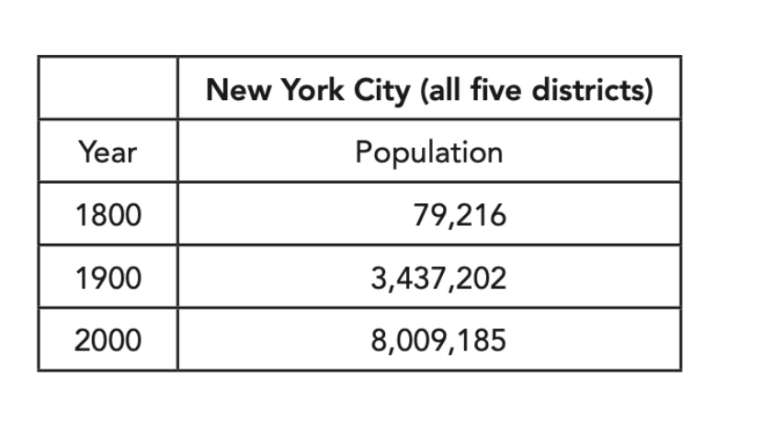
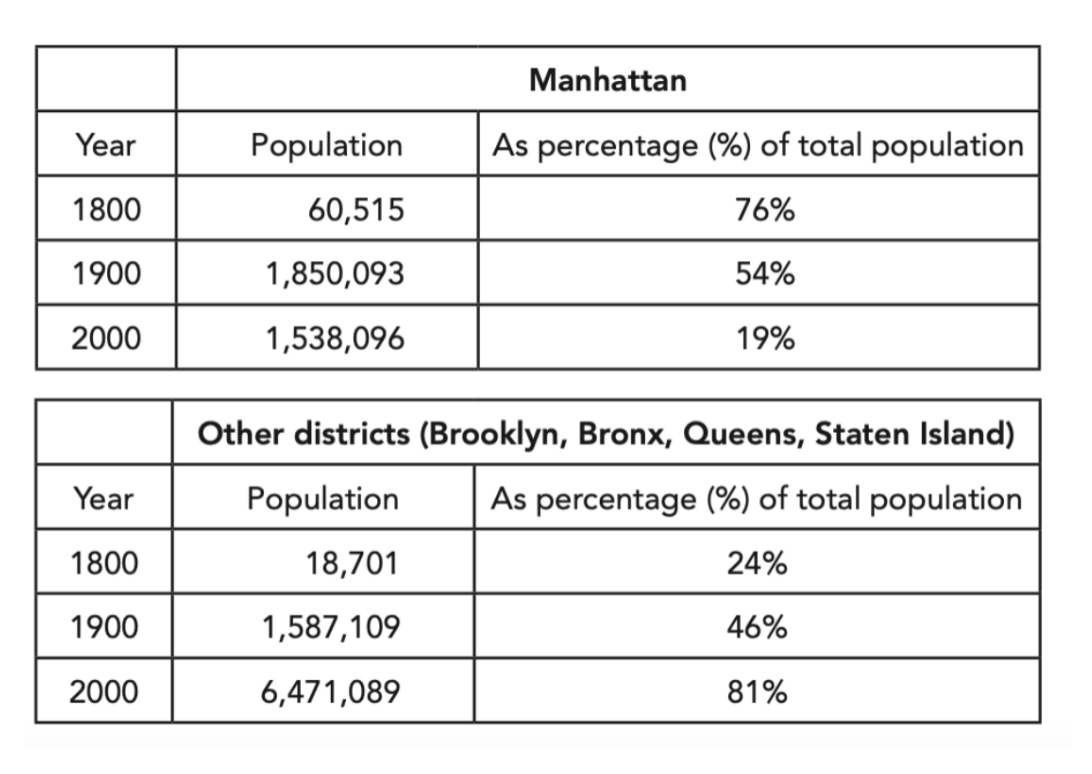
The first table below shows changes in the total population of New York City from 1800 to 2000. The second and third tables show changes in the population of the five districts of the city (Manhattan, Brooklyn, Bronx, Queens, Staten Island) over the same period.
Summarise the information by selecting and reporting the main features, and make comparisons where relevant.
Student answer (Band 5.5)
new york city's population expanded over the years from 1800 to 2000 , the population size and density was very low in 1800 it was about 79,216 but over the period population increased to a number of 8,009,185, it was clearly seen in the population census of the new york city. This census was of all five districts of the New York city including Manhattan, Brooklyn, Bronx, Queens, and Staten Island. In 1800 Manhattan had 76% of the total population which was around 60515 people, in 1900 it was 54% while in 2000 it was only 19% of the total population. As the other districts are concerned in 1800 they had 24% of the total population, in 1900, it was 46% while in 2000, population growed to 81% of the total population of the other four districts. This was all seen in the population census, Manhattan alone had more population than the other four districts in the New York city.
AI examiner evaluation
| Criterion | Band |
|---|---|
| Task Achievement / Task Response | 5.5 |
| Coherence and Cohesion | 5.0 |
| Lexical Resource | 5.5 |
| Grammatical Range and Accuracy | 5.0 |
| Overall | 5.5 |
Task Achievement / Task Response: Band 5.5
You identify the broad rise in New York City’s population and report the changing shares of Manhattan and the other districts, using several relevant figures. However, the response does not fully select and summarise the main features: it omits the 1900 and 2000 total population figures, and does not clearly highlight that the city’s total population rose throughout while Manhattan’s actual population peaked in 1900 and then fell by 2000. The final claim that Manhattan “alone had more population than the other four districts” is not supported across the period; it was true in 1800 and 1900, but not in 2000. A clearer overview and more accurate comparison of absolute populations would make the report more complete.
Coherence and Cohesion: Band 5.0
The response moves from the citywide population to Manhattan and then to the other districts, so the reader can follow its general subject. However, it is presented as one long paragraph, with no distinct overview to guide the comparison. Linking phrases such as “As the other districts are concerned” and repeated references to “the population census” do not create a clear progression and sometimes make relationships between figures less precise. The final sentence also introduces a broad comparison without specifying the year, which weakens the flow of the report. Organise the response into an introduction, an overview, and a paragraph comparing the district figures; use concise links such as “By contrast” and “By 2000” where they clarify the trend.
Lexical Resource: Band 5.5
You use relevant topic vocabulary, including “population,” “total population,” “districts,” and “census,” and the main meaning is generally understandable. However, the range is limited and some choices are imprecise or repetitive. “Population size and density” introduces density, which the tables do not measure, while “population growed” is an incorrect word form and “it was clearly seen” is vague. Repeating “population” and “total population” also makes the account less concise. Choose terms that describe the data precisely and vary them where appropriate—for example, “the city’s population,” “accounted for,” and “share.” More accurate collocations would help the report sound clearer and more suited to formal data description.
Grammatical Range and Accuracy: Band 5.0
You attempt to combine information in longer sentences, including the comparison beginning “In 1800 Manhattan had 76% …,” but control is uneven and the response relies heavily on simple or loosely joined clauses. Errors in sentence boundaries and punctuation appear in the opening, where several ideas are joined with commas, and capitalisation is inconsistent in “new york city.” There are also problems with agreement and tense, such as “the population size and density was” and “population growed.” The phrase “in 2000 it was only 19%” would be clearer with a more explicit subject. Use shorter, accurately punctuated sentences alongside controlled complex structures, and check subject–verb agreement and past-tense forms.
See this exact question answered at other band scores. The same prompt compared across bands.
Browse more IELTS Writing model answers or get your own writing scored by the same AI examiner.