Band 6.0 IELTS Writing Task 1 Model Answer
Overall Band Score: 6.0 · Cambridge IELTS 20 · 2026-11-14
IELTS Writing Task 1 question
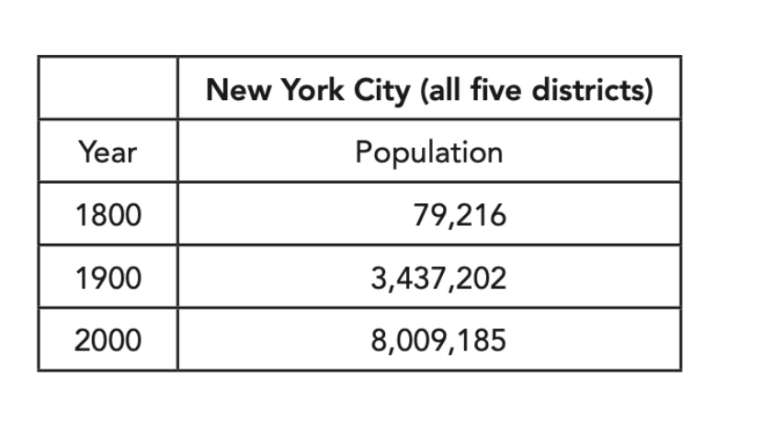
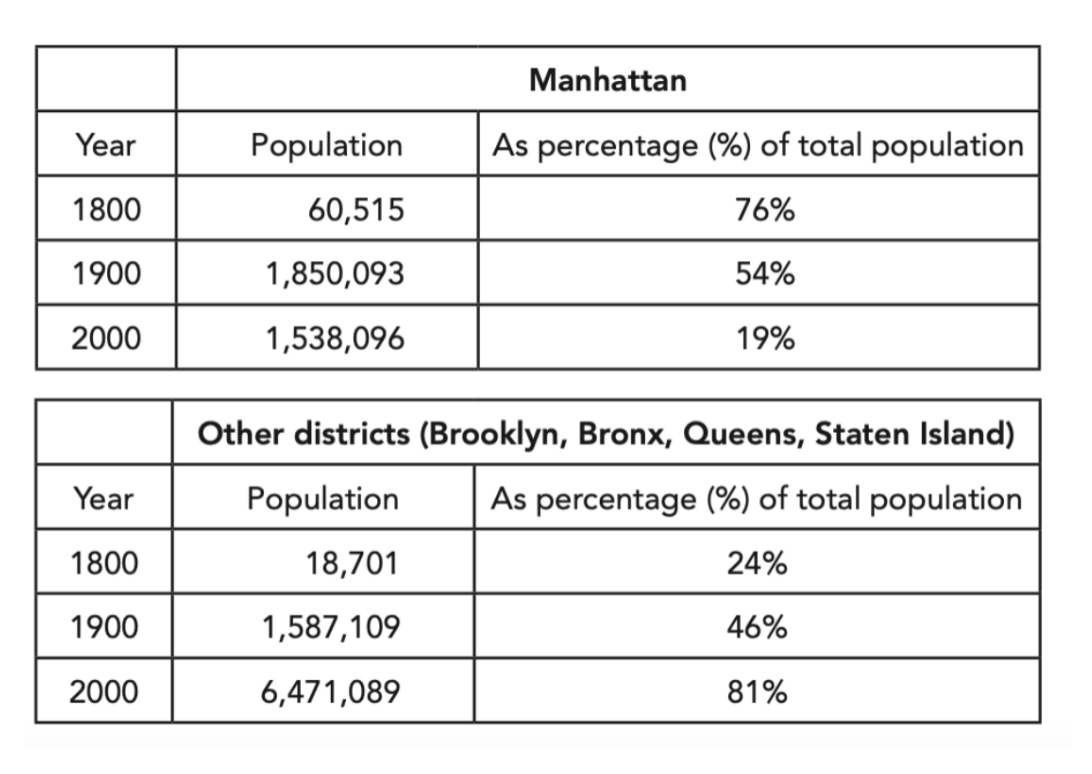
The first table below shows changes in the total population of New York City from 1800 to 2000. The second and third tables show changes in the population of the five districts of the city (Manhattan, Brooklyn, Bronx, Queens, Staten Island) over the same period.
Summarise the information by selecting and reporting the main features, and make comparisons where relevant.
Student answer (Band 6.0)
The tables present the change in population of the New York City between 1800 and 2000, another table is particularly for Manhattan district and one is for districts including Brooklyn, Bronx, Queens and Staten Island.
Overall, there is a rise in the total population of the New York City. Mantattan district had the highest share of the people from 1800 to 1900 which gets overtaken by the other four districts in 2000.
In 1800, about 79,216 were living in the New York City which rose significantly in 1900 to over three lacs and reached over eight lacs in 2000.
The Manhattan district had more than a half of the total population share of the city with 76% people in 1800 and 54% in 1900. Brooklyn, Brons, Queens, Staten Island together accounted for less than half of the total population. During 2000 less people were residing in Manhattan which was about 19% of the total while 81% of people were living in the other four districts of the New York City.
AI examiner evaluation
| Criterion | Band |
|---|---|
| Task Achievement / Task Response | 6.5 |
| Coherence and Cohesion | 6.5 |
| Lexical Resource | 5.5 |
| Grammatical Range and Accuracy | 5.5 |
| Overall | 6.0 |
Task Achievement / Task Response: Band 6.5
You identify the main overall changes: the city’s population grew substantially, and Manhattan’s share fell while the other districts’ share rose. The overview is relevant, and the percentages for 1800, 1900 and 2000 are reported accurately. However, the total-population figures are seriously misrepresented: 3,437,202 is described as “over three lacs” and 8,009,185 as “over eight lacs,” which are far below the actual values. Also, Manhattan’s absolute population peaked in 1900 and then declined by 2000, an important feature that is not clearly reported. The response covers the task, but some key data and comparisons need more precise development. Include accurate figures and distinguish population totals from percentage shares.
Coherence and Cohesion: Band 6.5
The response has a clear overall arrangement: an introduction, an overview, and paragraphs giving figures and district comparisons. The progression from the city-wide trend to the changing distribution between Manhattan and the other districts is easy to follow. Linking phrases such as “Overall,” “In 1800,” and “During 2000” help signal the stages, although the last phrase is not a natural time reference. Some connections are also repetitive, particularly the repeated use of “total population” and “district.” The opening sentence joins two separate points with a comma, making the relationship between the tables less clear. To strengthen cohesion, use more precise references to the tables and vary transitions while keeping the chronological comparisons explicit.
Lexical Resource: Band 5.5
You use relevant vocabulary for describing trends and proportions, including “rise,” “share,” “accounted for,” and “residing.” This gives you enough language to communicate the main comparisons. However, several word choices or forms are inaccurate or unnatural: “the change in population of the New York City,” “the highest share of the people,” and “less people” weaken precision. “Three lacs” and “eight lacs” are also unsuitable for this context and make the population figures difficult to interpret; use standard numerical expressions such as “3.4 million” and “8 million.” There are spelling errors in “Mantattan” and “Brons.” Aim for accurate, conventional demographic vocabulary and check spelling, especially for place names and numerical terms.
Grammatical Range and Accuracy: Band 5.5
You attempt a mixture of simple and more complex sentences, including the relative clause in “which gets overtaken” and the contrast introduced by “while.” The main meaning is generally understandable, but some grammatical errors recur. For example, “the New York City” uses an unnecessary article, and “another table is particularly for Manhattan district” has an incomplete article pattern. In “which gets overtaken,” the tense does not fit the historical period; use a past form. The opening sentence is a comma splice, while “In 1800, about 79,216 were living” lacks a clear noun for the population figure. Work on articles, tense consistency, and complete sentence structures, then proofread punctuation. More accurate control of these patterns would make the comparisons clearer.
See this exact question answered at other band scores. The same prompt compared across bands.
Browse more IELTS Writing model answers or get your own writing scored by the same AI examiner.