Band 6.0 IELTS Writing Task 1 Model Answer
Overall Band Score: 6.0 · Cambridge IELTS 20 · 2026-11-14
IELTS Writing Task 1 question
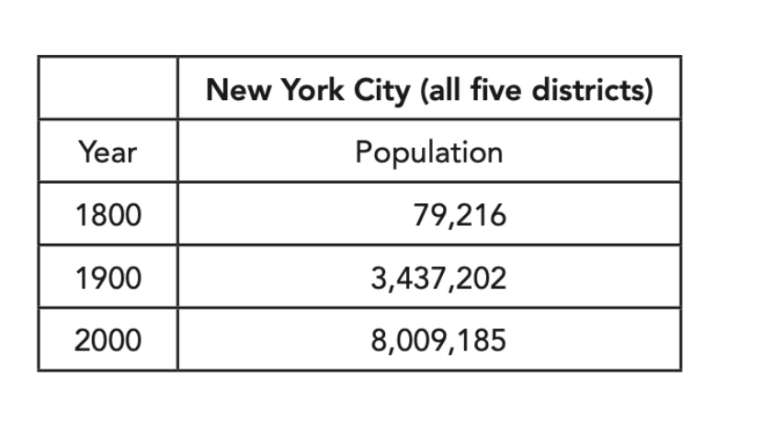
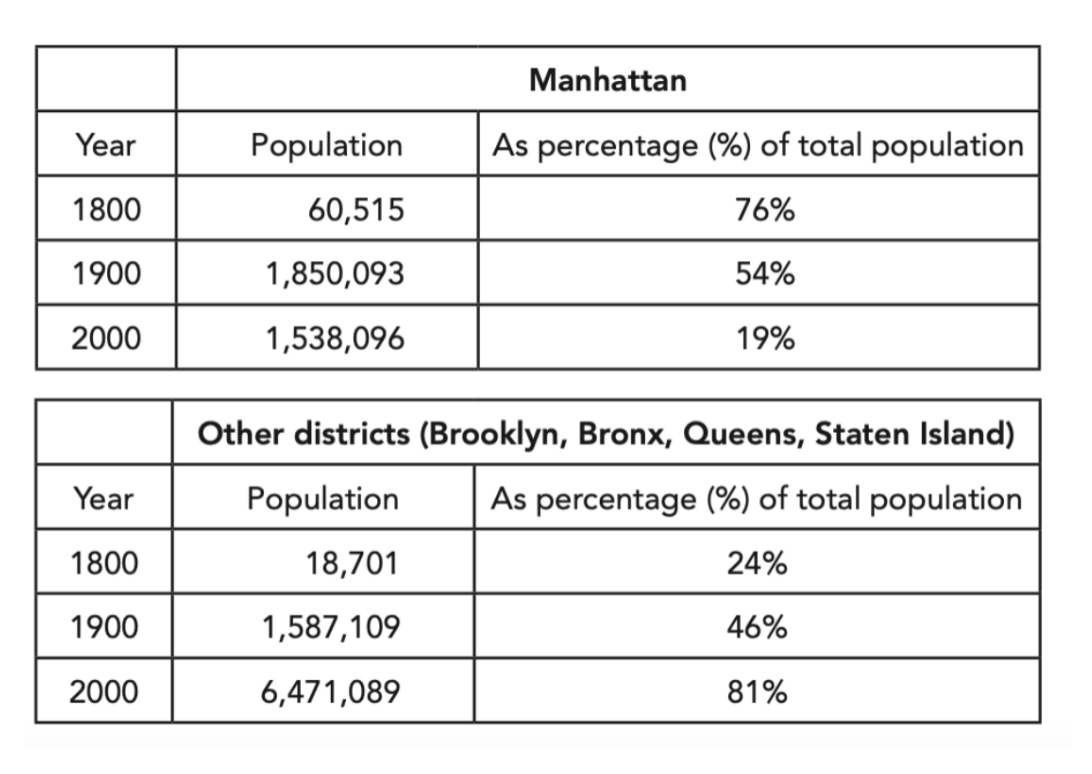
The first table below shows changes in the total population of New York City from 1800 to 2000. The second and third tables show changes in the population of the five districts of the city (Manhattan, Brooklyn, Bronx, Queens, Staten Island) over the same period.
Summarise the information by selecting and reporting the main features, and make comparisons where relevant.
Student answer (Band 6.0)
The tables gives information about the total number of people in New york city for a period of 2decades 1800 to 2000.Units measured in percentage.
Overall, it is evidented that Manhattan town contributed greatly to the large population conpared with the 4 towns combined.However, by 2000 the ratio of the four towns increased drastically outstanding that of Manhattan.
To start with, Manhattan contributed 76 % of the New yorks growth in 1800 and by 1900 it had further increased to 54% compared with the other cities.Meanwhile the other fiur cities had 24% and reached 46% in 1900 respectively.
However, Manhattan experienced a turnover by 2000,its ratio reduced to 19% while the other four cities increase rapidly to 81%.And this collectively resulted in the Bew york's to reach 8,009,185 occupants by 2000.
AI examiner evaluation
| Criterion | Band |
|---|---|
| Task Achievement / Task Response | 5.5 |
| Coherence and Cohesion | 6.5 |
| Lexical Resource | 5.5 |
| Grammatical Range and Accuracy | 5.5 |
| Overall | 6.0 |
Task Achievement / Task Response: Band 5.5
You identify the main shift in the districts’ shares: Manhattan falls from 76% to 19%, while the other four districts rise from 24% to 81%. You also report the city’s 2000 total accurately. However, the opening says the tables cover “2 decades,” although they span 200 years, and the overview’s claim that Manhattan contributed more than the other districts is not true across the whole period: by 1900 its share was only 54%, and by 2000 it was much smaller. The response omits the total population figures for 1800 and 1900 and does not mention that Manhattan’s population itself peaked in 1900 before declining. It is also 19 words below the required minimum. Add a fuller, accurate overview and select key figures to support it.
Coherence and Cohesion: Band 6.5
The response has a recognisable structure: an introduction, an overview, and two paragraphs describing the changes. The sequence from 1800 to 2000 is generally easy to follow, and transitions such as “Meanwhile” and “However” help signal comparisons. This coherent arrangement is a strength. However, the overview and body do not always connect clearly: the claim that Manhattan contributed more than the other districts conflicts with the later account of its declining share. Some linking is also mechanical, with “However” beginning both the overview and the final body paragraph, where a more precise contrast would help. Improve progression by grouping the citywide totals together and then comparing Manhattan with the combined other districts, using clear references to the relevant years.
Lexical Resource: Band 5.5
You use some relevant vocabulary for describing data, including “ratio,” “increased,” “reduced,” and “collectively,” so the reader can understand the broad comparison. However, the range is limited and several choices are inaccurate or unnatural for this task. “Manhattan town” and “other cities” mislabel districts, while “contributed … to the large population” and “Manhattan’s growth” do not accurately describe the percentages shown. There are also noticeable spelling errors, including “evidented,” “conpared,” “fiur,” and “Bew york’s,” which reduce clarity. Use precise terms such as “share of the total population,” “districts,” and “population rose/fell,” and check spelling carefully. This would make the description more accurate and fluent.
Grammatical Range and Accuracy: Band 5.5
You attempt both simple and more complex sentence forms, including a contrast introduced by “while” and a time clause in “by 2000.” The main comparisons are usually understandable, but some grammatical errors and punctuation problems remain. For example, “The tables gives” has subject–verb disagreement, and “the other four cities increase rapidly” uses the wrong tense for a change completed by 2000. The opening sentence also has an unclear time expression, and several sentences run together without spaces after full stops or commas. The phrase “this collectively resulted in the Bew york’s to reach” is structurally faulty and obscures the intended meaning. Use past-tense verbs consistently for historical data, check agreement, and separate clauses with accurate punctuation.
See this exact question answered at other band scores. The same prompt compared across bands.
Browse more IELTS Writing model answers or get your own writing scored by the same AI examiner.