Band 5.5 IELTS Writing Task 1 Model Answer
Overall Band Score: 5.5 · Cambridge IELTS 20 · 2026-11-14
IELTS Writing Task 1 question
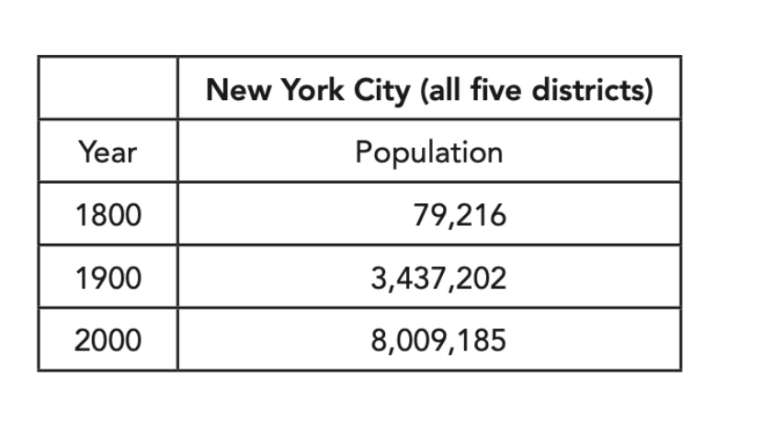
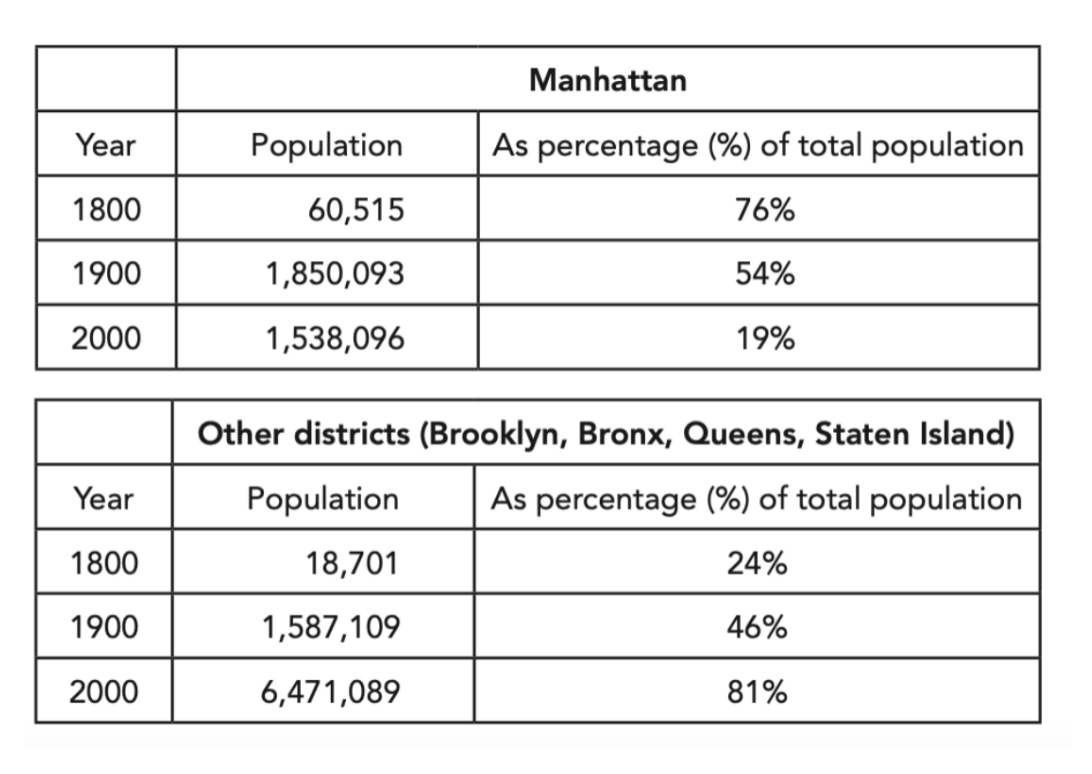
The first table below shows changes in the total population of New York City from 1800 to 2000. The second and third tables show changes in the population of the five districts of the city (Manhattan, Brooklyn, Bronx, Queens, Staten Island) over the same period.
Summarise the information by selecting and reporting the main features, and make comparisons where relevant.
Student answer (Band 5.5)
The first table shows the changes in the total population of New York between three hunder years. It shows the increasing or decreasing of individuals from 1800 to 2000. However, the other two tables show the rising or declining of population seperately. The second table shows the population of Manhattan while third table shows the the percentage of individuals in Brooklyn, Bronx, Queens, and Staten Island situated in New York.
Overall, the total number of population of all five districts were increased in 2000 rather than other two centuries. While comparing it seperately the large number of population were higher in Manhattan district while lower percentage in other five distrects.
The total number of population is 79,216 in the year 1800 while it was rapidly increased in 1900 and reached 3,437,202. Moreover, the number of population were highly increased in 2000 and stopped at 8,437,185.
The number of population in Manhattan were 60,515 in 1800 which was at 76%. There was increased in population at 1,850,093 but decline in percentage which was at 54% in 1900 while there was a rapid decreased in population at 1,538,096 but a huge decline in percentage at 19% then other four districts. on the otherhand, the number of population in other four districts were relatively less than Manhattan at 18,701 in 1800 which is at 24% and 1,587,109 at 46% in 1900. But, there was relatively higher increased in the last decade at 6,471,089 which reached at 81% in 2000.
AI examiner evaluation
| Criterion | Band |
|---|---|
| Task Achievement / Task Response | 5.5 |
| Coherence and Cohesion | 5.5 |
| Lexical Resource | 5.0 |
| Grammatical Range and Accuracy | 5.0 |
| Overall | 5.5 |
Task Achievement / Task Response: Band 5.5
You identify the broad population growth and make relevant comparisons between Manhattan and the other districts, including the shift in their shares from 76% versus 24% in 1800 to 19% versus 81% in 2000. However, the overview is unclear in places: saying Manhattan had a “large number” while the other districts had a “lower percentage” does not capture the key reversal by 2000. There is also a significant factual error: the city total in 2000 was 8,009,185, not 8,437,185. The response reports several useful figures, but the main trends are not consistently selected or accurately summarised. State the overall growth and the changing balance between Manhattan and the other districts clearly, then check each figure against the tables.
Coherence and Cohesion: Band 5.5
The response has a recognisable structure, moving from an introduction to an overview and then to details, and it uses linking expressions such as “Overall,” “Moreover,” and “on the other hand.” However, progression is weakened by repetition and unclear references. The opening repeats that the tables show population changes, while “the other two tables” and “the third table” are not described consistently. The overview’s comparison of Manhattan with the “other five districts” is confusing because the table groups four other districts. The final paragraph also combines several years and comparisons in a long sentence, making the relationships harder to follow. Organise the details by time period or by Manhattan versus the combined other districts, and use shorter sentences with precise references.
Lexical Resource: Band 5.0
Your vocabulary is sufficient to communicate the topic, with relevant terms such as “population,” “percentage,” “decline,” and “increased.” However, the range is limited and several word choices or collocations are inaccurate or repetitive. Phrases such as “the increasing or decreasing of individuals,” “number of population,” and “stopped at” are not natural ways to describe demographic data. “Rapid decreased” also uses the wrong form, and “distrects” and “seperately” are misspelled. These choices sometimes make the intended comparison less clear. Use standard data-reporting language, for example, “the population rose to,” “accounted for,” and “fell to,” and check spelling and word forms carefully.
Grammatical Range and Accuracy: Band 5.0
You attempt both simple and more complex sentences, including contrasts introduced by “while” and “although”-type relationships, but complex constructions are often faulty and errors occur frequently. Examples include “the total number of population … were increased,” where the subject and verb do not agree and the passive form is unsuitable, and “There was increased in population,” which lacks a correct verb pattern. Articles are also omitted in “while third table,” and the sentence beginning “The number of population in Manhattan were…” has agreement problems. Several long sentences join multiple comparisons without clear punctuation, particularly in the final paragraph. Practise accurate past-tense reporting patterns such as “the population increased” and “Manhattan’s share fell,” and separate contrasting data into complete, controlled sentences.
See this exact question answered at other band scores. The same prompt compared across bands.
Browse more IELTS Writing model answers or get your own writing scored by the same AI examiner.