Band 5.5 IELTS Writing Task 1 Model Answer
Overall Band Score: 5.5 · Cambridge IELTS 20 · 2026-11-14
IELTS Writing Task 1 question
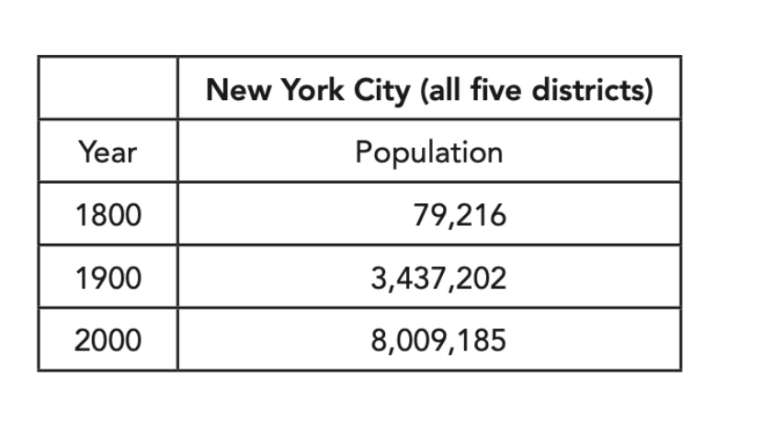
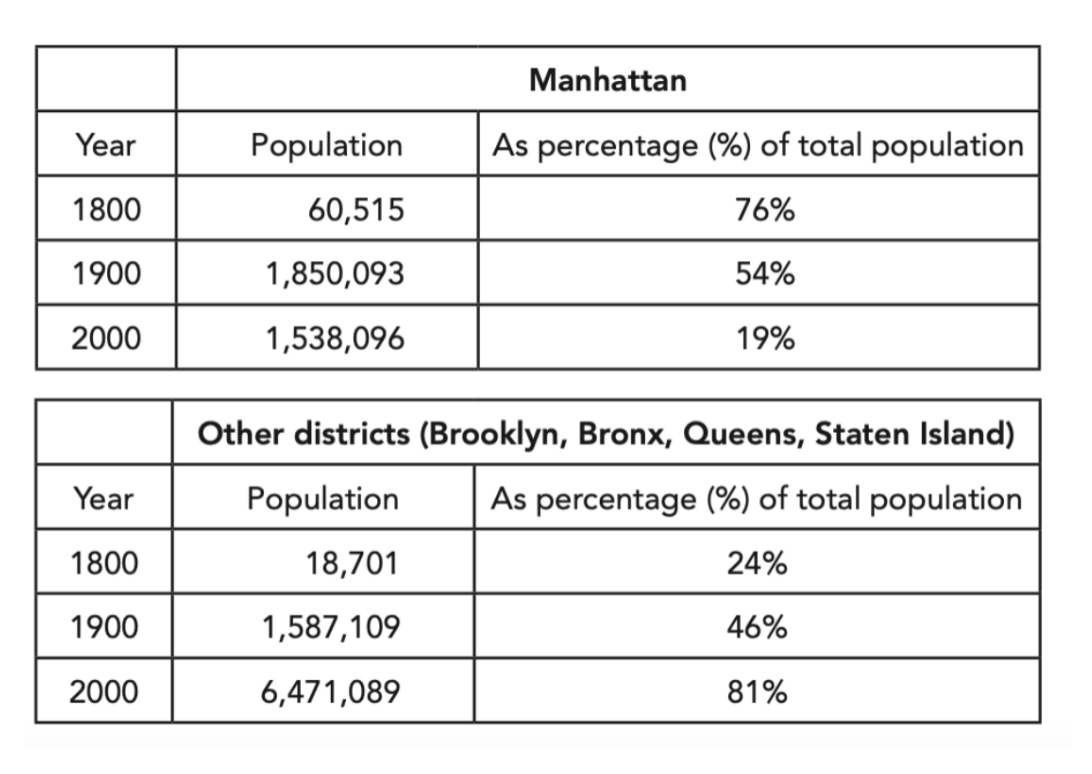
The first table below shows changes in the total population of New York City from 1800 to 2000. The second and third tables show changes in the population of the five districts of the city (Manhattan, Brooklyn, Bronx, Queens, Staten Island) over the same period.
Summarise the information by selecting and reporting the main features, and make comparisons where relevant.
Student answer (Band 5.5)
The tables present data about the population of New York City and changes in the number of people in five different districts ( Manhattan, Brooklyn, Bronx, Queens and Staten Island) from 1800 to 2000.
Overall, the population surged over the period given Manhattan's population decreased by the time while other four districts grew in the period given.
In the year of 1800, the overall population of the New York City was 79,216 and increased upto 3,437,202 in 1900 and reached to 8,009,185 in 2000. Moreover, Manhattan's number of people was 60,515 in the starting (1800) with 76% of the whole, after that there was a declined in the growth of the population to 54% with 1,850,093 people. in the end of the report, growth was only 19% with the figure of 1,538,096.
Further more, remaing four districts grew by the time. In 1800 the population was only 18,701 with 24% and got doubled in 1900 with 1,587,109 people while in the endng the number reached to 6,471,089 81% of the whole percentage.
To sum up, All the five states grew overthe period Manhattan's rate of growth was reduced by the time while the remaining four districts increased significantly in the period given.
AI examiner evaluation
| Criterion | Band |
|---|---|
| Task Achievement / Task Response | 5.5 |
| Coherence and Cohesion | 5.5 |
| Lexical Resource | 5.5 |
| Grammatical Range and Accuracy | 5.0 |
| Overall | 5.5 |
Task Achievement / Task Response: Band 5.5
You identify the main overall contrast: New York City’s total population rose substantially, while Manhattan’s share fell and the other districts’ share increased. You also include the key figures for all three years, so the response is relevant and gives a basic account of the tables. However, some comparisons are underdeveloped or unclear. For example, Manhattan’s population did not simply decrease over the whole period: it rose sharply from 60,515 to 1,850,093 by 1900, then fell to 1,538,096. The other districts’ population also did not merely “get doubled” between 1800 and 1900; the figures show a much larger increase. Make the overview more precise and distinguish changes in population from changes in percentage share.
Coherence and Cohesion: Band 5.5
The response has a recognisable structure, with an introduction, an overview and paragraphs reporting the figures. The information is generally grouped by the total population, Manhattan and the other districts, which helps the reader follow the main categories. However, progression is weakened by repetitive or imprecise linking, such as “after that,” “in the end of the report” and “To sum up.” The final sentence repeats the overview rather than adding a useful comparison. Some references are also unclear: “the figure” and “the whole percentage” do not specify exactly what is being compared. Use clearer links between years and groups, and organise the details so that each comparison follows directly from the relevant figures.
Lexical Resource: Band 5.5
You use enough topic vocabulary to communicate the basic trends, including “population,” “districts,” “increased” and “decreased.” There are also attempts at more varied expressions, such as “surged” and “significantly.” However, the range is limited and several word choices or collocations are inaccurate, which makes some descriptions imprecise. For instance, “declined in the growth” does not clearly describe the fall in Manhattan’s population after 1900, while “got doubled” misrepresents the scale of change in the other districts. Spelling errors such as “remaing” and “endng” are noticeable. Choose precise trend language and check spelling; distinguish a population’s size from its percentage share.
Grammatical Range and Accuracy: Band 5.0
The response attempts both simple and more extended sentence forms, and the main message is usually understandable. However, grammatical errors are frequent, and some complex constructions are faulty. Examples include “Manhattan's population decreased by the time,” “In the year of 1800,” and “increased upto 3,437,202 … and reached to 8,009,185.” These show problems with tense and verb patterns, articles, prepositions and sentence construction. Capitalisation and punctuation are also inconsistent, as in the lowercase “in” after a full stop and the comma splice in the overview. Practise accurate past-tense reporting and standard patterns such as “rose to” and “fell to,” then proofread each sentence for complete structure and punctuation.
See this exact question answered at other band scores. The same prompt compared across bands.
Browse more IELTS Writing model answers or get your own writing scored by the same AI examiner.