Band 5.5 IELTS Writing Task 1 Model Answer
Overall Band Score: 5.5 · Cambridge IELTS 20 · 2026-11-15
IELTS Writing Task 1 question
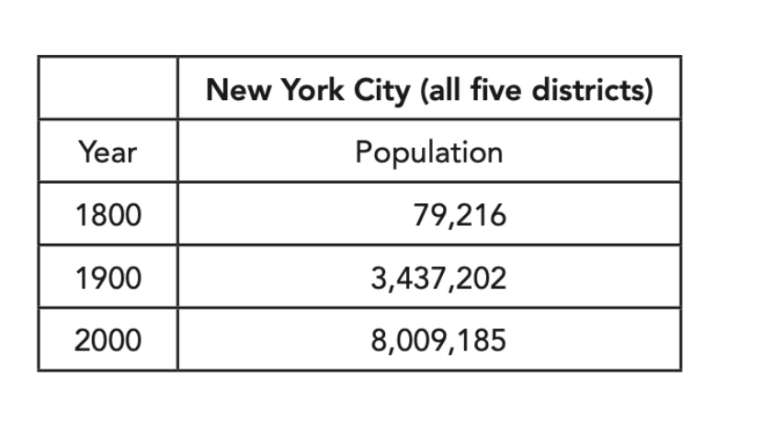
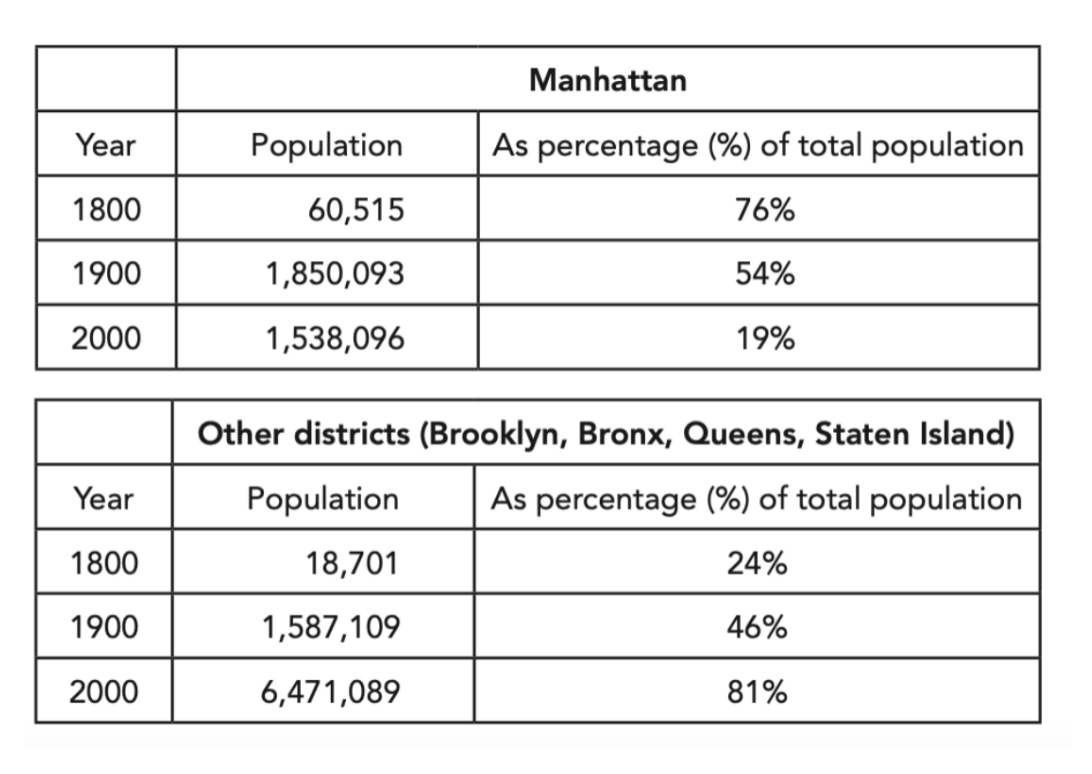
The first table below shows changes in the total population of New York City from 1800 to 2000. The second and third tables show changes in the population of the five districts of the city (Manhattan, Brooklyn, Bronx, Queens, Staten Island) over the same period.
Summarise the information by selecting and reporting the main features, and make comparisons where relevant.
Student answer (Band 5.5)
The tables illustrate information regarding the change in population of new York city over a period of 2 decade from 1800 to 2000.
Overall, the main table showed the population of all five districts of New york city. It showed highest figure in 2000, followed by the 1800 that showed lowest proportion of population. Consequently, the proportion was comparsing in between during 1900.
Looking more closely in the table two, showed the population of one city in which the population was 76% in 1800. while the population was 54% in 1900. And the population decreased more in 2000 at 19%.
Furthurmore, the table 3 showed the popoulation of other four district of New york where the population showed reverse trend. The population in 1800 increased by 17%. Whereas the proportion of population in 1900 was 46%. The population in 2000 incsease at double rate then in 1900. The population showed 80% in 2000.
AI examiner evaluation
| Criterion | Band |
|---|---|
| Task Achievement / Task Response | 5.5 |
| Coherence and Cohesion | 5.5 |
| Lexical Resource | 5.0 |
| Grammatical Range and Accuracy | 5.0 |
| Overall | 5.5 |
Task Achievement / Task Response: Band 5.5
You identify the broad contrast between Manhattan and the other districts, and correctly report Manhattan’s shares of 76%, 54% and 19%, as well as the other districts’ 46% share in 1900. However, the overview is unclear and focuses on the total population’s ranking rather than the key pattern: the city grew substantially overall, while Manhattan’s share fell and the other districts’ share rose. Some figures are inaccurate or confused: the other districts had 24%, not 17%, in 1800, and their 2000 share was 81%, not 80%. You also describe percentages as population figures and omit the actual total-population values. Select the main trends clearly and distinguish population counts from percentages.
Coherence and Cohesion: Band 5.5
The response has a basic paragraph structure, moving from an introduction and overview to Manhattan and then the other districts. This gives the reader some sense of organisation. However, progression within paragraphs is often unclear, and several linking expressions do not show the intended relationship. For example, “Consequently, the proportion was comparsing in between” does not clearly explain the 1900 total, while “Whereas” begins a fragment rather than a complete contrast. Repeated openings such as “the population” and references to “table two” and “table 3” also make the account feel mechanical. Organise the body around the main comparison, use clear references to the figures, and connect each year’s change explicitly.
Lexical Resource: Band 5.0
You use some relevant task vocabulary, including “population,” “proportion,” “decreased,” and “reverse trend,” so the topic is generally recognisable. However, the range is limited and several word choices or collocations make the meaning imprecise. “The population was 76%” should refer to Manhattan’s share of the city total, while “increased by 17%” does not accurately express the other districts’ 24% share. There are also noticeable spelling errors, including “Furthurmore,” “popoulation,” “comparing,” and “incsease.” Use precise terms such as “accounted for” or “represented” when describing shares, and check spelling and word forms carefully.
Grammatical Range and Accuracy: Band 5.0
The response attempts a few longer structures, such as “The population in 2000 incsease at double rate then in 1900,” but most sentences rely on simple patterns and several are incomplete or difficult to follow. For instance, “Looking more closely in the table two, showed…” lacks a clear subject, and “while the population was 54% in 1900” is incorrectly attached after a full stop with a lowercase opening. Tense and agreement are also inconsistent: “the main table showed” shifts from the present-tense introduction, and “the population … increase” lacks the correct verb form. Practise complete sentences with clear subjects, consistent past-tense reporting, and accurate punctuation when joining contrasts.
See this exact question answered at other band scores. The same prompt compared across bands.
Browse more IELTS Writing model answers or get your own writing scored by the same AI examiner.