Band 4.0 IELTS Writing Task 1 Model Answer
Overall Band Score: 4.0 · Cambridge IELTS 20 · 2026-11-15
IELTS Writing Task 1 question
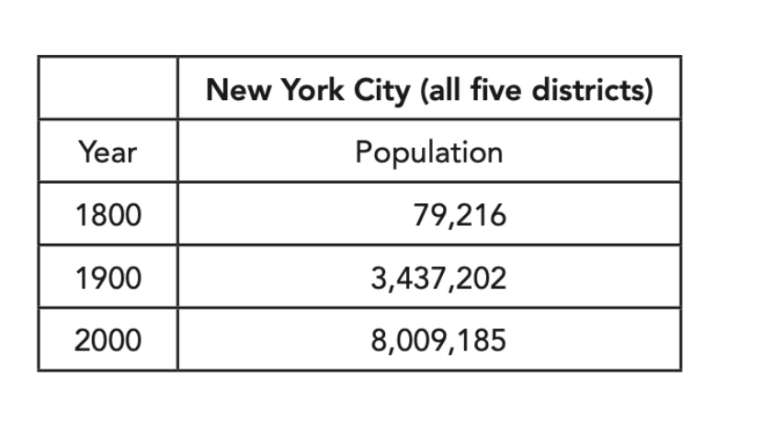
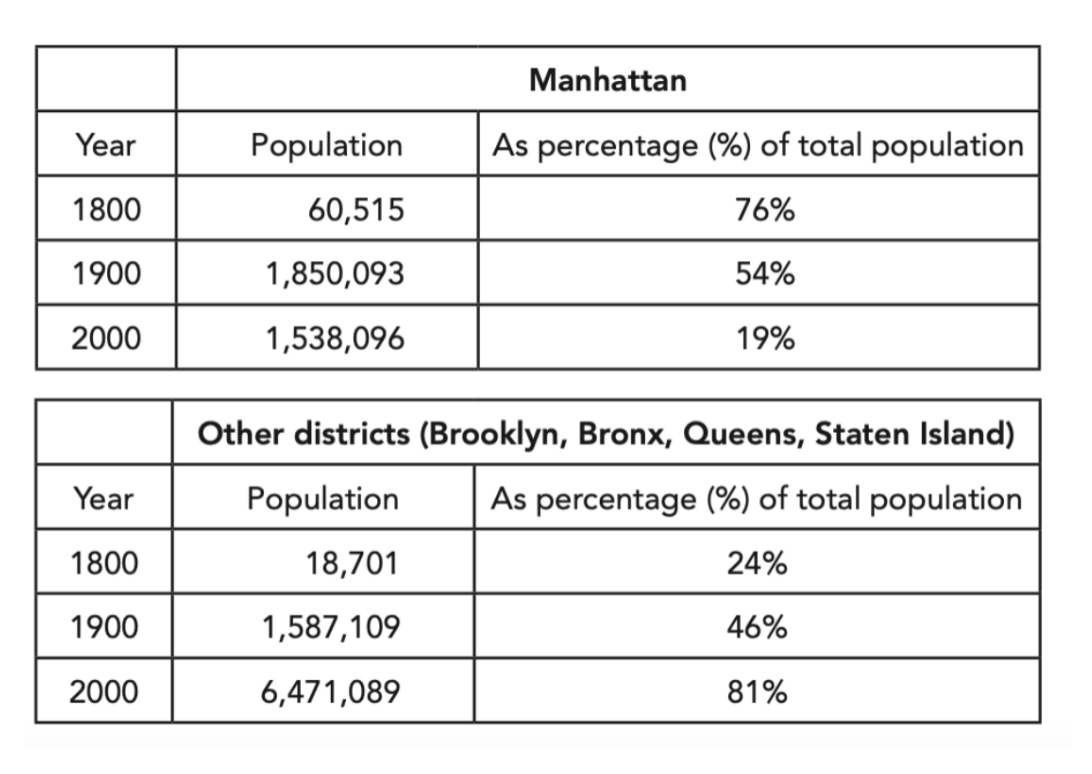
The first table below shows changes in the total population of New York City from 1800 to 2000. The second and third tables show changes in the population of the five districts of the city (Manhattan, Brooklyn, Bronx, Queens, Staten Island) over the same period.
Summarise the information by selecting and reporting the main features, and make comparisons where relevant.
Student answer (Band 4.0)
the tables illustrate the change in the whole population of New York city in five districts between 1800 to 2000. overall population rose in every district. in the start district Manhattan shows high population percentage but in the end other districts show sharply grew population.
by 1800 Manhattan district has 76 percentage
AI examiner evaluation
| Criterion | Band |
|---|---|
| Task Achievement / Task Response | 3.0 |
| Coherence and Cohesion | 4.0 |
| Lexical Resource | 4.5 |
| Grammatical Range and Accuracy | 4.5 |
| Overall | 4.0 |
Task Achievement / Task Response: Band 3.0
The response identifies two relevant broad features: New York’s population increased overall, and Manhattan’s share was larger at the beginning while the other districts’ share grew by the end. However, it gives almost no supporting information: the only figure reported is that Manhattan had “76 percentage” in 1800, with no comparison across the three years or mention of the city’s total population. The statement that population rose “in every district” is not established by the tables, which group the four other districts together. The response is also far below the required 150 words, leaving the task only minimally addressed. To improve, report key figures and changes, including Manhattan’s decline after 1900 and the other districts’ rise to 81% by 2000.
Coherence and Cohesion: Band 4.0
There is a basic sequence: an opening description is followed by an overall statement and then a detail about 1800. The use of “overall” signals an attempt to distinguish the main trend from a specific figure. However, the response ends abruptly after “by 1800 Manhattan district has 76 percentage,” so there is no developed progression or conclusion, and the relationship between the citywide trend and district shares remains unclear. The ideas are not separated into purposeful paragraphs, and the few linking expressions do not connect a fuller account. Organise the response into an introduction, an overview, and one or two detail paragraphs, using clear comparisons between 1800, 1900 and 2000.
Lexical Resource: Band 4.5
The response uses a small set of relevant terms, including “population,” “district,” “percentage,” and “sharply grew,” so the topic is generally recognisable. However, the vocabulary is limited and some combinations are unnatural or imprecise: “whole population … in five districts” does not clearly distinguish the city total from district figures, while “high population percentage” is vague. “76 percentage” also uses the wrong form for reporting a proportion. A wider range of accurate data-reporting language would help express changes and comparisons more precisely, such as “accounted for,” “share,” “increased,” and “declined.”
Grammatical Range and Accuracy: Band 4.5
The response attempts simple statements and an introductory clause with “overall,” but the range is very narrow and control is inconsistent. For example, “the change … between 1800 to 2000” has an incorrect preposition pattern, and “in the start district Manhattan shows” has an unclear sentence structure and tense choice. The final phrase, “by 1800 Manhattan district has 76 percentage,” also lacks accurate tense and article use. Capitalisation and sentence punctuation are inconsistent, with the response beginning in lowercase and lacking a full stop at the end. Practise complete, clearly punctuated sentences using past-tense reporting forms, for example, “In 1800, Manhattan accounted for 76% of the city’s population.”
See this exact question answered at other band scores. The same prompt compared across bands.
Browse more IELTS Writing model answers or get your own writing scored by the same AI examiner.