Band 5.5 IELTS Writing Task 1 Model Answer
Overall Band Score: 5.5 · Cambridge IELTS 20 · 2026-11-16
IELTS Writing Task 1 question
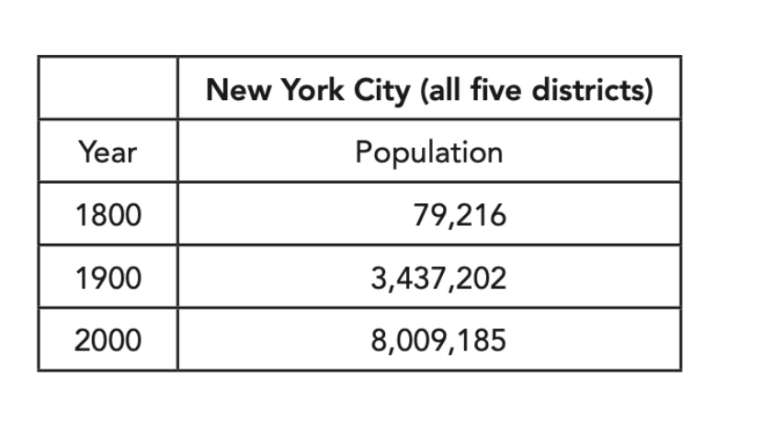
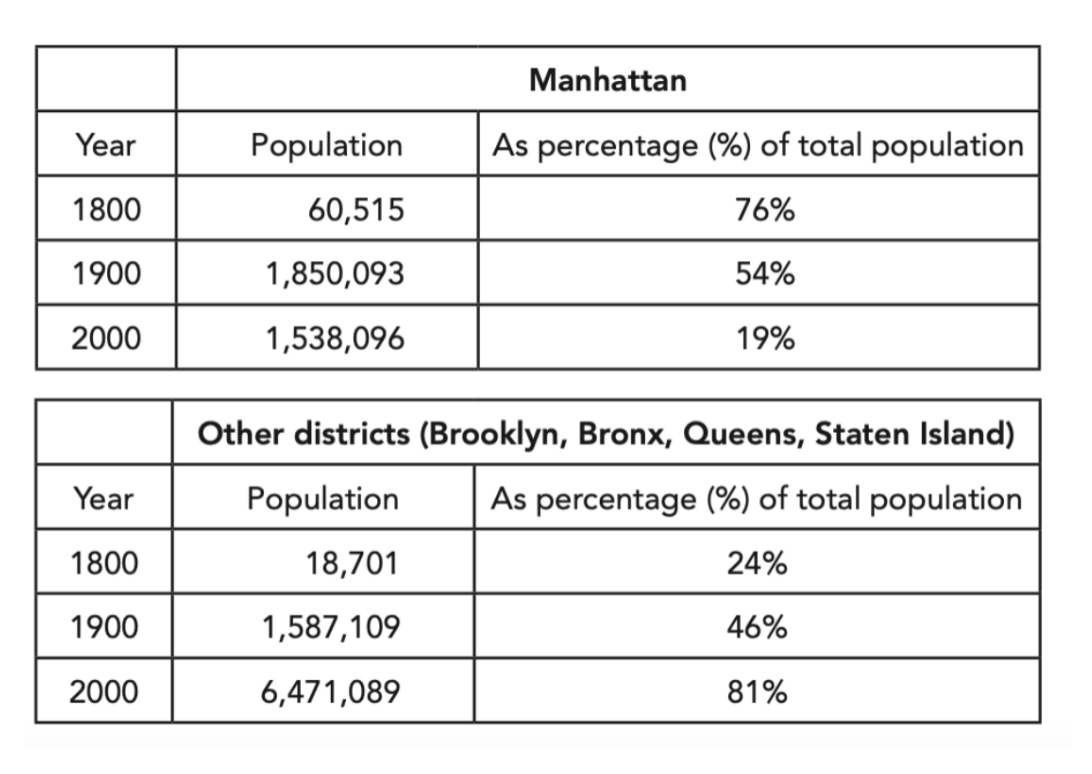
The first table below shows changes in the total population of New York City from 1800 to 2000. The second and third tables show changes in the population of the five districts of the city (Manhattan, Brooklyn, Bronx, Queens, Staten Island) over the same period.
Summarise the information by selecting and reporting the main features, and make comparisons where relevant.
Student answer (Band 5.5)
The first table demonstrates the changes of New York City's total population between 1800 and 2000 , however the second and the third tables illustrate the changes of the population for the five districts of the New York City such as Manhattan , Brooklyn , Bronx , Queens and Staten Island from 1800 for for 200 years.
Overall , the population of New York rose up sharply especially in Manhattan for two consequetive centuries. Yet in 2000 , the other districts population is way more higher than Manhattan.
New York City , showed a huge climb of the population. In addition , between 1800 and 2000 , it went from 79,216 up to 8,009,185.
Manhattan recorded the highest population for two decades from 1800 , espacially between 1800 and 1900 , where the population rose from 60,515 to 1,850,093 with a percentage of 76% and 54% , consequently more than a half of the 4 other districts.However , in 2000 Brooklyn , Bronx , Queens and Staten Island , showed a strong up trend with 81% of the total population with 6,471,089 people.
AI examiner evaluation
| Criterion | Band |
|---|---|
| Task Achievement / Task Response | 5.5 |
| Coherence and Cohesion | 5.5 |
| Lexical Resource | 5.5 |
| Grammatical Range and Accuracy | 5.0 |
| Overall | 5.5 |
Task Achievement / Task Response: Band 5.5
You identify the main overall change: New York City’s population rose from 79,216 to 8,009,185, while the other districts’ share grew to 81% by 2000. You also report Manhattan’s figures for 1800 and 1900 accurately. However, the overview is partly unclear: saying the population rose “especially in Manhattan” overlooks that Manhattan’s population fell between 1900 and 2000, while the other districts drove later growth. “For two decades” is also inaccurate; the tables cover two centuries. The response gives limited comparison across all three years and does not report the 1900 and 2000 city totals together or Manhattan’s 2000 figure. A clearer overview and more balanced selection of key changes would make the summary more complete.
Coherence and Cohesion: Band 5.5
The response has a basic paragraph structure, moving from an introduction to an overview and then to details, so the reader can identify the general topic and some key figures. However, progression is uneven: the city-wide increase is given in a separate short paragraph, while the final paragraph combines several comparisons without a clear sequence. Linking words such as “however,” “in addition,” and “consequently” are used, but some do not express the relationship accurately; for example, “consequently” does not clearly connect the percentages to the population figures. Punctuation spacing and the run-on transition in “districts.However” also interrupt flow. Grouping information by period or comparing Manhattan with the other districts consistently would improve cohesion.
Lexical Resource: Band 5.5
You use some relevant vocabulary for describing data, including “total population,” “percentage,” “rose,” and “up trend,” and the main subject remains understandable. However, the range is limited and several choices are inaccurate or unnatural for a formal report. “Changes of the population” would be more naturally expressed as “changes in population,” while “way more higher” is an incorrect and informal comparison. “Huge climb” and “strong up trend” are imprecise, and “for two decades” mislabels the time span. There are also noticeable spelling errors, including “consequetive” and “espacially.” Use precise reporting language such as “increased substantially,” “accounted for,” and “declined,” and check spelling and collocations carefully.
Grammatical Range and Accuracy: Band 5.0
You attempt a mixture of simple and complex sentences, including clauses introduced by “however” and “where,” but control is inconsistent. Errors include “the changes of New York City’s total population,” “the population for the five districts,” and “the other districts population,” where grammatical relationships and possessives are not formed correctly. The sentence beginning “Manhattan recorded the highest population for two decades from 1800” is difficult to follow, and the final sentence has awkward clause structure and punctuation. There are also problems with articles, prepositions, and comparative forms, as in “way more higher.” These errors sometimes make the intended comparison unclear. Practise building accurate sentences around one comparison at a time, and check agreement, possessives, and punctuation.
See this exact question answered at other band scores. The same prompt compared across bands.
Browse more IELTS Writing model answers or get your own writing scored by the same AI examiner.