Band 5.5 IELTS Writing Task 1 Model Answer
Overall Band Score: 5.5 · Cambridge IELTS 20 · 2026-11-16
IELTS Writing Task 1 question
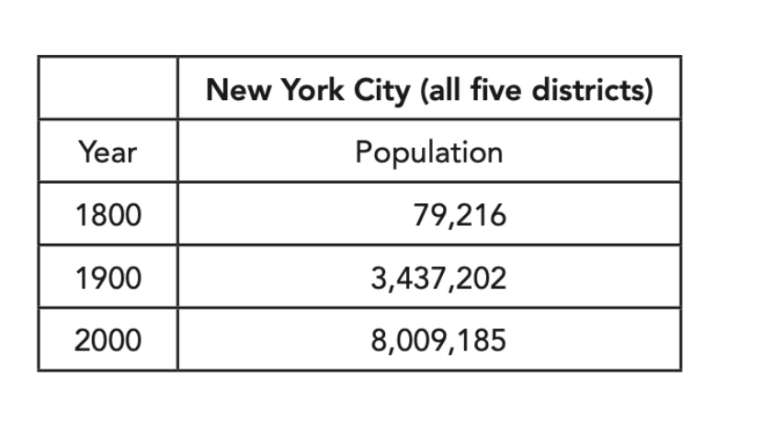
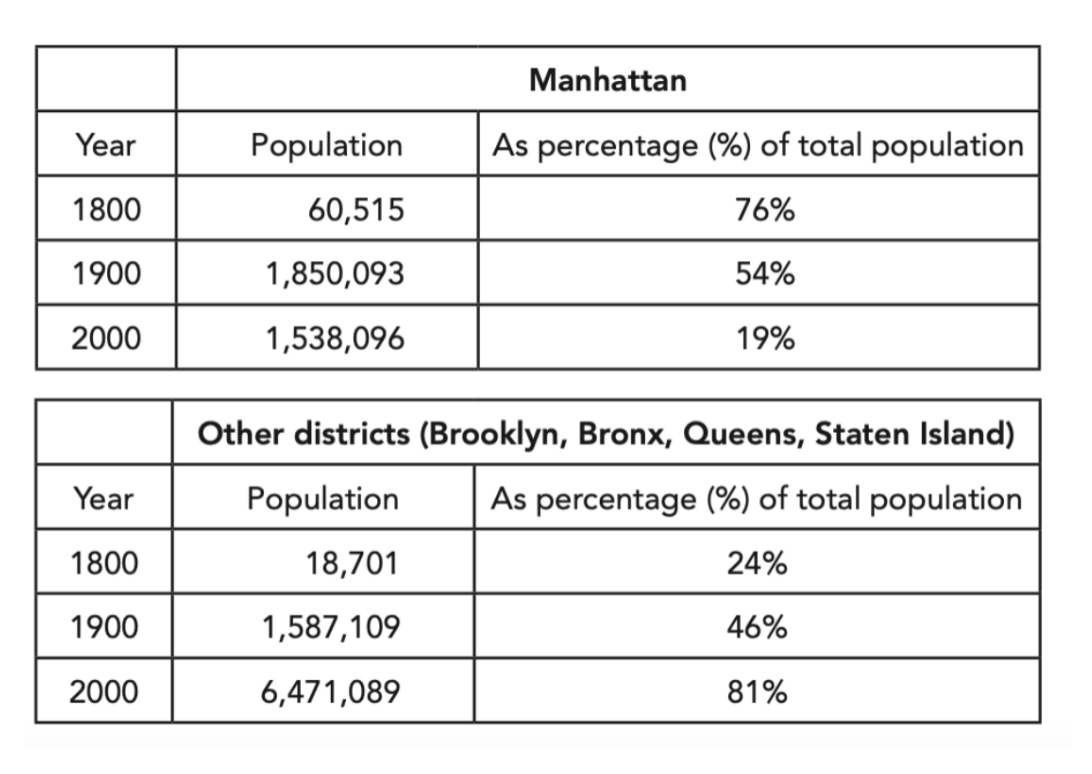
The first table below shows changes in the total population of New York City from 1800 to 2000. The second and third tables show changes in the population of the five districts of the city (Manhattan, Brooklyn, Bronx, Queens, Staten Island) over the same period.
Summarise the information by selecting and reporting the main features, and make comparisons where relevant.
Student answer (Band 5.5)
The first table illustrates the changes in the total population of New York City from 1800 to 2000.The second amd third tables represent changes in the population of the five districts of the city over same periods.Manhattan had the highest percentage in the total population from 1800 to 2000.
Overall,the total population of New york in 1800 is about 80k,later in 1900 the populationm increased up to around 35lac,Now in 2000 this number of individual can also rose upto 80lac.However, Manhattan is the highest populated district which has 60k population in 1800 that is 76% of the total population.In 1900,this district consisted of half of the population 18lacthat is 54% of total percent.But in 2000 its population fell down to 15 lac that is 19% of total.
On the other hand,the other five districts consisted of 18k population in 1800 that is about 24%,In 1900 the population can increased to 15lac which is 46%,and in 2000 it can be doubled and consisted of 81% of total population around 64lac.
AI examiner evaluation
| Criterion | Band |
|---|---|
| Task Achievement / Task Response | 5.5 |
| Coherence and Cohesion | 5.5 |
| Lexical Resource | 5.0 |
| Grammatical Range and Accuracy | 5.0 |
| Overall | 5.5 |
Task Achievement / Task Response: Band 5.5
You identify the main overall changes: New York’s population grew substantially, while Manhattan’s share fell and the other districts’ share rose. Several figures are broadly accurate, including Manhattan’s 76% in 1800 and 19% in 2000. However, the overview is not fully clear, and the total population figures are imprecise: 1900 is described as “around 35lac” rather than 3.44 million, and 2000 as “80lac” rather than 8.01 million. The response also calls Manhattan the “highest populated district,” although the tables show its population declined after 1900; this wording confuses population size with percentage share. The response is 144 words, six short of the required minimum, and some comparisons remain underdeveloped. Report the key figures precisely and clarify that the other districts overtook Manhattan in share by 2000.
Coherence and Cohesion: Band 5.5
The response has a basic structure: an introduction, an overview, and a comparison of Manhattan with the other districts. The contrast signalled by “On the other hand” helps the reader follow the shift between the two groups. However, progression within the paragraphs is sometimes difficult to follow because several figures and interpretations are packed into long, loosely connected sentences. For example, the opening overview moves from total population to Manhattan without a clear separation of the main trends, and “Now in 2000” is an awkward transition in a historical account. Punctuation and spacing also make boundaries unclear. Organise the overview around the two central trends, then use separate, clearly linked sentences to compare the figures for each year.
Lexical Resource: Band 5.0
You use some relevant task vocabulary, including “total population,” “percentage,” “consisted of,” and “fell,” so the main subject is generally understandable. However, the range is limited and several choices are inaccurate or unnatural, which makes some comparisons less precise. “Highest populated district” does not express the intended idea of having the largest share, while “number of individual” is unsuitable for describing a population. Expressions such as “fell down” and “can be doubled” are also not natural in this context. There are noticeable spelling and form errors, including “amd,” “New york,” and “populationm.” Use standard numerical forms such as “3.4 million” and choose precise terms such as “accounted for” or “population share” to describe proportions.
Grammatical Range and Accuracy: Band 5.0
The response attempts both simple and more extended sentence forms, including clauses linked with “which” and “that.” However, control is inconsistent, and errors in verb forms, tense, articles, and sentence boundaries sometimes make the meaning difficult to follow. For example, “the population can increased” has an incorrect verb form, and “this number of individual can also rose” combines incompatible forms. The historical account also shifts into present tense in “Now in 2000,” while “the other five districts” does not match the table’s grouping of four other districts. Missing spaces after full stops and commas further weaken punctuation. Practise describing past data consistently in the past tense and build shorter, accurate sentences before adding subordinate clauses.
See this exact question answered at other band scores. The same prompt compared across bands.
Browse more IELTS Writing model answers or get your own writing scored by the same AI examiner.