Band 5.5 IELTS Writing Task 1 Model Answer
Overall Band Score: 5.5 · Cambridge IELTS 20 · 2026-11-16
IELTS Writing Task 1 question
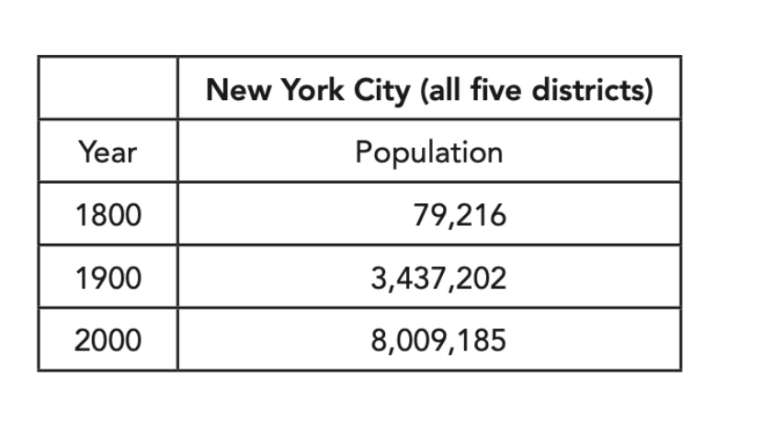
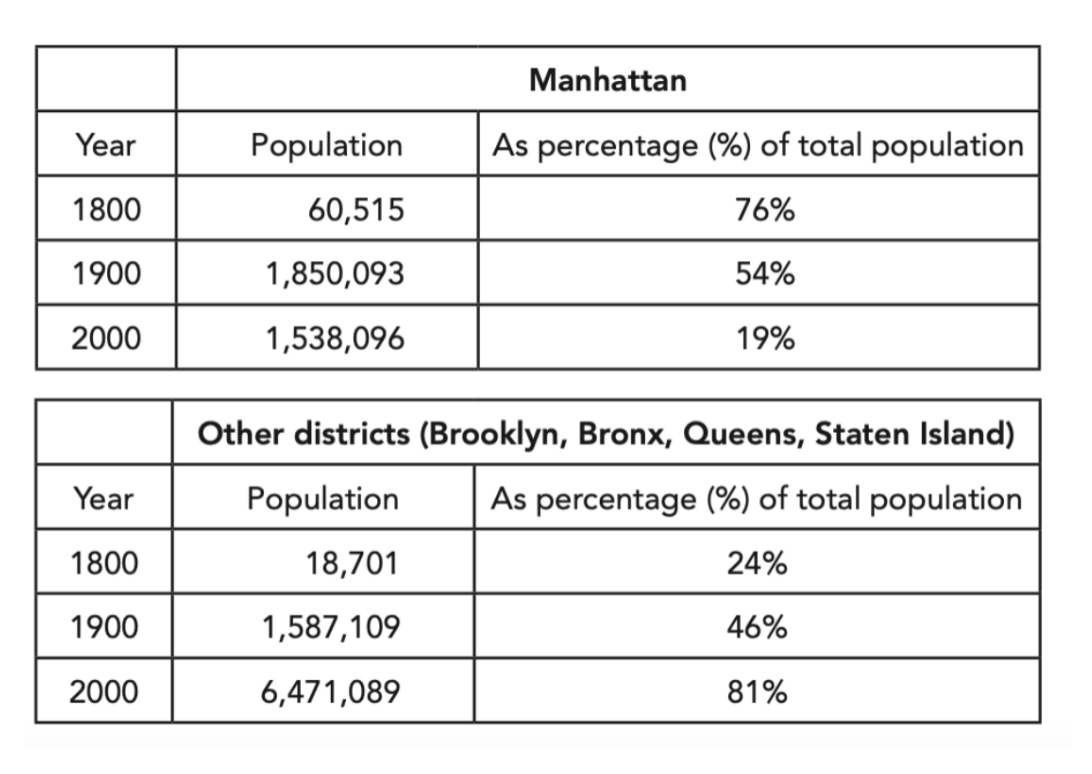
The first table below shows changes in the total population of New York City from 1800 to 2000. The second and third tables show changes in the population of the five districts of the city (Manhattan, Brooklyn, Bronx, Queens, Staten Island) over the same period.
Summarise the information by selecting and reporting the main features, and make comparisons where relevant.
Student answer (Band 5.5)
The first table illustrates the overall population of new york by the year of 1800 till 2000. the second and third table shows the modifications in the population of five different cities which includes Manhattan, Brooklyn, Bronx, Queens and Staten Island over the same time.
In the first table, New york's population have increased significantly over the years from all cities. In 1800, population of newyork was only 79,216 where as it has enormous surge in 1900 by [redacted phone] which is almost 7x the number of last decade.
On the other hand, the population of cities have described in the second and third table as well. By 1800, population of Manhattan have inclined dramaticaly however other citie's population was average. Morever the popluation of Manhattan have Increased with huge numbers and other cities have gradually increasing. However Brooklyn, Bronx, Queens and Staten Island have surged in 2000 where as Manhattan's population gets decline.
Overall, the other cities population was normal but it jump up over the years where as the Manhattan have dropped over the years.
AI examiner evaluation
| Criterion | Band |
|---|---|
| Task Achievement / Task Response | 5.5 |
| Coherence and Cohesion | 6.0 |
| Lexical Resource | 5.5 |
| Grammatical Range and Accuracy | 5.0 |
| Overall | 5.5 |
Task Achievement / Task Response: Band 5.5
You identify the broad trends: New York’s total population rose substantially, while Manhattan’s share fell and the other districts’ share increased. However, several key details are missing or unclear, so the main changes are only partly reported. The total for 2000 (8,009,185) is not mentioned, and the district figures and percentages are not accurately summarised. For example, Manhattan did not increase throughout: it rose to 1,850,093 in 1900, then fell to 1,538,096 by 2000. The statement that its population “have inclined” by 1800 is also unsupported by the table, which gives only that year’s figure. Include accurate comparisons across all three dates and make the overview more precise.
Coherence and Cohesion: Band 6.0
The response has a recognisable structure, moving from an introduction to the total population, then the district data, and finally an overview. This gives the reader a basic route through the information. However, the progression within the district paragraph is difficult to follow: “By 1800” is followed by claims about increases, although the table provides no earlier comparison, and “other cities” is an unclear reference to the other districts. Linking phrases such as “On the other hand” and “However” are used, but the relationships they signal are not always logical or necessary. Organise the body around clear time comparisons—1800 to 1900, then 1900 to 2000—and use precise references to Manhattan and the other four districts.
Lexical Resource: Band 5.5
You use some vocabulary suited to describing change, including “increased significantly,” “surge,” and “decline,” and the general topic remains understandable. However, word choice and collocation are often inaccurate or imprecise. “Population of cities” incorrectly describes the districts, while “other cities’ population was average” does not communicate a clear comparison. “Modifications” is also unnatural for changes in population, and “normal” is too vague for data reporting. Spelling and capitalisation errors, including “newyork,” “dramaticaly,” and “popluation,” further reduce control. Build a more precise range around terms such as population, proportion, rise, fall, and account for, and check spelling and proper nouns carefully.
Grammatical Range and Accuracy: Band 5.0
You attempt both simple and more extended sentence forms, including a contrast with “whereas” and a concluding overview. However, errors in verb forms, agreement, articles, and sentence construction are frequent enough to make some statements difficult to interpret. Examples include “the second and third table shows,” “population have increased,” and “Manhattan have inclined”; these require plural agreement or a singular subject with the correct verb form. The sentence beginning “In 1800, population of Newyork was only…” also needs an article, and “by 3437202” does not form a clear comparison. Practise building accurate sentences with a clear subject and verb, then use past-tense forms consistently when describing the historical figures.
See this exact question answered at other band scores. The same prompt compared across bands.
Browse more IELTS Writing model answers or get your own writing scored by the same AI examiner.